The FJ Fury series of aircraft has always interested me. I think mostly that’s because they were initially developed along with the F-86. Early decisions by the Navy resulted in their first version having straight wings, but they got their jet first. Of course, research into the information gathered from the Germans at the end of World War II showed that the swept wing was the way to go and the Navy eventually came around to the Army’s (later Air Force’s) way of thinking, resulting in the FJ-2. This aircraft was very similar to the Air Force’s F-86A. Improvements and more powerful engines for the FJ-2 led to the FJ-3, wherein the development started to diverge more and more from the F-86. Yet further developments let to the FJ-4 and FJ-4B Fury.
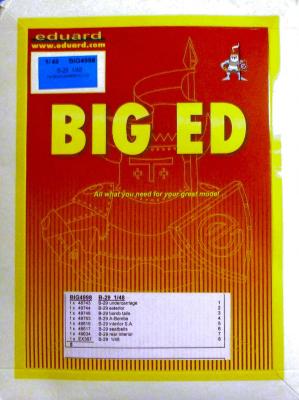
Many of the latest releases seem to have been ignored by many of the resin companies. One of these is the Trumpeter 1/48 A-3D Skywarrior. Eduard has come to the rescue with several sets that address some detail issues in the kit. This set is a self-adhesive (SA) upgrade for the cockpit. The set comes with one standard sheet of photoetch and one precolored sheet with SA backing. The SA sheet is for the instrument panel, side instruments and about anywhere a black panel is needed. The other sheet addresses replacement boxes on the back of the cockpit, sidewalls to the cockpit and rudder pedals.
Each issue of Scale Aircraft Modeling follows a basic design and format. There are usually two Feature Articles, an Aviation in Profile piece, industry news and a series of Compact Build Reviews.
The Feature articles for this issue covers a build of new H-K Models 1/32 Gloster Meteor and a 1/48 Wingman Models Latin American Kfir. The Meteor is from Jay Laverty and is Part 1 of a two part series. Part 1 covers the some issues with the kit and their easy fixes as well as preparation for the metallic finish and several hints and tips towards making it perfect.
The other Feature article is from Brian Wakeman and builds Wingman Models 1/48 Kfir. This is the Kinetic kit with the addition of lots of resin for cockpit, nose and a host of other parts. He finishes the kit in markings for Columbian Air Force with superb weathering.
Quickboost has added two different sets of gun barrels to their aftermarket parts line that are specifically designed to replace those in two different brands of 1:32 scale J2M3 Raiden kits. This set is to be used to replace parts in Hasegawa kits. The barrels are quite impressive. They have hollow openings, the detail is refined and crisp, and there are no injection molding seam lines for the modeler to eliminate.
History Brief
The F6F Hellcat, was a completely new design from Grumman for the U.S. Navy and U.S. Marine Corps. The F6F Hellcat, a single-seat carrier-based fighter is credited with destroying a staggering 5,271 enemy aircraft. In all, some 4,402 F6F-3 carrier-borne fighters were produced up until April 1944 before it was replaced by the F6F-5. This type first flew on 3 October 1942 and it reached operational readiness the following February with VF-9 aboard USS Essex. The fighter’s standard armament was six .50-cal M2/AN Browning machine guns plus six High-Velocity Aircraft Rockets (HVAR) mounted under its wings , while later aircraft had three hard-point’s capable of carrying 900kg of bombs.
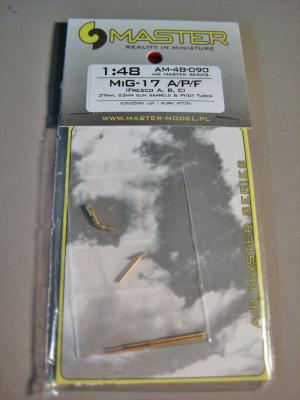
Master Model is an aftermarket supplier that offers modelers the opportunity to add exceptional turned metal parts to their models. Generally, the sets are available for builders in 1:72, 1:48 and 1:32 scale. Most builders who prefer to add aftermarket gun barrels, refueling probes, antennas and pitot tubes to their aircraft models are quite familiar with Master Model’s line of excellent detail parts.
This set (AM-72-066) provides highly detailed 1:72 scale Hispano Mk. 1 cannon (with flat recoil springs) for the Hawker Hurricane Mk IIC. The parts may be used to replace the injection molded ones in Revell, Airfix, Hasegawa, Academy, Smer, Matchbox and Heller kits. In some cases, they simply will drop into place, in others a little surgery may be required. Holes may need to be drilled in the leading edge to accept the fairing and barrel combination or a kits’ molded wing fairing may be drilled to accept only the cannon barrel.
History
The Messerschmitt Bf-110 series was originally designed as a long range escort fighter, and so much has been written about the type that I need not be repetitious. Preceded into production by the Bf-110B, which first appeared in 1938, the Bf-110C was the first major production model, followed by the “D”, “E”, “F”, and “G” variants. It was not particularly successful at the beginning of the war, as it was used against more nimble single seat fighters. Later in the war, it was used as a night fighter, where it was very successful and even outlived the aircraft intended to replace it.
Master Model is an aftermarket supplier that offers modelers the opportunity to add exceptional turned metal parts to their models. Generally, the sets are available for builders in 1:72, 1:48 and 1:32 scale. Most builders who prefer to add aftermarket gun barrels, refueling probes, antennas and pitot tubes to their aircraft models are quite familiar with Master Model’s line of excellent detail parts.
Quickboost has added a detailed pitot tube to their line of aftermarket parts that can be used to replace the one found in any 1/32 scale J2M Raiden kit. It has crisper and more refined detail than that found in any currently available kit. Anyone building a Raiden should be pleased with the delicate look of this detail part...so delicate that the review sample had a slightly warped curve in the thin tip (easily straightened after immersing it in hot water for a minute).
Number 59 in Osprey’s ‘Duel’ series provides a trip back in time to an era when flying machines began serving as platforms for continuing warfare above ground level. In this volume of ‘Duel’ author Jon Guttman presents the story of how exchanging rifle and revolver gunfire rapidly evolved into aerial duels between aircraft mounting machine guns. War in the air became serious business when, in the summer of 1915, the Fokker E1 appeared on the scene with a forward mounted machine gun and interrupter mechanism that permitted a pilot to aim and fire upon an enemy without concerns of shooting off his own propeller. The result of this game-changer was a period that became known as the ‘Fokker Scourge’. In an attempt to counter this technological advantage and level the playing field, the Brits introduced various pusher Scouts and the French mounted forward firing machine guns on the top wings of nimble Nieuport Scouts that fired above the propeller arc.