Quickboost has released two Parabellum WWI aircraft gun resin details sets, 48 813 (LMG-14) and 48 814 (LMG-14/17). The Parabellum 7.9mm caliber LMG 14/17 was an upgrade of the LMG-14, which itself was a redesign of the MG 08 (The MG 08 was an adaptation of the Maxim machine gun). The LMG 14 was used primarily in German bombers (i.e.: Gotha G.IV), reconnaissance aircraft (i.e.: Halberstadt CL.II), and zeppelins, although it did see some limited use early on with the Fokker Eindecker E.I prototypes. The LMG-14/17 featured a thinner air-cooling jacket, redesigned controls, and an added mounting rail for a telescopic sight. I have included a photograph comparison below of the LMG 14 vs the LMG 14/17 out of the Wingnut Wings 1/32 Junkers J.I kit for reference.
Author Steve Ginter is a noted military historian who publishes the Naval Fighter series that was founded in 1980. After graduating from California State University-Northridge, Ginter became a US Navy pilot, serving from 1966 to 1972. Upon leaving the US Navy, Ginter held a series of management positions within the Thrifty Drug chain for the next twenty-one years. In 1996 he became the CEO of Sentai Distributors where he directed company operations until 2011. The Air Force Legends series was initiated in 1998 with the publication of ‘The Martin XB-51’.
History
The Hien was notable not just as the sole Japanese fighter in the Pacific War with a liquid-cooled engine, it also fought numerous battles against incoming B-29’s in defense of the Japanese home islands. In December 1940 Kawasaki Aerospace Company produced a prototype 1,175hp engine, Ha-40, a licensed version of the Daimler-Benz DB 601 engine. This liquid-cooled engine was more powerful and had less aerodynamic impact than comparably-sized air-cooled engines. Engine production could not keep up with airframe production so eventually a radial engine was fitted to the airframe and the aircraft designated the Ki-100.
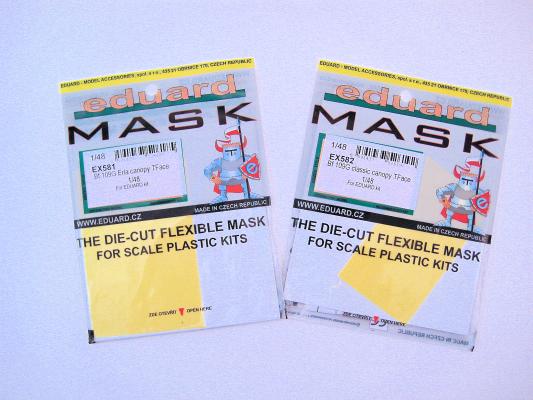
Recently I was given the opportunity by IPMS USA to review Eduard's canopy masks for the new 1/48 Airfix P-51D Mustang kit. One of the first things to notice with this product is the excellent presentation of the packaging with the easy to open flap. Package includes a single sheet of kabuki paper masks for the canopy panels, landing lights, and wheel hubs.
Upon removal of the masks from the package I could easily remove the masks from the paper and apply to appropriate section of the canopy. The instructions included with the masks gives you a good feel for which panel you are working with compared to how canopy is sectioned off. The masks lay down well and no trimming had to be done to center up the masks with the canopy framing. The main canopy has to be masked with extra tape or a liquid mask, you only get the outer frame.
A versatile twin-engine medium bomber, the B-25 was to find its first fame on April 18th, 1942, as the Bomb Group led by Jimmy Doolittle flew them off the carrier USS Hornet and made the first attack on Tokyo. Mitchells were flown by many of the United States’ Allies, were used throughout WWII, and were in service up into the 1960s.
The new Airfix B- 25C/D was sorely needed in 1/72 scale. The kit comes in a sturdy box with nice box art and is cast in gray plastic with finely molded recessed panel lines. Although each sprue was individually wrapped in clear plastic bags, one half of my sample’s fuselage was warped, and this ended up being a challenge throughout the build. The kit comes with an option of an open or closed bomb bay, and if you decide to open it, 500-pound bombs are provided.
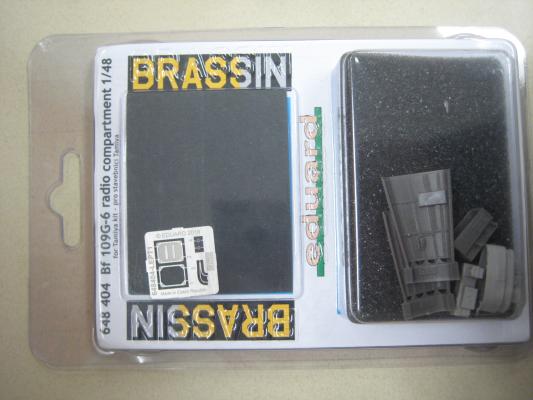
This set is the latest in Eduard’s “Brassin” line. The set comes in a resealable clamshell package with a cardboard insert to separate the decals, etched parts, and instructions from the sixteen resin parts. The instructions comprise one sheet representing the cover sheet with the decal application guide along with painting instructions. The inner spread provides the assembly guide, with the back sheet showing the parts list and the color codes for Gunze paint (Aqueous and MrColor). I will note that the resin parts on my set had lots of room in the blister to move and as a consequence, I had the rear fins broken off (R33) on two of the four bombs. This set will need to be installed with your favorite CA (super glue) or epoxy, as the normal plastic glues or solvents will not react with the resin or photoetch.
The J-31(FC-31) is a twin engine “fifth generation” fighter currently under development by China’s Shenyang Aircraft Corporation. First exhibited at the Zhuhai Airshow in November 2014, the aircraft is very similar in size to the F-35 Lightning II, and appears to be designed for a similar mission. The airframe has a number of features that that are look like those on the F-35 (such as the humped fuselage sides and forward swept intakes) and the overhead planform of the two aircraft is very similar (other than 2 engines for the J-31 and 1 for the F-35), while the side profile is similar to a shortened F-22. As the jet is still in the early stages of development, a lot of questions remain about its actual performance and capabilities, as well as to what the final version will look like.
I was drawn to this decal set for two reasons:
One, I thought that camouflaged Mustangs are not seen as much as the bare metal US aircraft.
Two: I had to do the Aussie Southern Cross marking being an Aussie!
LPS Hobby is a decal manufacturer from Brazil. The decal sheet, instruction sheet and cover page are contained within a generously sized zip-lock bag.
This small decal set contains marking for three British camouflaged P-51K Mustangs from Royal Canadian, South African and Royal Australian Air Forces:
- KH608, Y2, “Edmonton Special”, PO John Mallandaine, 442 Sqn RCAF, Hunsdon, England. May 1945
- KH673, GL-N, “Sweetpea”, 5 Sqn SAAF, Udine Italy, January 1945
- KH676, CV-A, F/Lt 'Dusty' Lane, 3 Sqn RAAF, Cervia, Italy, April 1945
The recommended donor kit is the Tamiya 1/72 P-51D Mustang, however the newer Airfix, or any other manufacturers P-51D/K could also be used.
MORE SAC FUN! Yes, the Revell P-51D-5 receives the SAC treatment because it’s a big kit, and Ross and his team came up with metal gear for this kit. Thanks to Phil for sending it and Fearless Leader John for approving my working the set.
Included in this set are two main gear, two Oleo strut braces, and a tail gear strut. All replace the Revell kit parts, and fit is just like the plastic except it’s stronger and can be re-adjusted as required.
IPMS/USA thanks the Eduard team once again for sending us this simple, excellent set for the new Eduard FW-190 series. And thanks to Phil and John for running the team…
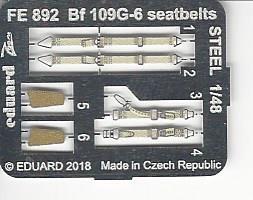
This seat harness is simplicity itself. There are four parts. That’s it, four. FOUR-lap belts, and over the shoulder harness. Installation? Carefully bend these durable steel belts into place. No paint flaking, no fiddling with parts that are too small for even surgical standard tweezers to hold. Just install and admire.
Far better than tape and paint, the STEEL series seat harnesses should become one of Eduard’s fastest sellers for upgrading kits that don’t have harnesses attached. Competitively priced too!
Thanks once again to Eduard and their groundbreaking technology leaps and for keeping AMS alive in those of us who have it!