

Bill O'Malley
Reviews By Author
|
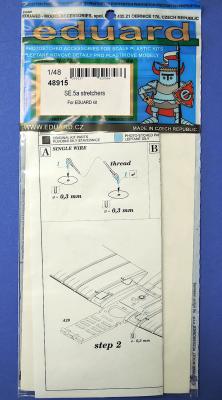
SE.5a StretchersPublished:
These are Eduard’s brass photoetch cable anchors for their new SE.5a kits. Eduard refers to them as stretchers, but they are simple anchors without any kind of turnbuckle or way to tighten cables. The package includes both single and double anchor points for the double wires on the SE.5a. Eduard supplies way more pieces than are actually required for the aircraft to make up for all of those that will be lost. The anchor point holes on the wings will need to be drilled out deeper for the length of the anchor, which will then fit neatly. The stretchers for 1/48 scale are extremely small. The holes on the structures are much smaller than my smallest drill bit, a #80. The holes in the stretchers were too small for E Z Line, invisible thread, or 2 lb. fishing line. The only thing I… more |
|
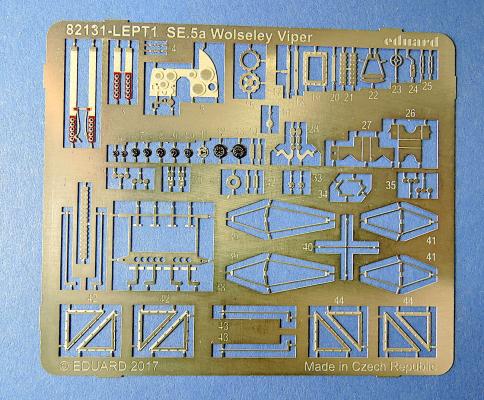
SE.5a Photoetch SetPublished:
This is the photoetch fret for Eduard's 1/48 SE.5a. It is listed for the Wolseley Viper Version of the kit, but can also be used for the Hispano-Suiza Version of the SE.5a. This is the same photoetch fret included with Eduard's Wolseley Viper, and with the Royal Class edition as R0015-LEPT 1. It can also be purchased separately from either kit. The photoetch fret is not required for completion of the kits, but adds more accurate scale detail than the kit parts. The steel fret is about 2-3/4 x 2-1/4 inches and includes photoetch pieces for the seatbelts, instrument panel and gauges, machine gun magazine upgrades, several different cockpit levers, brackets for the exhaust pipes, cables and stanchions for the control surfaces, bomb rack, and frames for the wing pulley observation… more |
|
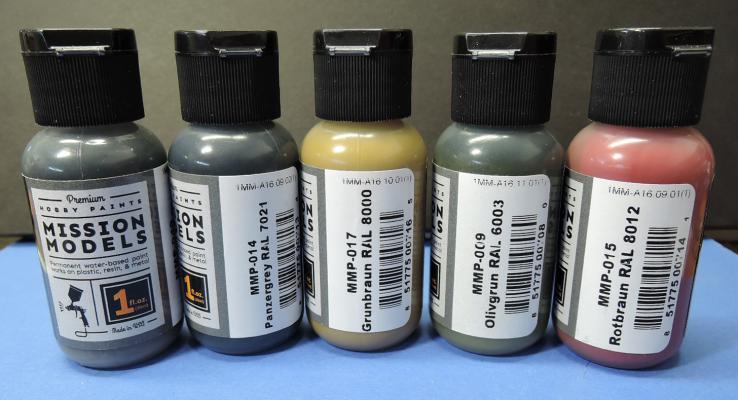
Acrylic PaintPublished:
Mission Models has a new line of ‘airbrush ready’ acrylic paints. These paints are odorless, spray easily to a nice, hard, even finish, and have less ‘tip-drying’ than other acrylic paints. The paints come in 1 oz. dropper bottles to facilitate measuring and contain a BB to help mix the paint. MMP paints include the following:
Acrylic PaintMMP paints are non-solvent based, odorless, organic acrylics that produce a flat finish. The paints appear thicker than other paints. MMP says that compared to other paints that are thinned to the consistency of… more |
|
SE.5a OvertreePublished:
This is the Overtrees edition of the excellent new SE.5a kit from Edward, who continue to set the standard for the finest in model kits. An Overtrees edition is the ‘bare-bones’ of the SE.5a kit, including just the plastic sprues, nothing else. No instructions, no decals, no photoetch, masks, etc. The box doesn’t even include any artwork! This kit includes two gray plastic sprues and a clear plastic sprue. Instructions are not included with the Overtrees edition but can be downloaded from the Eduard website at this link. An Overtrees edition can build a stand-alone kit or share parts with one of the other versions of the SE.5a. At only $14.95 the Overtrees provide great value. With the Overtrees kit, the modeler… more |
|
SE.5a Wolsely ViperPublished:
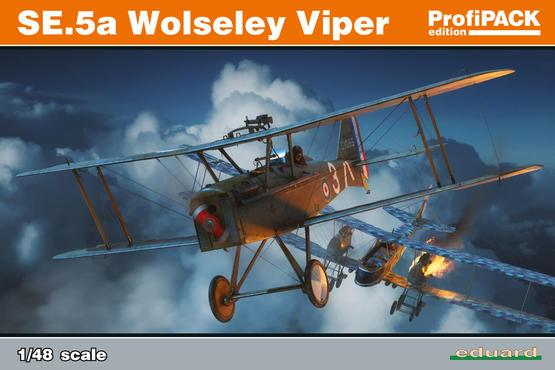
SE.5a Wolsely ViperThis is an excellent newly tooled kit from Edward, who continue to set the standard for the finest in model kits. This kit will appeal to less experienced modelers, who may not want to use the photoetch or install the plane’s rigging. More advanced modelers will be able to enjoy the detail provided by the photoetch and rigging. Either way, this builds into a beautiful model. BackgroundThe Royal Aircraft Factory S.E.5 was a World War I British biplane fighter aircraft first introduced in March 1917. The SE.5 was initially powered by a geared 150 HP Hispano-Suiza engine with two-bladed counter-clockwise rotating propeller and had many technical problems. An improved version, the SE.5a, was issued with a 200 HP Hispano-Suiza 8B engine (‘… more |
|
SE.5a GunsPublished:
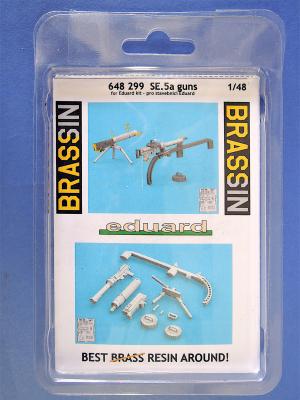
This is a nice resin & photoetch set that replaces the Vickers and Lewis machine guns in Eduard’s new SE.5a kit. The resin has better detail than the kit plastic parts and the Vickers gun is easier to install. Some of the resin and photoetch pieces are extremely small. BackgroundThe Royal Aircraft Factory SE.5a was armed with a single synchronized .303-inch Vickers machine gun mounted in the fuselage in front of the cockpit. Many versions also had an upper wing-mounted Lewis gun fitted on a Foster Mounting to allow the pilot to fire at overhead aircraft. Eduard’s newly released SE.5a kit includes both guns, which are replaced by the parts in this add-on package. KitThis set includes 16 resin parts, some that are extremely small. It also… more |
|
SE.5a Propeller Two-Blade (right) and Two-Blade (Left)Published:
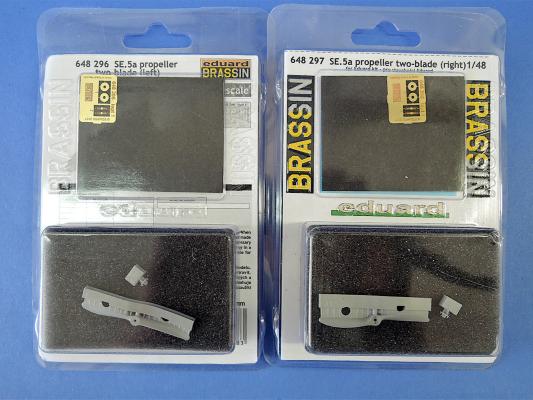
Eduard has issued two resin propellers as upgrades to the propellers issued with their SE.5a Wolsely Viper kit. The upgraded propellers include resin and photoetch parts with much finer detail than the kit propeller. The Royal Aircraft Factory SE.5 was introduced in 1917 with a 150 HP V8 Hispano-Suiza 8A engine with two-bladed counter-clockwise (left) rotating propeller. The SE.5a was an improved version of the SE.5 and was one of the fastest fighters of WWI. The SE.5a aircraft was originally produced with a 200 HP Hispano-Suiza 8B gear-driven engine (‘Hisso’), with a counter-clockwise (left) rotating four-bladed propeller. The gear-driven engines proved unreliable, and were quickly replaced with the 200 HP Wolsely Viper direct drive engine with clockwise rotating (right) two-… more |
|
SE.5a Radiator – Wolsely ViperPublished:
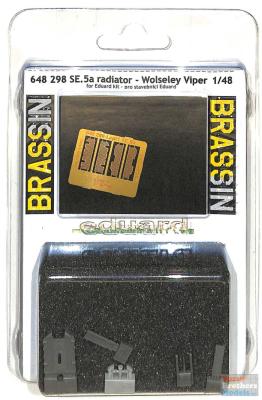
This set provides a highly detailed resin and photoetch radiator to replace the standard kit part in Eduard's newly released SE.5a Wolsey Viper aircraft kit. The radiator is a beautiful little assembly that looks fantastic on the aircraft model! The Royal Aircraft Factory SE.5a was an improved version of the SE.5 and was one of the fastest fighters of WWI. The SE.5a aircraft was originally produced with a 200 HP Hispano-Suiza 8B engine that proved unreliable, and was quickly replaced with the 200 HP Wolsely Viper engine. This Eduard Brassin set includes resin and photoetch parts to replace the kit supplied radiator in the Eduard Wolsey Viper version of the SE.5a. The kit supplied radiator has very nice detail, but the assembly provided with the Brassin set has… more |
|
Hanomag RL-20Published:
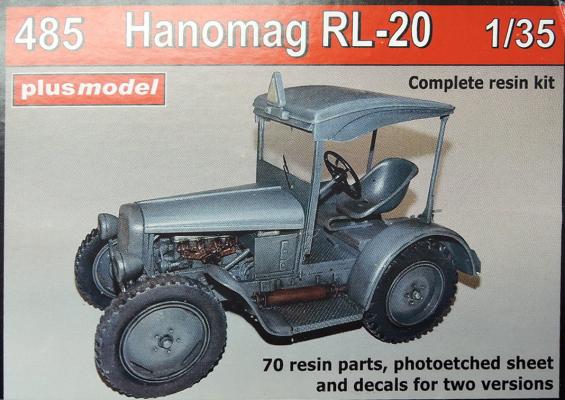
BackgroundHanomag (Hannoversche Maschinenbau AG) was a German producer of steam locomotives, tractors, trucks, and military vehicles in Hanover. During World War II, the car plant made military vehicle engines, a military version of their heavy tractor renamed the SS-100, and halftrack troop carriers. The single most important and iconic military vehicle to be designed and built by Hanomag during World War II was the Sd.Kfz. 251 half-track (commonly called simply "the Hanomag") with a total production numbering just over 15,000. The Hanomag RL 20 wheeled tractor was manufactured from 1937 to 1942. The 1.9 litre, four-cylinder diesel engine produced 20 HP. At the beginning of WWII many of these tractors were put… more |
|
Railroad Water CranePublished:
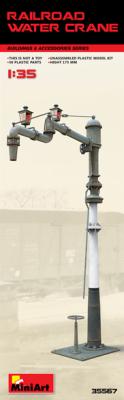
The water crane is the type used at German railyards during World War II and will be an excellent addition to railroad dioramas. This is another great kit from MiniArt with fine detail and excellent fit of the parts. The kit comes in a 4.75 x 15.25 x 1.75 end opening box. It includes three gray plastic sprues and two clear plastic sprues with 50 parts. There is also a length of thread included for the water crane pulley rope. The model will measure 175 mm (6 7/8”) tall. My package did not include sprue Af which is the light bulbs for the two lanterns. I sent an email off to MiniArt and got a quick reply that a replacement was on its way. Great customer service by MiniArt! Paint colors are called in AMMO MIG, Vallejo, Testor, Tamiya, Humbrol, Revell, Mr. Color, and… more |