What's New

Review Author
Jim Pearsall
Published on
Company
Quickboost
Scale
1/72
MSRP
$4.95

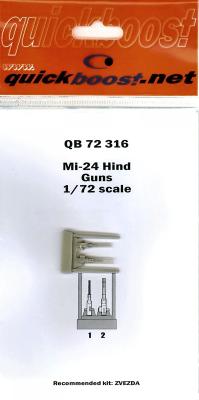
A while back I built the Zvezda 1/72 Mi-24 Hind. I got the opportunity to do this review and grabbed it, as I wouldn’t have to build the entire kit just to add the nose guns

The package contains two guns. The kit gives options of two different guns in the nose turret. The one I used is the Yak-B 4 barrel Gatling-type gun, 12.7 mm. The other is a twin-barrel gun the G-Sh-30, a 30 mm weapon. The 12.7mm has been phased out, and the 30 mm is preferred, as it has more punch, particularly on light armored targets.

The G-Sh-30 is definitely superior to the kit parts, as the kit gun comes in 2 parts, so you have to deal with a seam. The QB part has slightly finer detail, which is still hard to see in 1/72.

The Yak-B looked quite a bit like the kit part, and fit into the turret nicely. The only outstanding difference was that the hump on the kit part is a recess on the resin part.
Review Author
Roger Rasor
Published on
Company
Quickboost
Scale
1/32
MSRP
$5.99

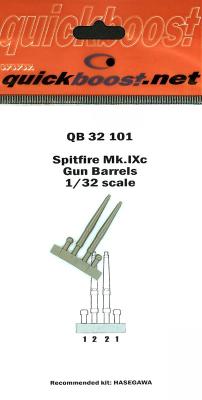
While a lot of attention has been focuses on aftermarket offerings for Tamiya’s growing line of 1/32 Spitfire kits, Quickboost has release a set of resin gun barrels that are designed to replace those found in Hasegawa Spitfire kits. They are direct replacements for kit parts #CC3 and #CC16, and the detail is crisp and delicate. The castings, like all other Quickboost resin parts are blemish free and offer detail superior to that found in the kit parts. The gun barrels provide hollow ends, fine recessed details and delicate rivets. No clean up is required and there are no pinholes to worry about. They are easily removed from the casting block with a #11 blade and should be attached with super glue or epoxy cement.

This Detail Set is highly recommended to anyone who wants to enhance the detail of a 1/32 Spitfire built from a Hasegawa kit.

My thanks to IPMS/USA, Quickboost.net and Aires Hobby Models for the opportunity to review this detail set.

Review Author
John Lyons
Published on
Company
Quickboost
Scale
1/72
MSRP
$6.95

History:

The Bf 110 served with success in the early campaigns, the Polish, Norwegian and Battle of France. The Bf 110's lack of agility in the air was its primary weakness. This flaw was exposed during the Battle of Britain, when some Bf 110-equipped units were withdrawn from the battle after very heavy losses and redeployed as night fighters, a role to which the aircraft was well suited.

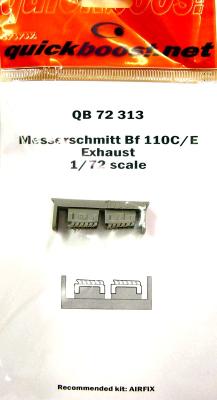
Quickboost has some of the best resin parts I have seen. For a 1/72 scale part the edges are sharp and the details are clearly defined. This will be a nice upgrade to the Airfix kit.

I would like to thank Quickboost.net, Aires Hobby Models and IPMS/USA for the opportunity to conduct this review.

Review Author
Jim Pearsall
Published on
Company
Minicraft Model Kits
Scale
1/144
MSRP
$10.00

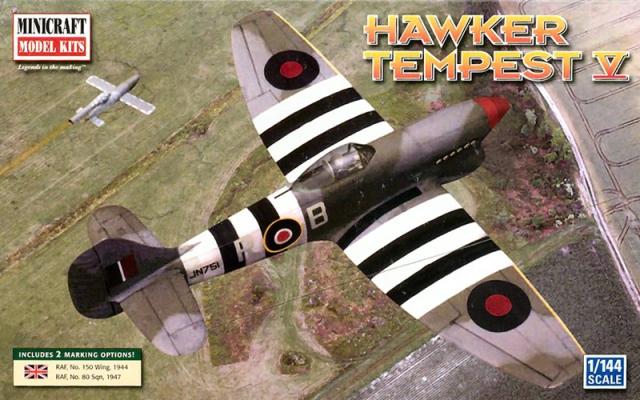
The Aircraft

The Tempest was a follow-on for the Hawker Hurricane and Typhoon. Through the Typhoon and Tempest development, Hawkers had problems with several new systems, and the Air Ministers were ready to scrap the new aircraft programs. One of the people who successfully argued for their retention and one of the problem solvers was Roland P. Beamont.

The resulting aircraft was very fast, quite maneuverable, and a success against the Luftwaffe. But its biggest use in late World War II was against V-1 flying bombs. The Tempest had the speed and toughness to fly alongside a V-1 and tap the wing tip of the missile. This would cause the gyros in the navigation computer to tumble, and the V-1 would crash well short of its target. Good for London, not so good for those living along the flight corridor. Tempest Wing (#150) accounted for 638 V-1s.

Review Author
John Lyons
Published on
Company
Lifelike Decals
Scale
1/48
MSRP
$16.50

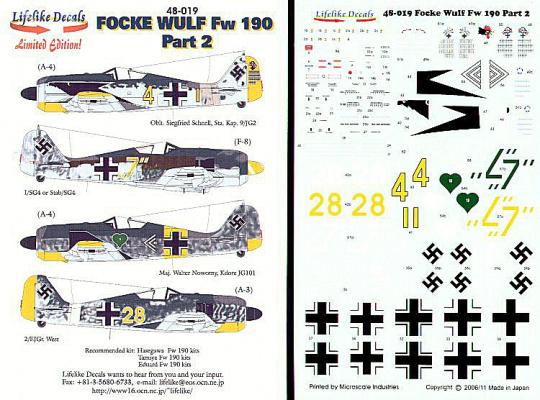
Lifelike Decals are some of the best designed and clearly printed decals on the market today. This set has a combination of Fw190A/F examples for four different Focke Wulf aircraft.

This decal set provides markings for:

  • Fw 190A-3, 2/EJG2. West, Yellow 28, Cazaux AB, France, 1942
  • Fw 190A-4, 9./JG 2, Yellow 4, Vannes AB, France, Feb 1943, as flown by Oblt Siefried Schnell
  • Fw 190A-4, Commander JG 101, Triple Chevron, Pau AB, France, Summer 1944, as flown by Major Walter Nowotny
  • Fw 190F-8, I./SG 4, Yellow 7, Wenden AB, Germany, Sep 1944

The color profile sheets show a Side, top and bottom views of each aircraft.

This set also comes with “swastikas” (Thank you Lifelike for including them on the sheet and not wasting our time with lame politically correct nonsense) and the national markings. You also get a nice set of stencils.

Review Author
Jeffrey Brown
Published on
Company
Lifelike Decals
Scale
1/48
MSRP
$15.99

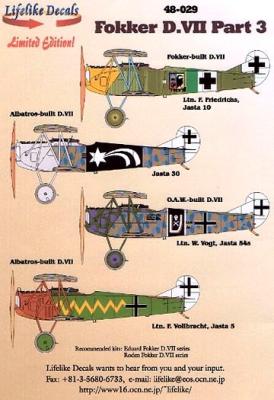
Originally when I asked to review these I had the intention of putting them on my Eduard Fokker D.VII Weekend Edition, as you may or may not know that is Herman Goring’s white Fokker. I already built Herman’s plane so I thought these would be a colorful option to the plain white version. I was right they are a colorful option however this review has turned into a non-build version for the simple fact that all four choices in the Lifelike Decal sheet require the dreaded Lozenge camouflage.

Review Author
Andy Renshaw
Published on
Company
Afterburner Decals
Scale
1/48
MSRP
$20.00

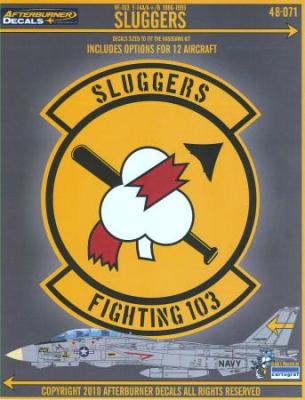
Nothing symbolizes US Naval Aviation during the latter half of the Cold War more than an F-14 Tomcat, at least among fighters. Birthed from the abortive US Navy’s involvement in the F-111B it was kept from its full potential during most of its service with finicky engines and being limited to the interceptor/fighter role. It wasn’t until the last decade of its carrier that it had a chance to show all it could do with the Air-Ground role restored and GE engines. The last of the Grumman “cat” lineage to leave the flight deck, it was the pinnacle of brute force, performance, and power projection all wrapped up in a sexy package that could do over Mach 2.

Review Author
Andrew Birkbeck
Published on
Company
Dragon Models
Scale
1/72
MSRP
$17.95

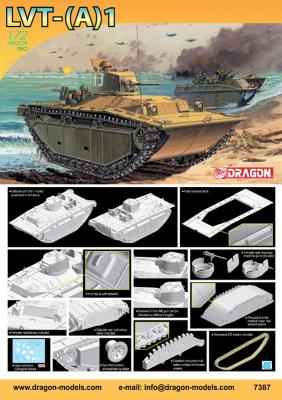
The LVT-(A) 1 was part of a series of US Marine Corps. and Navy amphibious assault vehicles developed during WW2. The idea for the military vehicles came from an original, civilian design by Donald Roebling, who designed his Alligator as a rescue vehicle for use in areas inaccessible to standard cars or trucks, such as swampland. LVT stood for Landing Vehicle, Tracked, and the main contractor during WW2 was FMC: Farm Machinery Corp. As well as the standard open topped tracked landing craft designed to bring troops and cargo ashore, there were also vehicles such as the LVT-(A) 1 which came completely enclosed, and armed with turrets. The LVT-(A) 1 (“A” for Armor) had the turret and gun of the M3 Stuart light tank, and the vehicle was also powered by an M3 Stuart engine. Just over 500 (A) 1’s were produced during the War, with a total of just over 18,000 LVT’s of all varieties eventually rolling off the assembly lines.

Book Author(s)
James P. Delgado (foreword by Clive Cussler)
Review Author
Scott Hollingshead
Published on
Company
Osprey Publishing
MSRP
$24.95

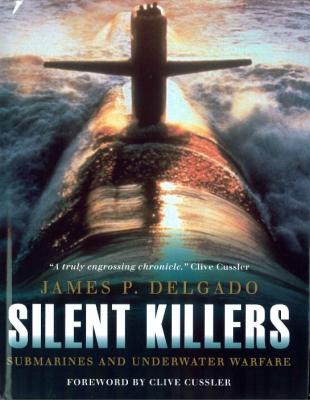
Although I am a former carrier sailor, I have had a long-standing appreciation for submarines and underwater warfare, from the pioneers and early craft to the latest technology afforded to the submariners of today. It takes something special in a person to go out to sea in a vessel designed to sink, and built by the lowest bidder (I had to get that one in), but those who have answered the call in the past, and those will do so in the future, are nothing less than courageous. The submarine has been in existence in one form or another for centuries, and similar to any other weapon of war, has developed into something that would astound the early inventors.

Review Author
Clarence Wentzel
Published on
Company
Lifelike Decals
Scale
1/72
MSRP
$15.00

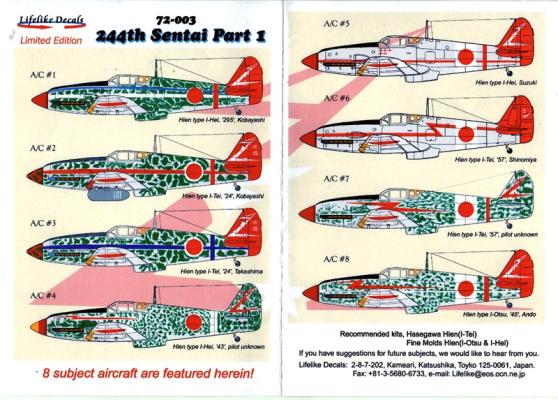
Lifelike Decals have recently provided some of their products for review. They produce a wide range of 1/72, 1/48 and 1/32 scale decals for WW II fighters and a couple of B-17s. This sheet is the first of three sheets covering 244 Sentai aircraft. I am sure that most modelers are familiar with the red tailed Ki-61 Tonys of this group. This sheet covers eight different aircraft including a couple of natural metal birds. Five of them are aircraft of aces. The aircraft of this Sentai included a great variety of fuselage stripes and bands. This sheet provides all of that material for the various schemes. The level of detail includes two slightly different colors of blue to properly recreate the individual markings. The directions also provide details for the props and landing gear doors. A single set of national insignia Hinomarus are provided however these are available with the kits.