
Whiskey-Class Submarines: Soviet Project 613 Submarines in Service with Foreign Navies, 1950-1990
Helion is a UK-based company that produces books on many aspects of Military History from the Late Medieval period through the present day. Helion was established in 1996 by University of Warwick graduate Duncan Rogers. Since then, they have published over 1,200 books, with 100 or more new titles coming out every year for readers around the world.
Dmitry Zubkov from Russia, a banker with 25 years of experience, has a lifelong interest in the subject of military history and has written several books and articles in Russian on a variety of related subjects. His area of interest is the little-studied issue of Soviet arms exports during the Cold War, especially warships. His studies of little-known details of the warships’ careers, the warships’ influence on the buildup of the recipient navies, and the experiences of their crews.
Helion’s latest volume in the Technology @ War series is a square back, soft cover that includes 86 glossy paper pages [excluding covers] in their standard portrait A4 (8.25 inches x 11.75 inches) format. This tome is the 9th in this series and was released in Britain on November 22, 2025, and in the United States on January 31, 2026.
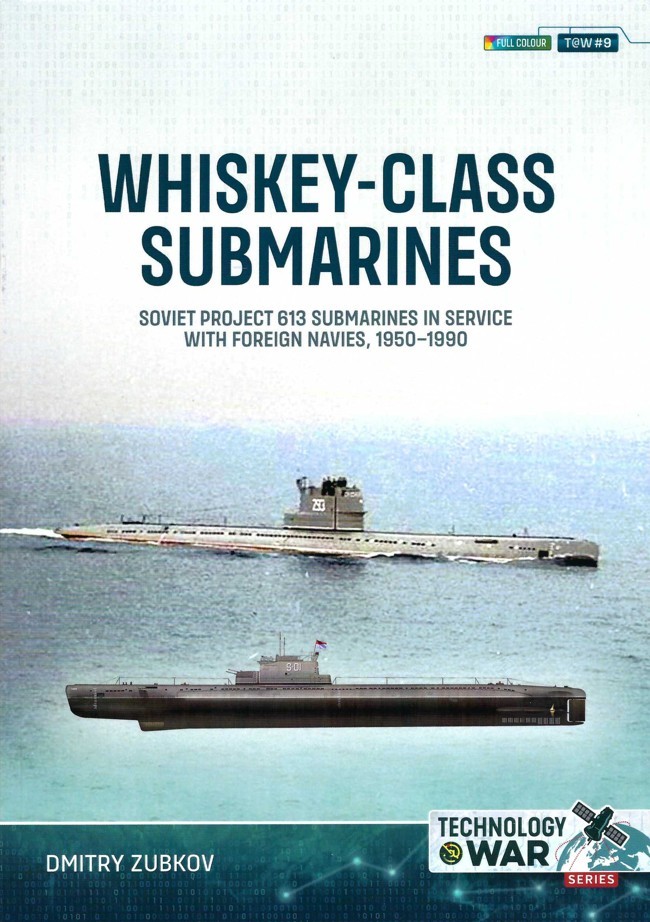
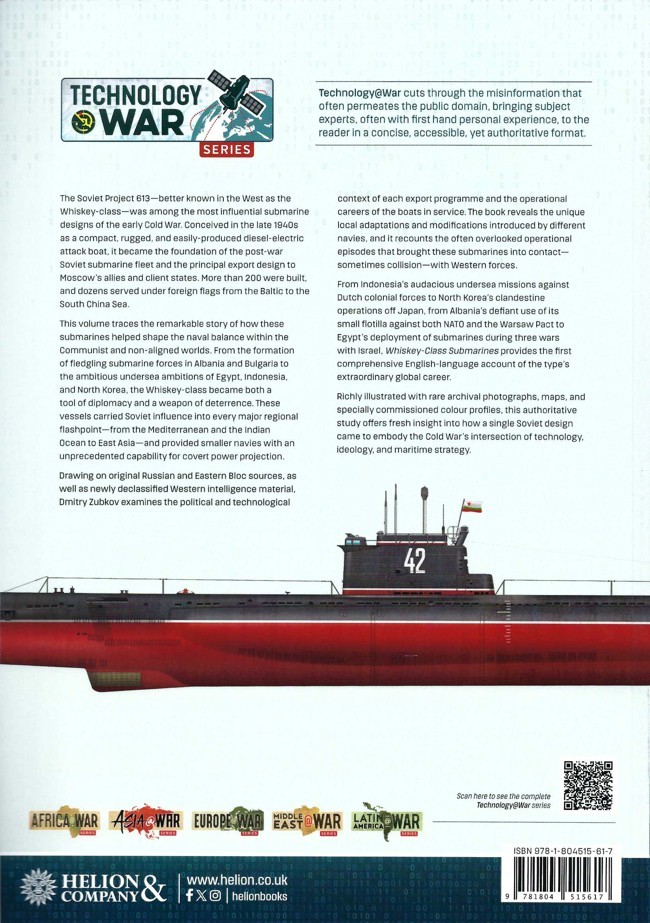
The front cover’s color photograph is of the Polish Navy’s ORP Sokół (Falcon) submarine in 1978. She was built in the Soviet Union as S-265 and was commissioned by the Polish Navy in 1962. She served primarily as 292 but was briefly coded 317. She was decommissioned in 1983, and she was the third ORP Sokół to serve with the Polish Navy. The first was a 1920 tugboat that was scrapped in 1957. The second ORP Sokół (N97), was a 1940 British U-Class submarine that was later returned to England in 1945 as the HMS Urchin. The fourth was a Kobben-class submarine, formerly the Norwegian KNM Stord, that was transferred to Poland in 2002 and is currently a museum submarine. I counted 28 color photographs and 136 black and white photographs. Three color maps provided by b.b.h.illustrations. Normally there is a section of color profiles or maps near the center of Helion’s @War series of books, but that is strangely absent in this volume. The only color profiles are those found on the front and back covers by Anderson Subtil.
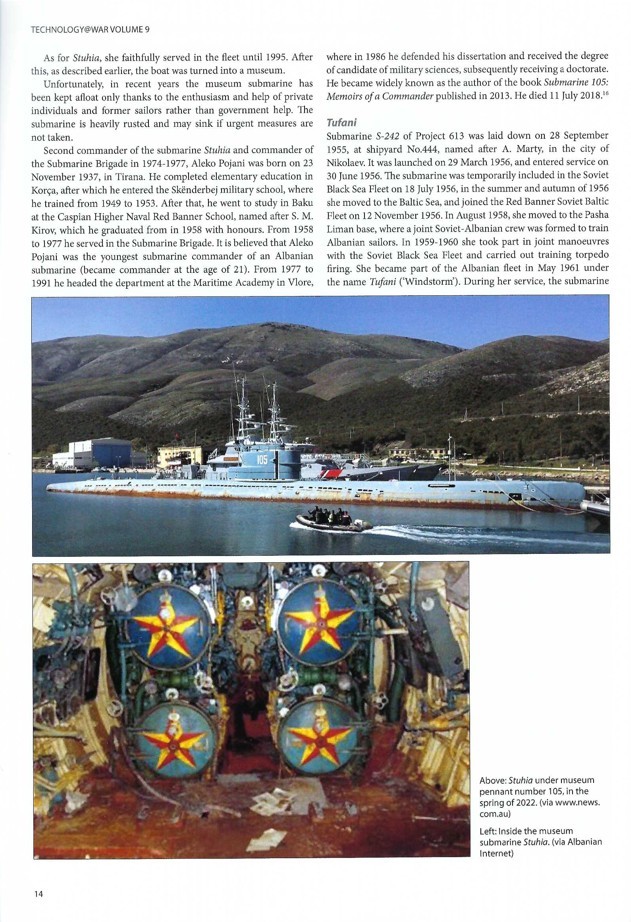
The focus of this volume from Dmitry Zubkov is on Project 613 Whiskey-class submarines in service with navies other than the Soviet Union. After a one-page Introduction, Dmitry Zubkov kicks off with Albanian Whiskey-class submarines. The first group of four submarines were transferred in early August 1958, along with a depot ship, Vladimir Nemchinov. Later, an additional eight Whiskey-class submarines joined them at the Gulf of Vlora on August 21, 1958. An ongoing battle between the Soviet Union and Albania on who was the better communist state caused the Soviets to withdraw from the base on May 26, 1961, but the Albanians refused to transfer the first four submarines back to the Soviet Union. Dmitry Zubkov covers the Albanian service career of these four submarines in detail that survived until 2010, when three of them were sold for scrap. The sole survivor can be seen on Page 14 as a museum ship. Stuhia, S-241, was launched on January 23, 1956, and originally served in the Soviet Black Sea Fleet.
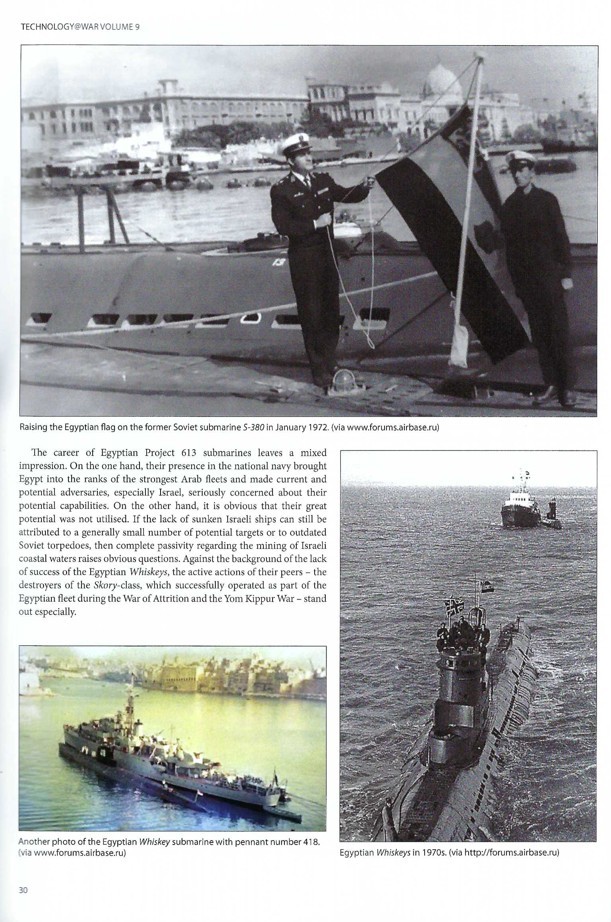
Egypt’s introduction to the Whiskey-class began with three submarines leased from the Soviet Union on June 26, 1957. This included one Project 96 submarine and two Project 613 submarines. The Egyptian Navy had many issues bringing them into service, leading to the smaller Project 96 coming to Egyptian Navy service first. Egypt would eventually operate ten ex-Soviet Whiskey-class submarines, but they did not have any significant actions against Israel. One of the last two Whiskey-class submarines to enter Egyptian service is seen at the top of Page 30 in January 1972. This photograph shows the transfer of S-380 from Soviet service to Egyptian service as S-29 and would wear pennant 418. She would enter Soviet service on June 30, 1957, and would serve in the Soviet Black Sea Fleet, the White Sea, the Northern Fleet, and the Baltic Fleet prior to transfer to Egypt.
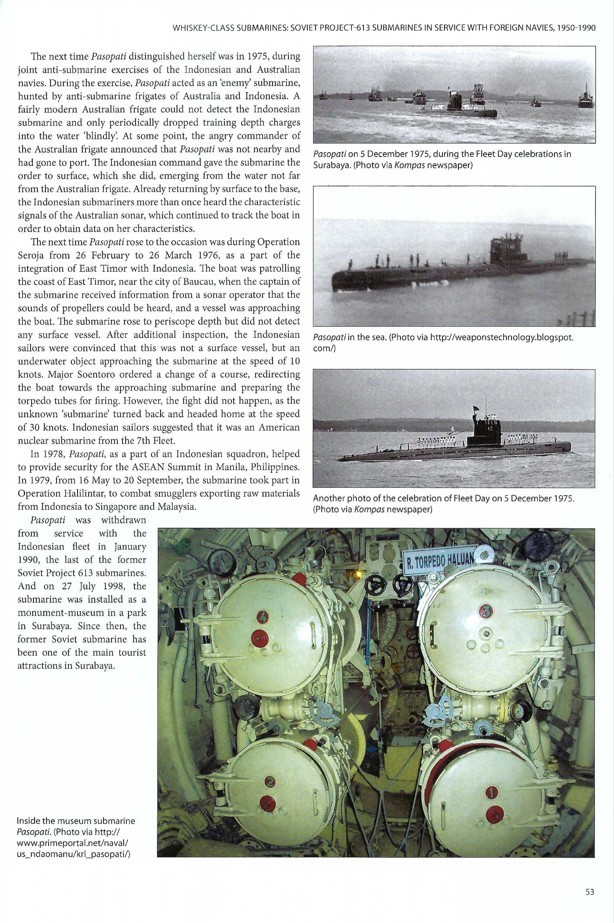
The next chapter addresses Indonesia’s experience with twelve Whiskey-class submarines. Indonesian officers and crews were trained in the Soviet Union and Indonesia took delivery of two Whiskey-class submarines on September 12, 1959. The Indonesian Navy took delivery of four more of these submarines on January 29, 1962. The remaining six were accepted on December 15, 1962. One of these last six, now a museum ship, RI Pasopati can be seen on Page 53 with a color photograph of the torpedo room. RI Pasopati entered service with the Soviet Union as S-290 on February 3, 1956. Interestingly, RI Pasopati was involved in several joint exercises with other nations, notably with Malaysia and Australia. The 1975 exercise with the modern Australian Navy saw RI Pasopati embarrass an Australian frigate by surfacing close by undetected. She served with distinction with the Indonesian Navy before being the last of the Whiskey-class submarines to be withdrawn from Indonesian service in January 1990.
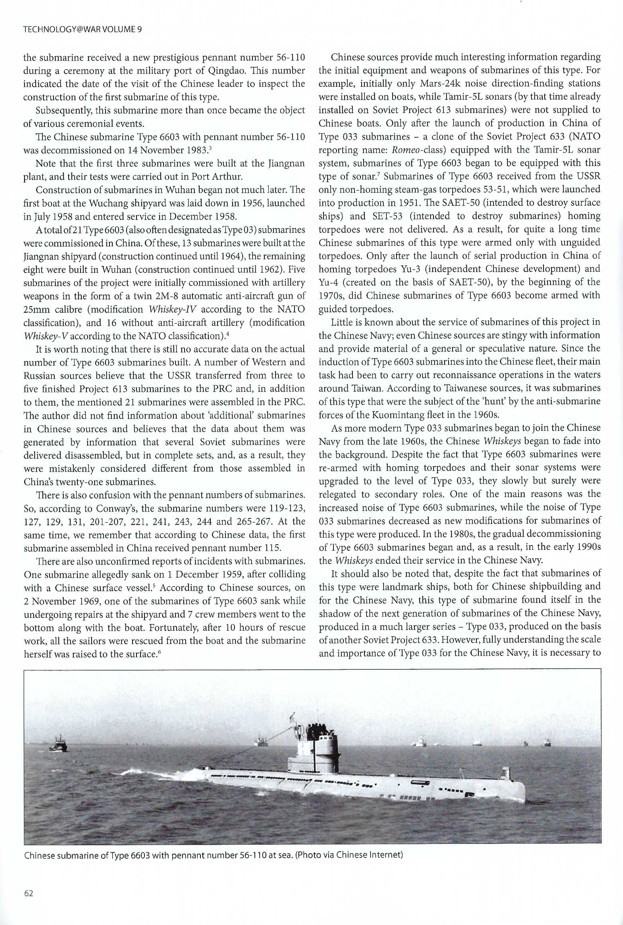
The People’s Republic of China was the largest operator of Whiskey-class submarines outside the Soviet Union, with at least 24 submarines. The first three (some say five) were assembled from Soviet supplied kits in China under the supervision of Soviet engineers. An additional 21 (possibly more) were built in China, probably with key parts and raw materials made in Russia. These Chinese submarines were designated as Type 6603, or sometimes as Type 03. The bottom of Page 62 shows off pennant number 56-110 at sea. 56-110 was the first Chinese Whiskey-class submarine accepted into the Chinese Navy (PLAN) on October 19, 1957. She was also the most famous Whiskey-class submarine in PLAN service, participating in many ceremonial events. She was decommissioned on November 14, 1983.
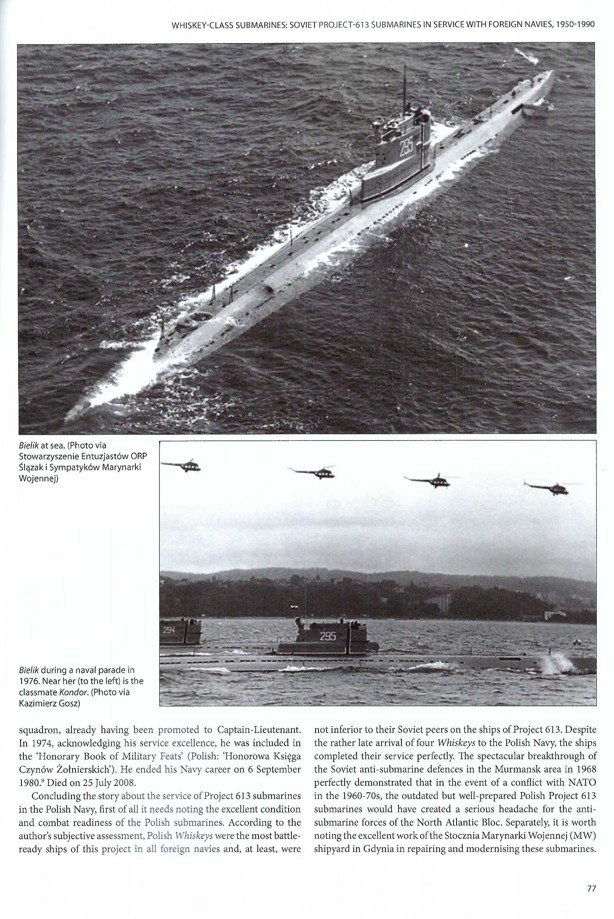
Chapter 8 covers the four Whiskey-class submarines that served in Poland. Poland was clearly the most experienced in submarine operations and maintained their submarines in excellent condition. This resulted in the Polish Project 613 submarines being the most battle ready of all foreign navies and the equivalent of those in the Soviet Navy. The Polish Navy leased the submarines from the Soviets before eventually purchasing them outright by the end of 1965. ORP Bielik, seen on Page 77, was originally commissioned as S-279 on October 20, 1955. She originally served with the Soviet 4th Navy (The Red Banner Baltic Fleet). She was based at Ust-Dvinsk (Latvia) before being transferred to the port of Gdynia, Poland. ORP Bielik (White Tailed Eagle) was accepted into the Polish Navy on July 1, 1965. She earned the title of “Leading Ship of the Fleet” in October 1975 after taking part in “Poseidon 75” exercises. She served until September 29, 1988, and was later dismantled.
The sections of this book include the following:
- Abbreviations and Acronyms
- Acknowledgments
- Introduction
- Albanian Whiskeys
- Service History of Albanian Whiskeys
- Stuhia [Page 14]
- Tufani
- Rrufeja
- Vetëtima
- Service History of Albanian Whiskeys
- Bulgarian Glory and Victory
- Service History of Bulgarian Whiskeys
- Slava
- Pobeda
- Service History of Bulgarian Whiskeys
- Whiskey Submarines in the Land of the Pharaohs
- Service History of Egyptian Whiskeys
- S-1
- S-2
- S-3
- S-4
- S-5
- S-6
- S-7
- S-8
- 415
- 418 (Page 30)
- Service History of Egyptian Whiskeys
- Steadfast Indonesian Whiskeys
- Operation Jayawijaya
- Soviet Involvement
- Lessons Learned
- Submarine Tender
- RI Tjakra
- RI Nanggala
- RI Nagabanda
- RI Trisula
- RI Nagarangsang
- RI Tjandrasa
- RI Alugoro
- RI Tjundamani
- RI Widjajadanu
- RI Pasopati [Page 53]
- Table 1: List of Operations and Expeditions of Submarine Pasopati
- Table 2: List of 14 Commanders of Pasopati…
- RI Hendradjala
- RI Bramasta
- Obscure North Korean Whiskey
- Floating Charging Station for the Cuban Foxtrots
- Chinese Whiskeys [Page 62]
- Poland’s Best Whiskeys of the Warsaw Pact
- ORP Orzel
- ORP Sokół
- ORP Kondor
- ORP Bielik [Page 77]
- Missing Whiskeys of the Syrian Navy
- Conclusion
- Table 3: Number of Submarines by Operating Navy
- Albanian Whiskeys
- Bibliography
- Endnotes
- About the Author
There were five basic configurations of Project 613 Whiskey-class submarines, from Whiskey I to Whiskey V. To model any of the above Whiskeys in foreign service, you will need to find the corresponding Russian S number and then find out if it was upgraded. MikroMir currently has a 1/350-scale Project 613/Whiskey III-class kit available in injection molded plastic. It will get you close, but it will require modifications to become another configuration. There is a resin Whiskey V-class kit that was released by Polar Bear at some point but seems quite rare currently. There were many specialized variants that carried guided missiles that sometimes carried the Whiskey moniker, but these did not serve outside the Soviet Union. This includes Project 640, Project 644, and Project 665 submarines.
It was a pleasure to read this book, especially after reviewing an earlier Helion book, “Whiskey on the Rocks”. One of the events that caught my attention was Operation Jayawijaya, which was a 1962 joint attack between Indonesia and the Soviet Union on the Dutch island of Biak. Biak is the primary island of the Biak Archipelago near the northern coast of Paupua, just north of New Guinea. President John Kennedy met with the Indonesian ambassador and informed him that the United States would side with the Netherlands if the attack began. In the end, the attack was called off at the last minute as pressure on the Dutch led to negotiations that resulted in the end of Dutch control of the islands. If you own one of the previous releases in the Technology @ War series, you know what you are getting. If this is your initial entry into this series, you will be quite pleased.
My thanks to Helion & Company, Casemate Publishing, and IPMS/USA for the chance to review this great book.
Highly recommended!
Reviewer Bio
Frank Landrus

Frank retired from the Ophthalmic industry with over thirty-six years of Research and Development experience. Frank's first model kit was a 1959 Hawk 1/72 US Marines Vought AU-1 Corsair and has been building models for over sixty years. Frank's first encounter with IPMS was attending a North Central Texas ScaleFest show in 1984. Frank soon became more involved in Make-N-Take activities and became the IPMS Western Coordinator for Make-N-Takes [West of the Mississippi River]. Make-N-Takes quickly became a local model contest and airshow staple reaching a high of reaching over 1,300 children before the COVID shutdown. Frank has volunteered to assist in contest judging since 1985 and is currently the Nationals Head Figure Judge until he is dead or they find someone better.
Comments
Add new comment
This site is protected by reCAPTCHA and the Google Privacy Policy and Terms of Service apply.
Similar Reviews