
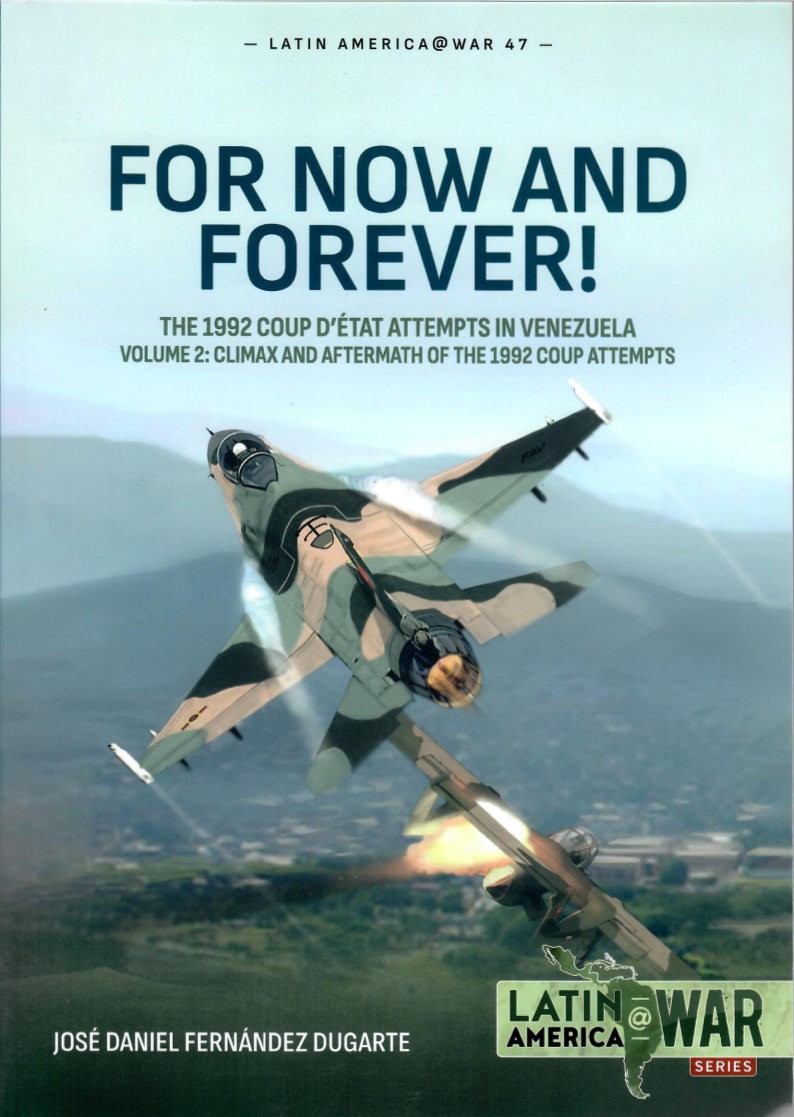
For Now and Forever! The 1992 Coup d’etat Attempts in Venezuela Volume 2: Climax and Aftermath of the 1992 Coup Attempts
Illustrators: George Anderson, David Bocquelet, Luca Canossa, Tom Cooper, Paul Hewitt, and Anderson Subtil
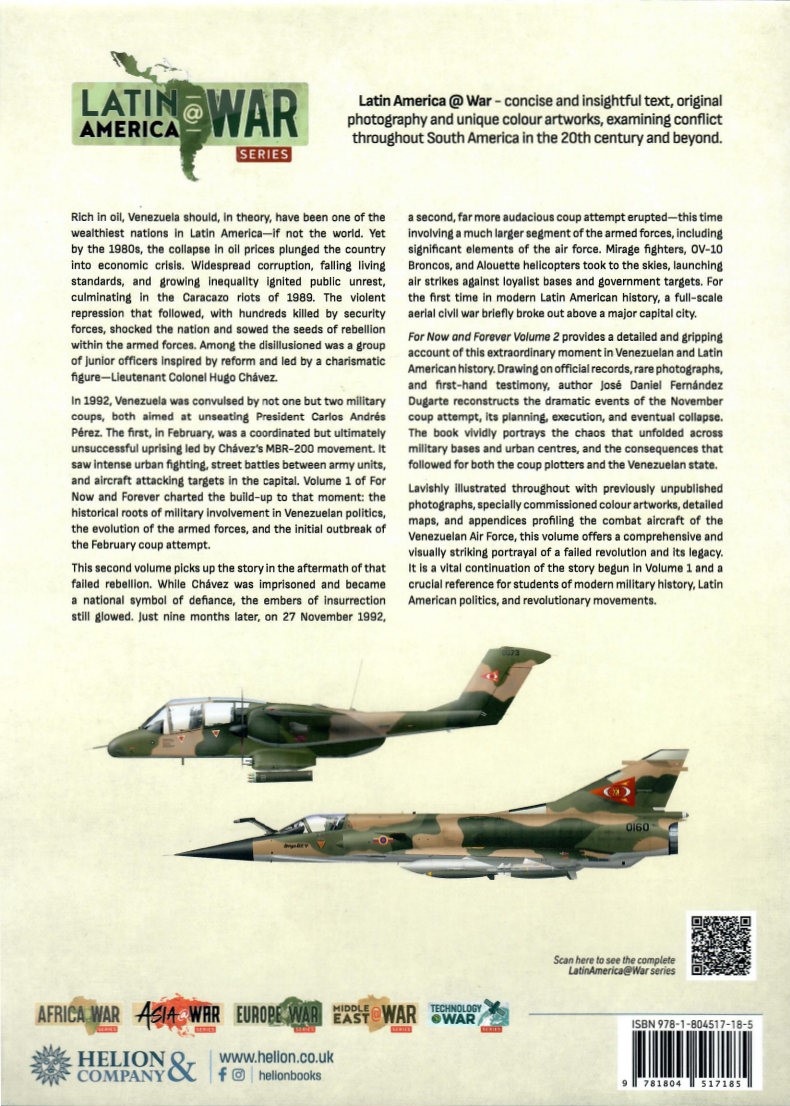
This is author José Daniel Fernández Dugarte’s second volume of the 1992 coup d'état attempts in Venezuela, focusing on events of the February 1992 coup that were set up in the first volume, and the subsequent November coup that ultimately failed. The original manuscript was too large for the @War series, so the editors decided to break it into two volumes. Both volumes are essential to telling this complex story. This volume starts right where the first volume ends and outlines the rest of the first coup, the aftermath, then the second coup just nine months later, its aftermath, and the path of power for Hugo Chávez. Please read the first volume before attempting the second volume.
For a quick summation of the first volume, some members of the Venezuelan armed forces planned a coup d'état for December 1991 as Venezuela was suffering under President Carlos Andrés Pérez. The December coup did not take place as the president was not in the country at the time. The planning continued with a target date of 4 February 1989. The leadership of the coup was the forces of MBR-200 (Movimiento Bolivariano Revolucionario 200) led by, among others, Lieutenant Colonel Hugo Chávez Frias and Lieutenant Colonel Francisco Javier Arias Cardenas. As the events leading up the coup unfolded, a lot of the participants backed out at the last minute, leaving the largely Army-led effort exposed and, while initially successful in capturing several cities and military bases, they were unable to hold their gains as the loyalist forces counterattacked and regained their strongholds. The second volume picks up at 23:00 on 3 February 1992.
For Now and Forever! The 1992 Coup d’etat Attempts in Venezuela Volume 2: Climax and Aftermath of the 1992 Coup Attempts is a part of Helion and Latin America@War No. 47 (HEL1966). The 72-page page book is complete with extensive photographs, technical details and specifications, and detailed illustrations, comprising the following seven chapters:
- Abbreviations and Acronyms
- An Editorial Note
- Operational Collapse
- A Country in Shock
- Overlapping Conspiracies
- New Rebellion, New Betrayals, New Problems
- A Regime in Decline and a New Dawn
- Appendix
- Bibliography
- Endnotes
- About the Author
As the first volume eluded, the February coup d’etat failed, and the first part of the book outlines the actions and results of the failed attempt. President Pérez ordered his loyal military to eradicate the rebels, but calmer heads prevailed as the coup was mostly over by mid-day. Hugo Chávez angered many in the coup as during his surrender that he carefully orchestrated, he gave the impression that he was in charge and that the coup was over, “for now”. The coup leaders were identified, tried by military courts-martial, and most were given sentences of 15-28 years of imprisonment. Most of the troops faced no consequences as many were following their officers’ orders and didn’t realize they were part of the coup. As most of the Venezuelan military were conscripts, a lot were dismissed before their term expired, which led to more problems with civilian employment without having their certificate of completion of military service. The officers were imprisoned, allowed to wear their uniforms, and had access to visitors and media. Surprisingly, the coup received a lot of support from civilians.
While the first coup leaders were in jail, another coup, or actual groups of conspirators, were planning a follow-on coup. The intrigue and confusion are well documented by the author as the planners sought to avoid the same mistakes. This coup was to take advantage not just of the army, but also the navy (primarily in the form of the Cuerpo de Infantería de Marina, Venezuelan Marines) and Fuerza Aérea Venezolana (FAV-Venezuela Air Force).
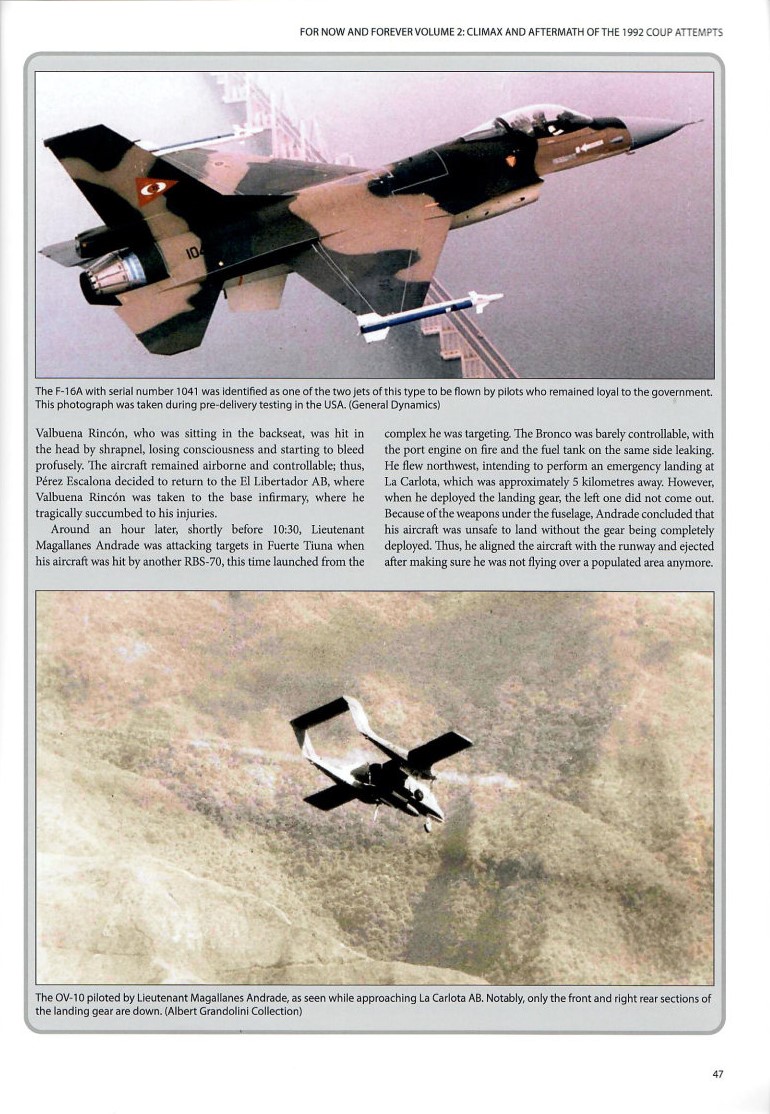
The 26 November 1992 coup started strongly and had success like the February coup, with the FAV taking the lead and securing their objectives at the airfields, including aircraft to transport units and provide air support and reconnaissance. The author did an amazing job breaking down who did what when and where. As with all plans, the enemy has a vote, and some loyalist FAV pilots made things particularly hard for the rebels, including using two F-16s that created havoc, although the pilots were not wearing G-suits and had only the internal 20mm cannon for weapons.
Civilian groups played their role as well, fighting the National Guard and DISIP (Dirección Nacional de los Servicios de Inteligencia y Prevención, the General Sectoral Directorate of Intelligence and Prevention Services). The coup ultimately failed by midday (sensing a trend?) as loyalist forces, primarily the army, conducted assaults on the airfields and re-consolidated power. As with the first coup, the second coup leaders faced the same fate, 15-28 years of imprisonment, with the enlisted being expelled from the military. The official death toll was 178, but other reports place the number at over 400.
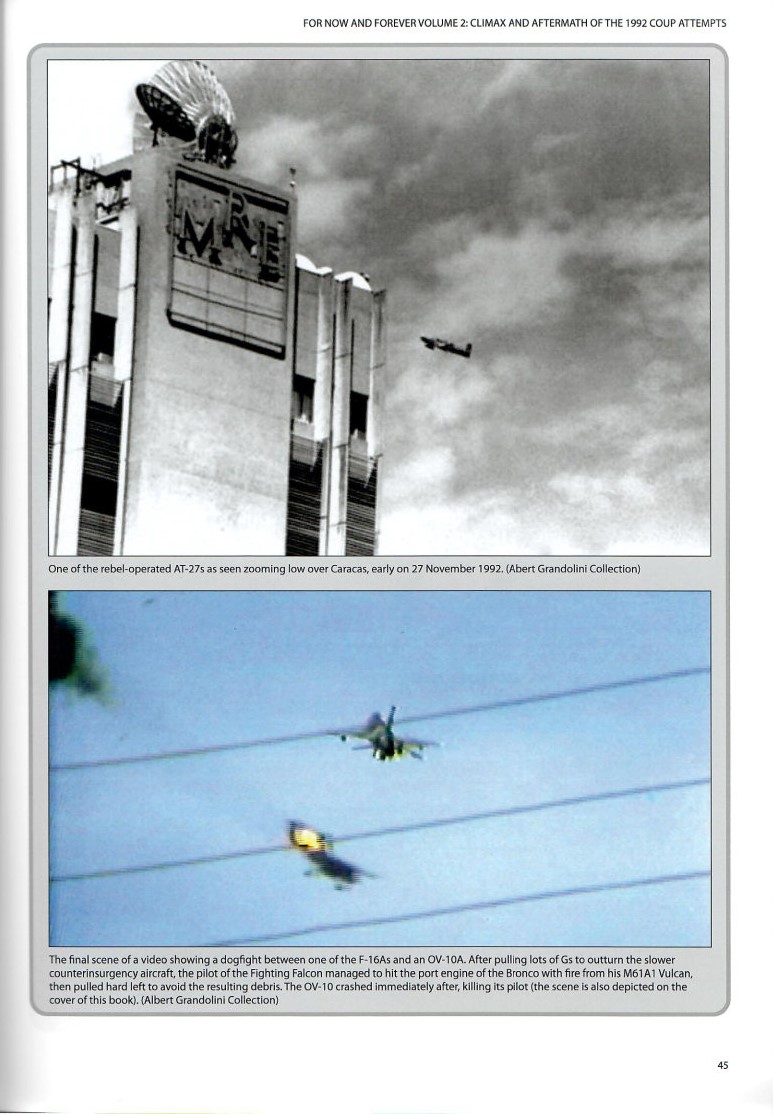
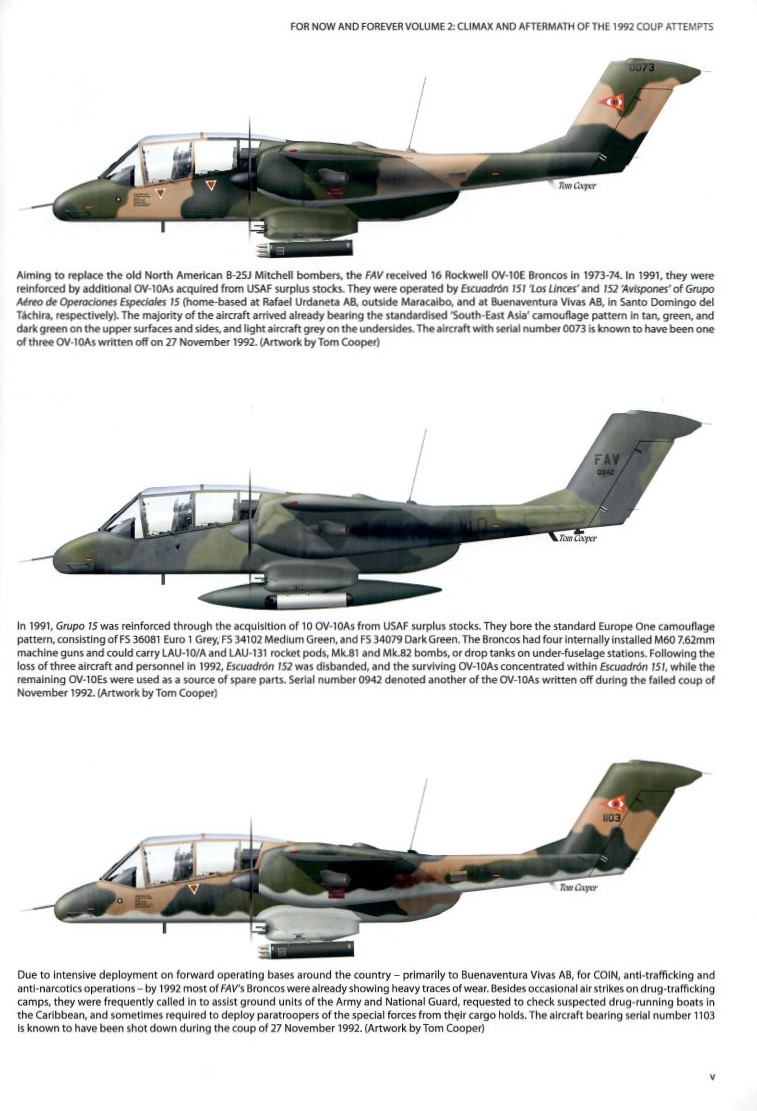
The author was successful in explaining a very confusing situation with amazing detail and research. There are two remarkable sub-sections of the book worthy of note. One is titled, “Air War of 27 November 1992: Summary” and highlights the fascinating air struggle on that fateful day, along with video screen shots of some of the flying and fighting. Another is “A Note On the Serial Numbers of FAV Aircraft”, which states, “At the FAV Headquarters at La Carlota AB in Caracas, there is a huge book holding pages 0001 through 9999. Whenever a new aircraft or helicopter is added to the fleet, the book is opened at a random page: if this page has already been taken by an active aircraft, then another page is opened, so that any new aircraft or helicopter receives a new serial number in this manner. The thickness of this book is also the reason why there are many aircraft bearing serial numbers in the 1000 range: the book is opened more often at lower than at higher page numbers.
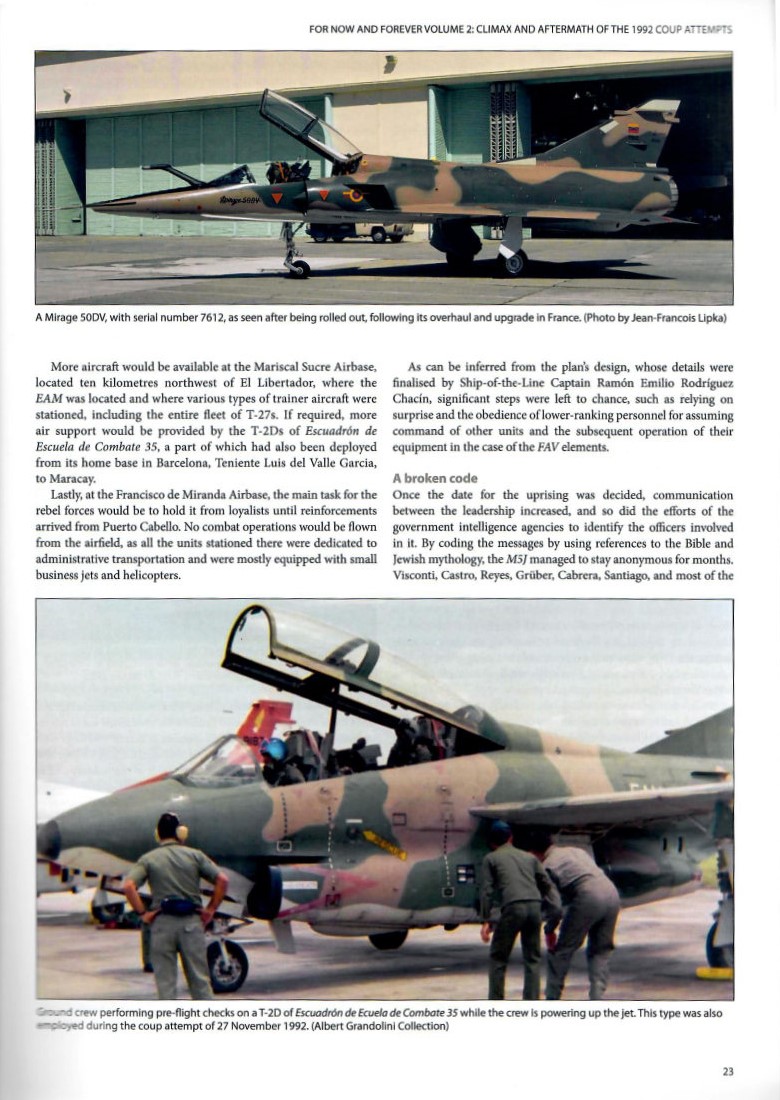
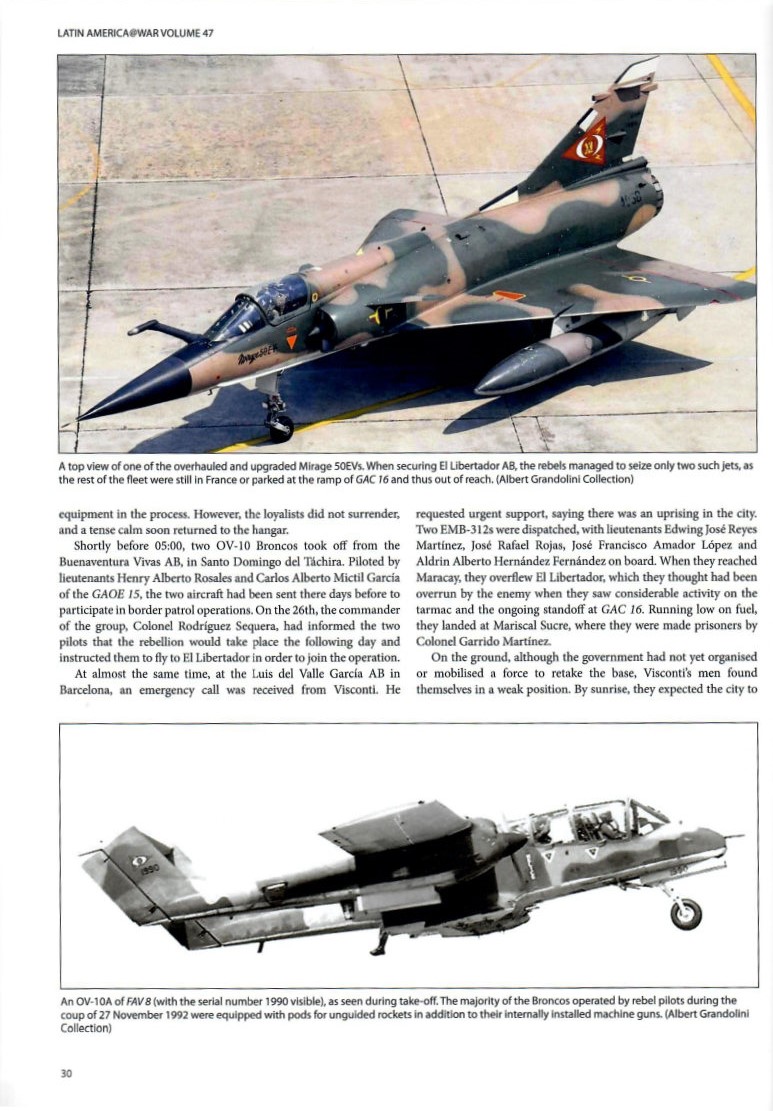
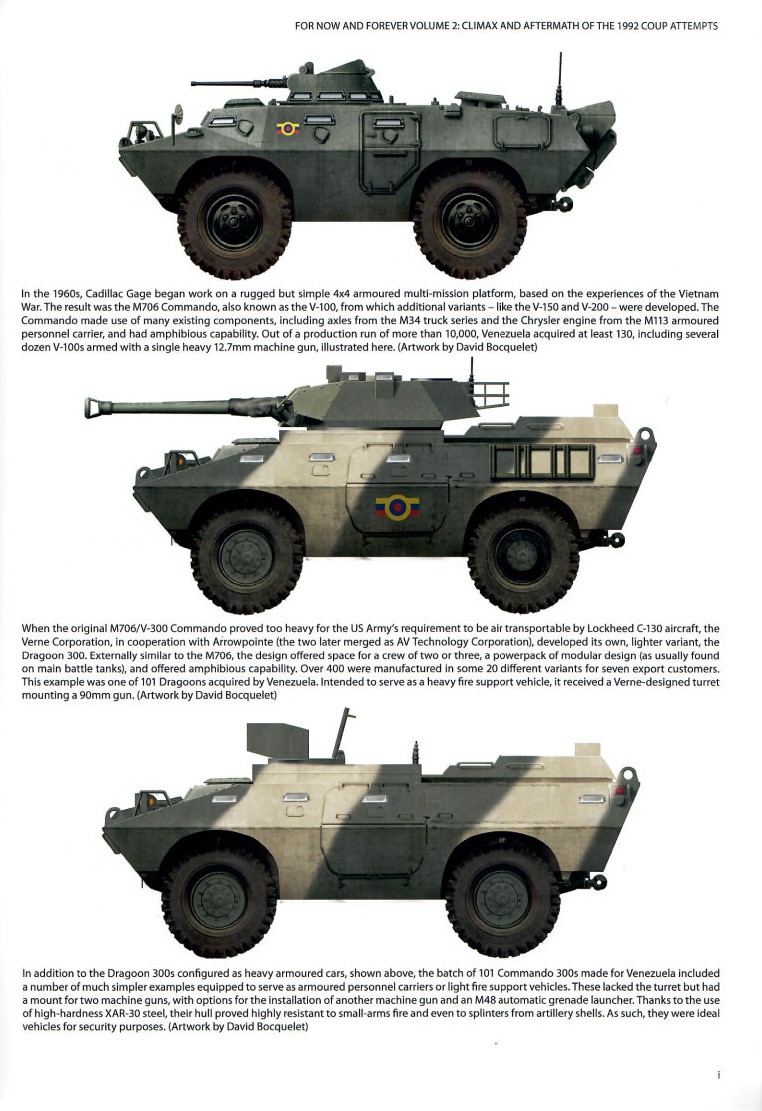
Modelers will appreciate the plethora of black and white period photographs of the Venezuelan military armored vehicles, anti-aircraft, aircraft, helicopters and soldiers with their weapons. The color profile section, for which Helion’s @War series is known, is replete with images of the Cadillac Gage V-100 (M706) Commando, Dragoon 300, and Commando 300. Aircraft are represented by the T-2D, Mirage III, Mirage 5V, Mirage IIIEV, Mirage 50EV, F-5, VF-5, OV-10A and E Broncos, F-16A and B Falcons, C-130H Hercules, Boeing 707-346 tanker and transport aircraft, and Alouette III and Bell UH=1B, D, and H helicopters.
Ironically, three weeks after the second coup, President Pérez and his administration were accused of embezzling public funds and he was voted out of office on 21 May 1993. An interim president, Velasquez Mujica, served the remainder of Pérez’s term until 2 February 1994. The new president, Rafael Caldera, just 12 days into his term, commuted the coup leaders’ sentences. Hugo Chávez consolidated his power and became president on 2 February 1999, serving until his death in March 2013. His hand-picked successor, Nicolás Maduro, became president in April 2013. He remains in power today as Venezuela faces its latest crisis.
Profuse thanks to Casemate and IPMS/USA for providing the review sample.



Comments
Add new comment
This site is protected by reCAPTCHA and the Google Privacy Policy and Terms of Service apply.
Similar Reviews