
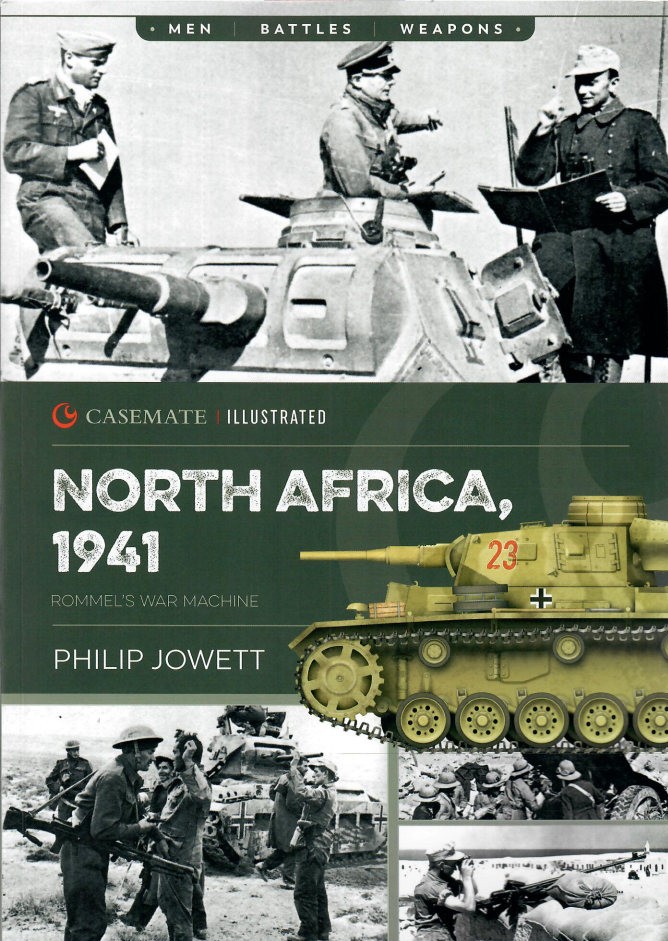
North Africa, 1941 - Rommel's War Machine
As 1941 dawned, the British were mopping up the last Italian strongholds in Libya after seven months of fighting. The outnumbered British Western Desert force of 30,000 men had effectively defeated an Italian force of 250,000. The British had captured hundreds of thousands of Italian soldiers, plus hundreds of tanks and artillery pieces, and several thousand valuable trucks, and pushed the Italians out of Egypt and then across the coastline of Libya until they controlled only a small section of western Libya.
Thus opens this incredible book of the World War II North African campaign in 1941. What began as Italy’s supposedly easy victory was turned on its head in 1940 as the vastly outnumbered British and Commonwealth forces rallied and provided not only a strong defence but quickly gained the initiative and pushed the Italians back past their start lines. Italy’s Il Duce Benito Mussolini felt he could expand his North African empire and force the British withdrawal from the Suez Canal as England was decisively engaged in its own survival. British Prime Minister Winston Churchill “looking to put the blame at the feet of Mussolini, broadcast to the Italian people a few days before Christmas: ‘One man and one man only was resolved to plunge Italy, after all these years of strain and effort, into the whirlpool of war.’”
Author Philip Jowett has an extensive library of over forty books, and his writing style is easy to follow and understand. Even more impressive is his extensive collection of photographs used to support his chapters, some previously unpublished. The photos are worth the price of the book alone.
North Africa 1941 - Rommel’s War Machine is one of his great books and is organized in the Casemate Illustrated format, and is composed of the following chapters:
- Timeline of Events
- Introduction
- Italian Collapse, January-February 1941
- Enter the Afrika Korps, February – April 1941
- Siege of Tobruk, April – November 1941
- Operations Brevity and Battleaxe, May – June 1941
- The Air War, 1941
- Lull, July – October 1941
- Operation Crusader, November – December 1941
- Afterword
- Further Reading
- Index
The Italians, and the indigenous Libyan troops, are often given short shrift in historical accounts of the North African campaign. The brave soldiers were often failed by their leadership who did not comprehend the harsh terrain, vast distances and nature of desert warfare. The North African theater truly was a campaign of logistics and mobility. The Italians were not prepared to meet an equal adversary and their defeats in 1940 proved that fact. The vulnerable Mediterranean supply routes would also heavily affect both sides, particularly the Axis forces.
Adolf Hitler didn’t want his Italian ally to fail and so bolstered the Italians. As he did so, Hitler didn’t want North Africa to became more than a sideshow, instead focusing on his soon to be unleashed Operation Barbarossa, the German invasion of Russia (which was soon to be modified for the failed Italian operations in the Balkans). 1941 was the story of General Erwin Rommel and his Afrika Korps as they pushed the British forces back into Egypt and Tobruk. This book does a fantastic job of describing the fighting between the Italian and German allies against the British forces to include Australian, Free French, Indian, New Zealand, Polish, and South African forces in not only North Africa, but also East Africa, the Middle East and Greece as the world unraveled in 1940 and 1941.
There are some amazing tidbits of information and anecdotal memories provided in this book. One tank crewman, referring to his British Light Tank Mk VIB, “is reported to have plugged a hole in their armor with a pair of ‘smelly’ socks to keep the daylight out of the interior of their vehicle!” Others talked about the incessant flies that would descend on any open water or food container. Aircraft without sand filters could only operate as little as 30 flight hours. Perhaps one of the most vaunted historical inaccuracies was that the German 88mm flak gun was used against allied tanks for the first time; the author points out that General Rommel had already used this tactic during his battles in France as commander of the 7th Panzer Division.
While the British were ascendant against the Italians, the Germans turned the tables and began a succession of British commanders with General Sir Archibald Wavell, Lieutenant General Philip Neame and, as 1941 came to end, General Alan Cullingham (as commander of the nearly created Eighth Army) under General Sir Claude Auchinleck (as Commander in Chief Middle East, previously in charge in North Africa) to find the right counter to General Rommel. Eighth Army’s Operation Crusader in November-December 1941 took advantage of the summer lull to bolster their ranks and forces, widening the gap between the Axis forces who were struggling to replace losses across the perilous, British controlled sea lanes.
The author does a great job dispelling myths. “A quote from Major General F.W. Mellenthin’s memoirs, Panzer Battles 1939-45, describes the situation in late 1941 well:
Contrary to the generally accepted view, the German tanks did not have any advantage in quality over their opponents, and in numbers we were always inferior… To my mind, our victories depended on three factors: the superiority of our antitank guns, our systematic practice of the principle of “Cooperation of All Arms,” and last but not least our tactical methods.
He also describes Rommel disregarding Hitler’s orders to stabilize Libya and bolster its defense against further British offensives, and instead he went on the offensive to prove his prowess, thus tying up more valuable and rare German supplies in a sideshow theater. He also focuses on Rommel’s fixation on Tobruk, costing the Germans time and valuable resources best used elsewhere. While Rommel was a genius, his ego clouded his judgement. The author also talks about the friction between the Italians and the morally superior Germans. The Italians could fight, especially when properly supplied and led. They would prove this under Rommel’s command.
In the Afterword, after the conclusion of Eighth Army’s successful Operation Crusader,
In the aftermath of the offensive the British mopped up the left-behind garrison at Bardia, capturing 7,000 men and took Halfaya Pass in early January 1942. Outside problems again came to impact the British war effort in North Africa when the Japanese attacked Pearl Harbor and began their blitzkrieg through East Asia and the Pacific from December 1941. The fresh situation in the Far East meant that, like the spring distraction of Greece, men and machines were needed to defend the empire: Burma, Borneo, Malaya, and ostensibly India, plus the vital naval base at Singapore, all threatened by the Japanese offensives through Asia which lasted until May 1942.
Modelers are well served by this book that delivers amazing photographs of Italian, German and Commonwealth soldiers, equipment and vehicles in the brutal North African desert. Armor modelers can use the photographs for inspiration, whether being Italian tankettes in choking dust, early German panzers in choking dust, or British Cruiser tanks in choking dust (notice the trend?), along with light skinned vehicles, and soldiers in their tropical uniforms. Aircraft modelers are also served, to a lesser degree as air forces of both opponents were small due to larger commitments in other parts of Europe, with the desert air forces photos and profiles.
This book is well worth your hard-earned modeling money for the photos alone. There is inspiration on every page, and respect for those soldiers, regardless of nation, who fought in that unforgiving landscape. I look forward to Philip Jowett’s next book, North Africa, 1942-The Turning Point.
Profuse thanks to Casemate and IPMS/USA for providing the review sample.


Comments
Wrong book!
The text of this review is referring to a different book, not the one whose cover and ISBN number are shown ("North Africa, 1941"). The review is for the Images of War volume "Tanks and Armour in Ukraine 1941–1944."
Thanks
Appears the reviewer cross mixed his text. Getting it fixed.
IPMS USA
Fixed
All better
Add new comment
This site is protected by reCAPTCHA and the Google Privacy Policy and Terms of Service apply.
Similar Reviews