
German Light Armored Cars of WWII : Sd.Kfz. 221, 222, 223, 247, 260, and 261
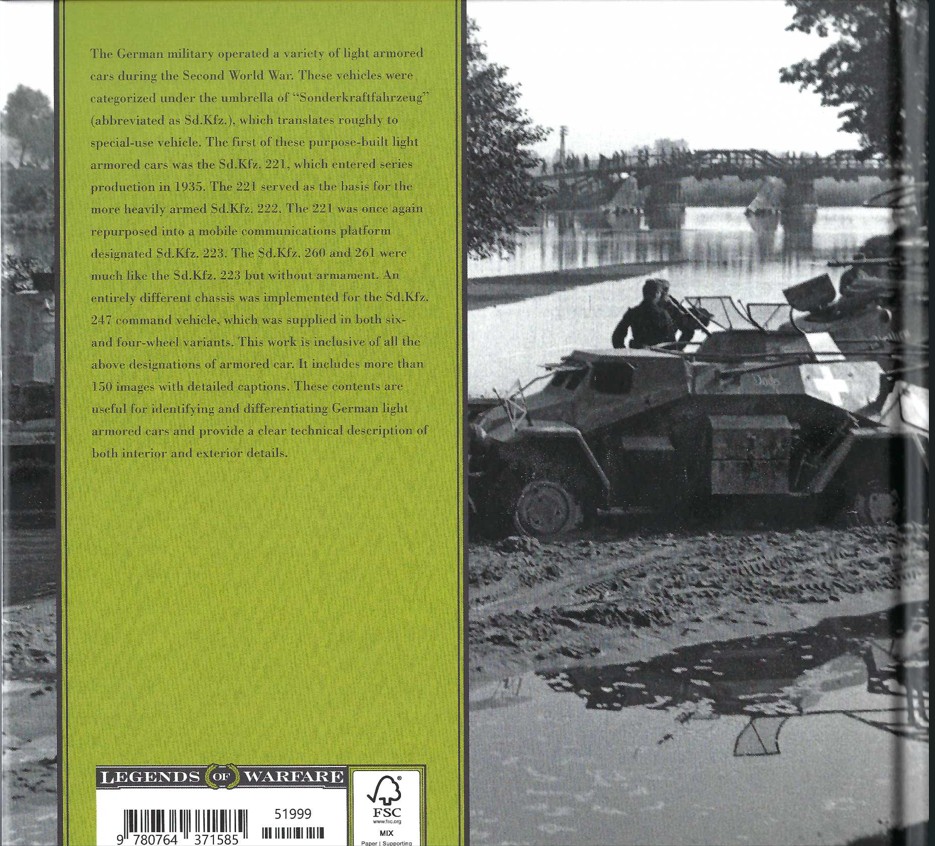
David Doyle's book on the German Light Armored Cars of WWII : Sd.Kfz. 221, 222, 223, 247, 260, and 261 is one of the latest entries in the 'Legends of Warfare' series with entries in Ground, Naval, and Aviation. Schiffer Publishing’s The Legends of Warfare series has expanded rapidly since its 2017 debut in the market with now over 100 titles released. This hard cover series covers a wide variety of monographs at a good price point. Catch up with Schiffer Publishing on Facebook.
After many years of being published in enthusiast publications focused on military vehicle restorations, David Doyle 'graduated' to full-fledged books in 2003. His first book was a hefty 512-page history of US military vehicles. He has now had more than 175 books published in military vehicles, aviation and naval topics. David and his wife Denise have amassed a collection of ten Vietnam era military vehicles that still displays at shows. In June 2015, was honored with the Military Vehicle Preservation Association's Bart Vanderveen Award, given in recognition of "...the individual who has contributed the most to the historic preservation of military vehicles worldwide." Be sure to check out David's website and Facebook.
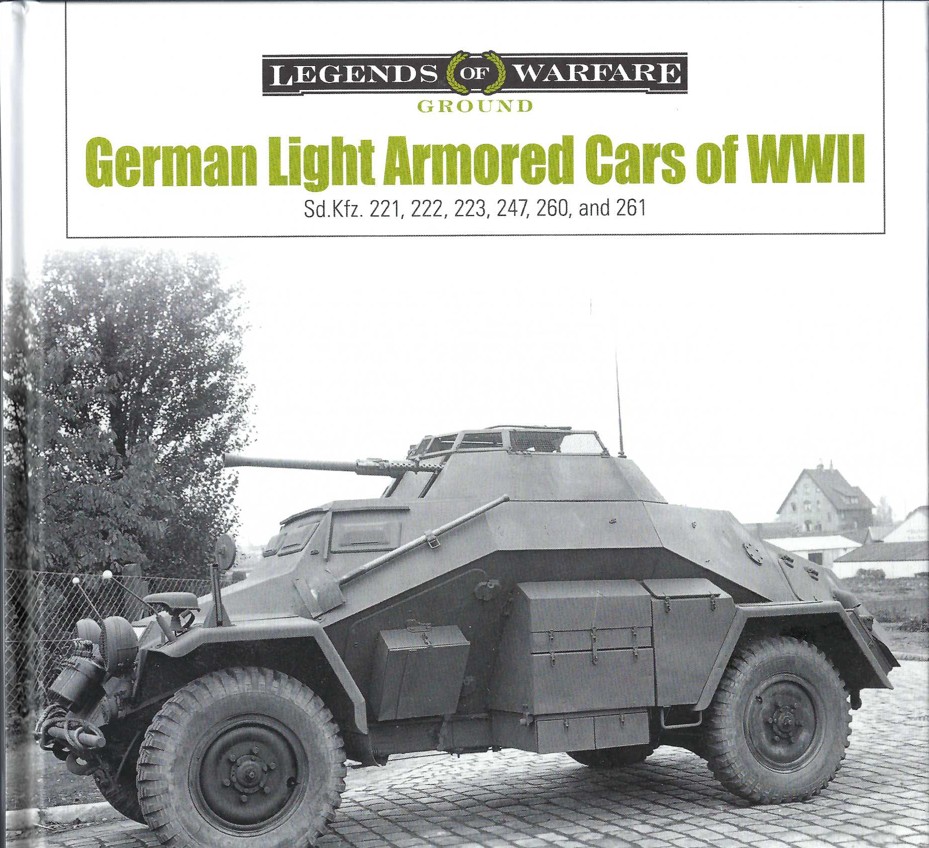
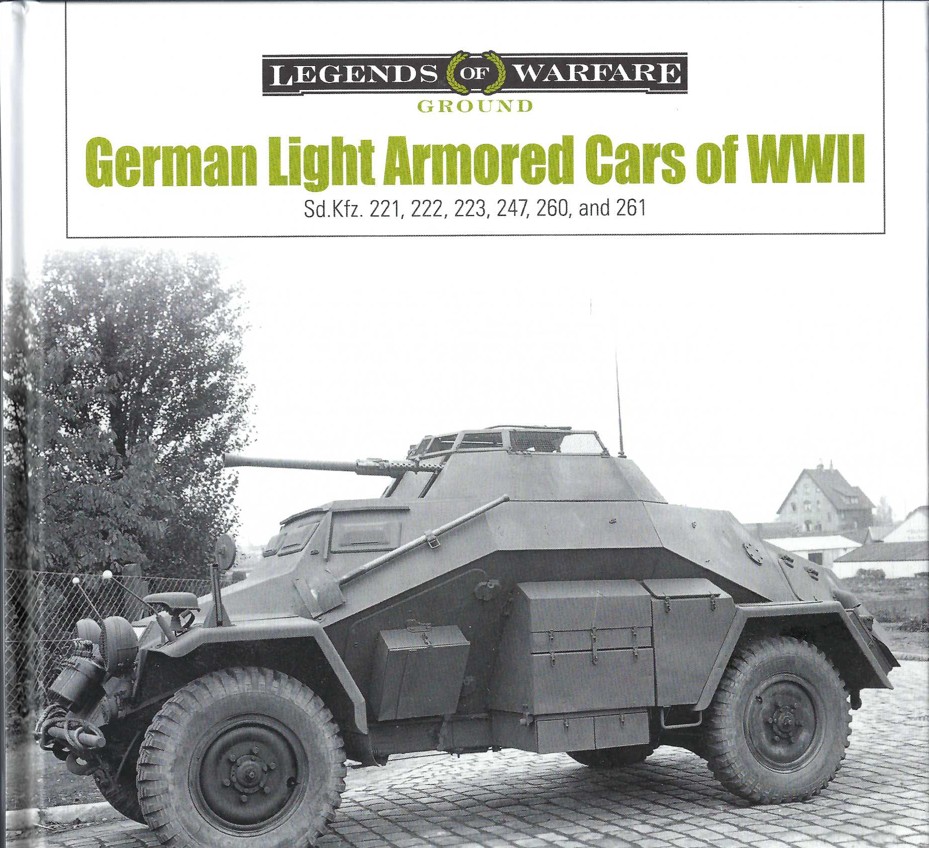
Schiffer’s latest is their standard [9.313” x 9.375”] format square-back hardbound publication that is 112 glossy pages. This tome had a preview at the 2026 IPMS Nationals in Fort Wayne with a formal publication date of August 28. 2026. The front cover features a period black and white photograph of a Sd.Kfz. 222 Series 5 Late. Identification features include turn signals being moved from the body sides to the front fenders tops and the addition of doors to the storage boxes on the left side of the body. A wedge-shaped storage box was placed between the rear fender and the storage boxes between the wheels. The Series 5 Late Production cars had the visors deleted from the sides of the turret and standardized on a three-part body. I counted 157 photographs: 51 in color and 106 in black and white. Many of the archival photographs are being published for the first time.
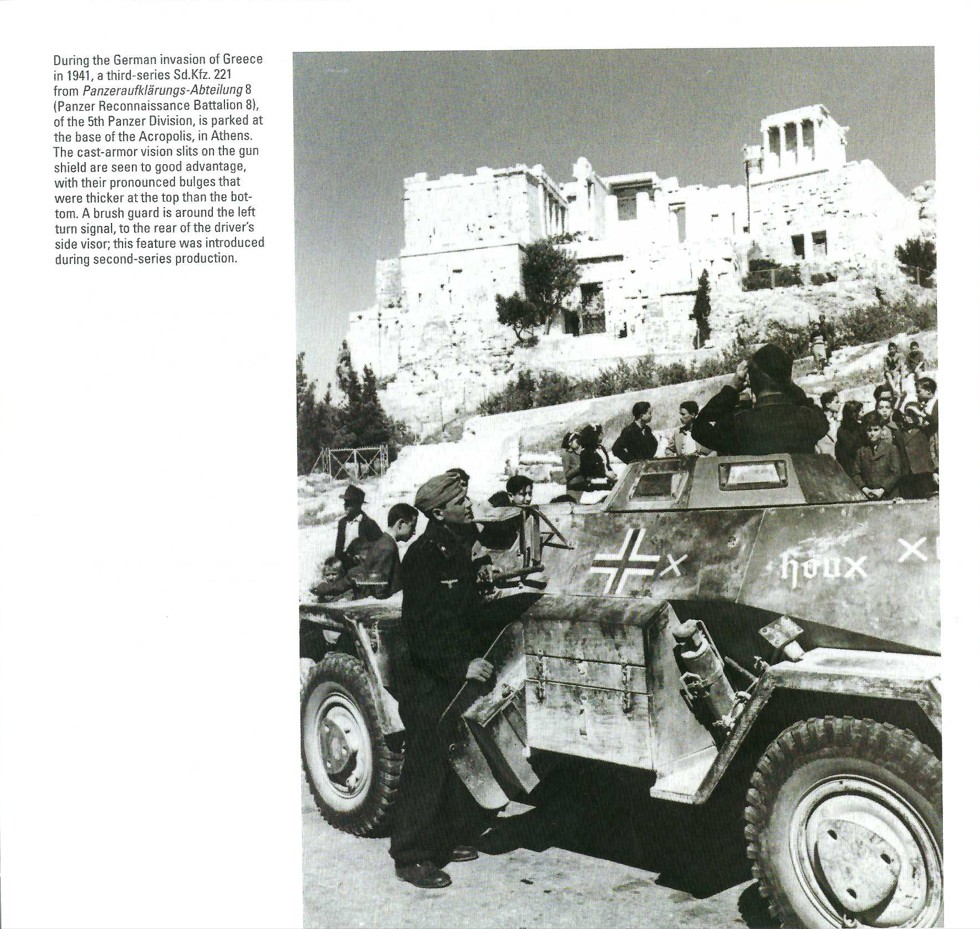
David Doyle kicks off the Introduction with a brief discussion of the Kfz. 13 and 14 that were the first armored cars in Germany after WWI. Germany had banned from anything but police vehicles, but the Kfz. 13, introduced in 1932, was clearly in violation of the Treaty of Versailles. The Sd.Kfz. 221 was a purpose-built four-wheel drive / steering armored car with 339 manufactured between 1935 and 1940. Field modifications were common, often upgrading the single MG 13 machine gun and heavier armor plating. A Sd.Kfz. 221 Series 3 is shown on Page 15 during the invasion of Greece in 1941. Serving with the Panzer Reconnaissance Battalion 8 of the 5th Panzer Division, she is parked at the base of Acropolis in Athens. The turn signal, protected by a brush guard, is located on the body just to the rear of the drivers’ side visor. Note the name “houx” on the rea body panel.
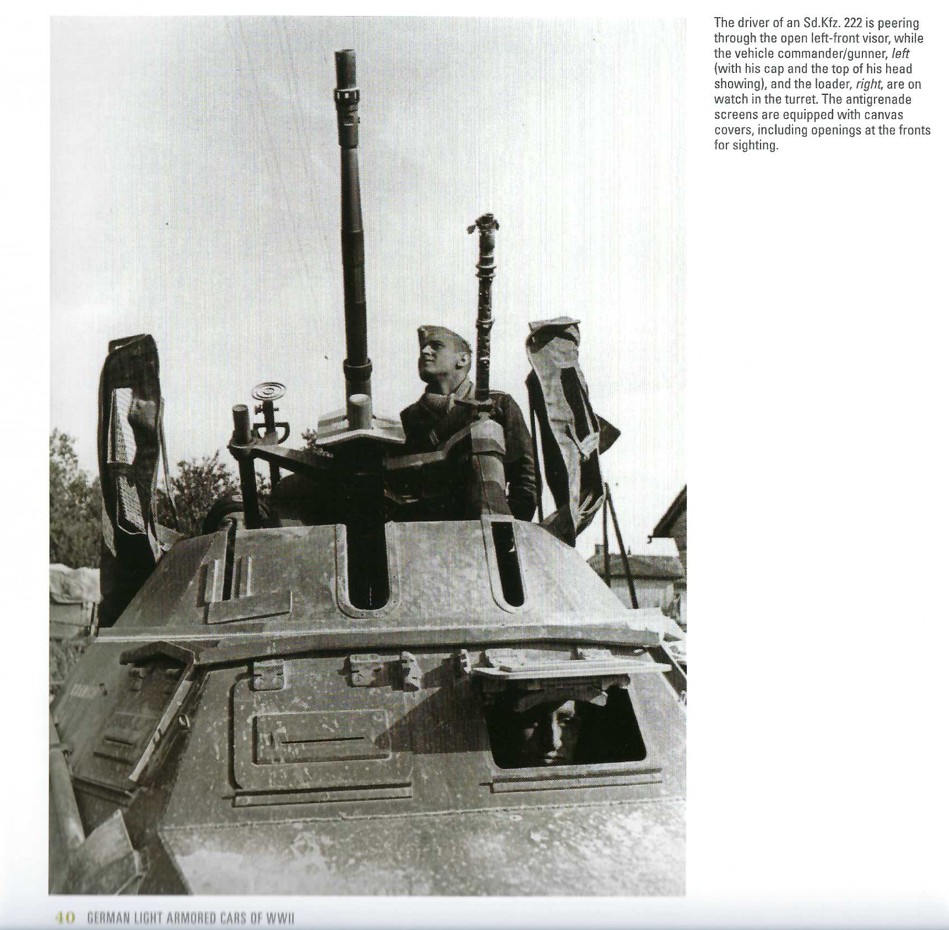
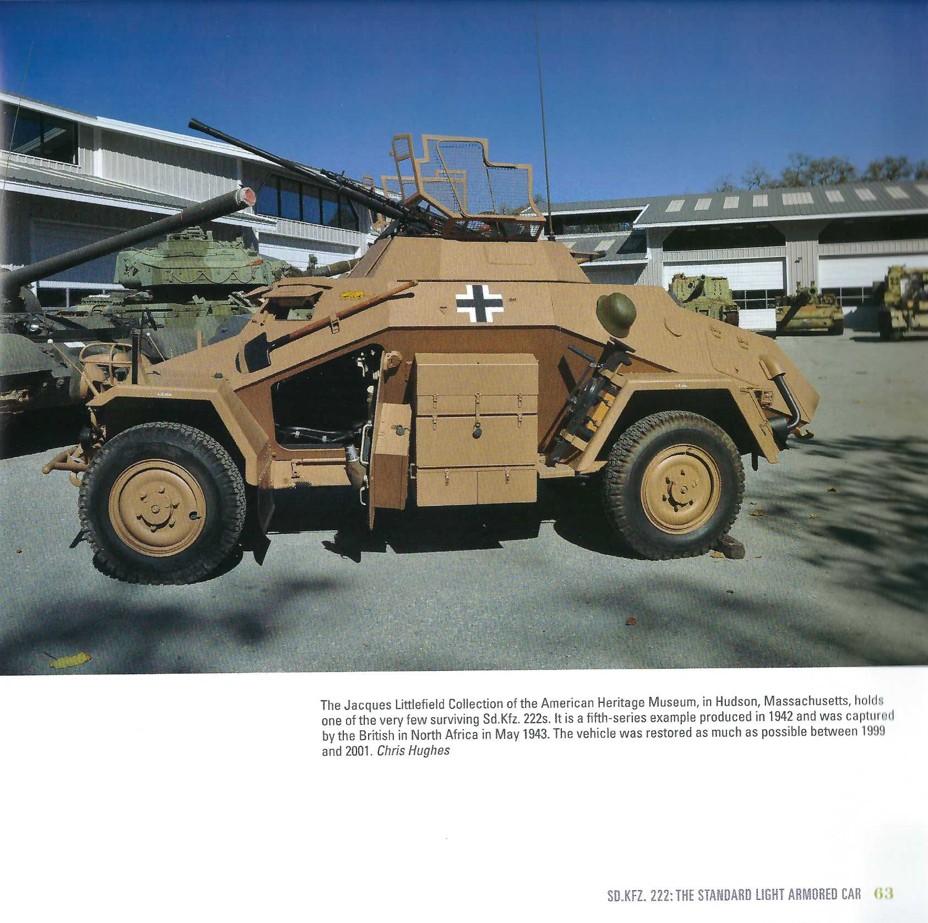
Chapter 2 introduces the Sd.Kfz. 222 that carried different armament than the Sd.Kfz. 221 along with an additional crew member. Production was 990 manufactured beginning in 1941. Standard armament was the 2cm KwK 30 L/55 autocannon and a MG 13 machine gun. Later the MG 13 was replaced with the MG 34 and the KwK 30 with the KwK 38 autocannon. Both are depicted on Page 40 with both elevated into the air. Notable are the canvas covers on the anti-grenade screens. The driver can be seen peering out of the open left-front armored visor. One of the few surviving Sd.Kfz. 222s is detailed in the 19-page color walk-around section, led off with a side view on Page 63. Based in the Collings Foundation’s American Heritage Museum in Hudson, Massachusetts, this is a Series 5 Sd.Kfz. 222 Ausf. B. She was captured in May 1943 in North Africa and was restored between 1999 and 2001. The family of Jacques M. Littlefield donated the Sd.Kfz. 222 to the museum in 2013. Part of a 240-plus military vehicle collection, 120 of which were auctioned off to build the American Heritage Museum.
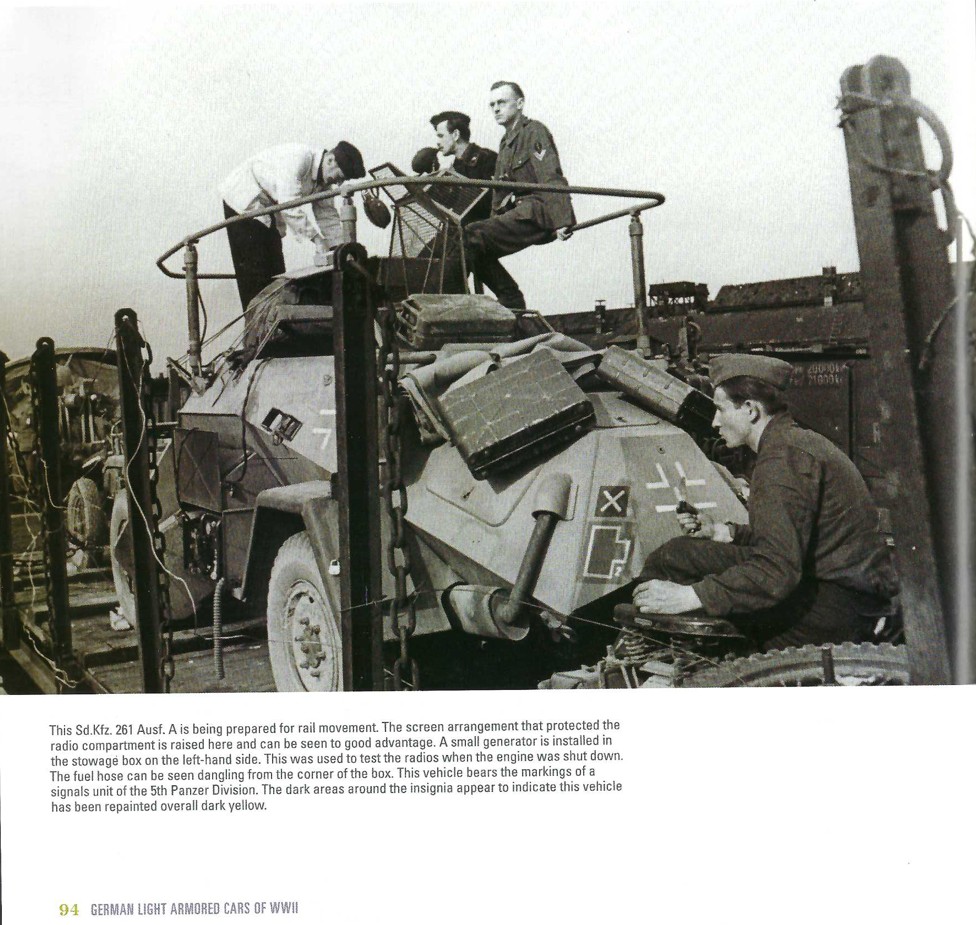
Chapter 4 discusses the Sd.Kfz. 260 and 261 that were built on the same chassis as the Sd.Kfz. 221, 222, and 223. These vehicles carried no armament and were dedicated to communication only. A Sd.Kfz. 261 Ausf. A, similar to a Series 4 build, is seen on Page 94 as it is being loaded on to a railroad car. Soldiers can be seen resting on the large frame antenna. This antenna worked well but the enemy could easily identify it becoming a high-value target. Production was 215 units between April 1941 and March 1942. While the Sd.Kfz. 260 was focused on ground to air communication, the Sd.Kfz. 261 was specialized for long range communications. Notable is the small generator installed in the storage box where a fuel hose can also be spotted hanging. The Table of Contents includes:
- Acknowledgments
- Introduction
- Early Armored Cars: Kfz 13 and Kfz 14
- Chapter 1: Sd.Kfz. 221: The First Purpose-Built Light Armored Car [Page 010]
- Sd.Kfz. 221 Series Development and Variations
- Series 1 (1935 - 1937)
- Series 2 (April – November 1938)
- Series 3 (June 1939 – August 1940)
- Field Modifications (1940 – 1942)
- Field Use [Page 015]
- Sd.Kfz. 221 Series Development and Variations
- Chapter 2: Sd.Kfz. 222: The Standard Light Armored Car
- Series 1 (1935 – 1937)
- Series 2 (April – November 1938)
- Series 3 (June 1939 – January 1940)
- Series 4 (September 1940 – December 1941)
- Series 5 / Ausf. B (May 1942 – June 1943)
- Field Use [Page 040]
- American Heritage Museum Sd.Kfz. 222 Series 5 Walk Around [Page 063]
- Chapter 3: Sd.Kfz. 223: The Communication Variant
- Series 1 (1935 – 1937)
- Series 2
- Series 3 (June 1939 – September 1940)
- Series 4 (September 1940 – December 1941)
- Series 5 (July 1942 – February 1944)
- Chapter 4: Kleiner Panzerfunkwagen (Sd.Kfz. 260 and 261)
- Sd.Kfz. 260 Development
- Series 4 / Ausf. A (April – July 1941)
- Series 5 / Ausf. B (April 1942 – April 1943)
- Sd.Kfz. 261 Development
- Series 4 / Ausf. A (April 1941 – March 1942)
- Series 5 / Ausf. B (April 1942 – April 1943)
- Operational Use and Field Modifications [Page 094]
- Sd.Kfz. 260 Development
- Comparison of German WWII Light Armored Cars (Sd.Kfz. 221 – 261 Series) [Table]
- Chapter 5: S gl gep Personenkraftwagen (Sd.Kfz. 247)
- Sd.Kfz. 247 (Sechsrad / Six-Wheeled), 1937 – 1938
- Sd.Kfz, 247 (Vierrad / Four-Wheeled) 1941 – 1942
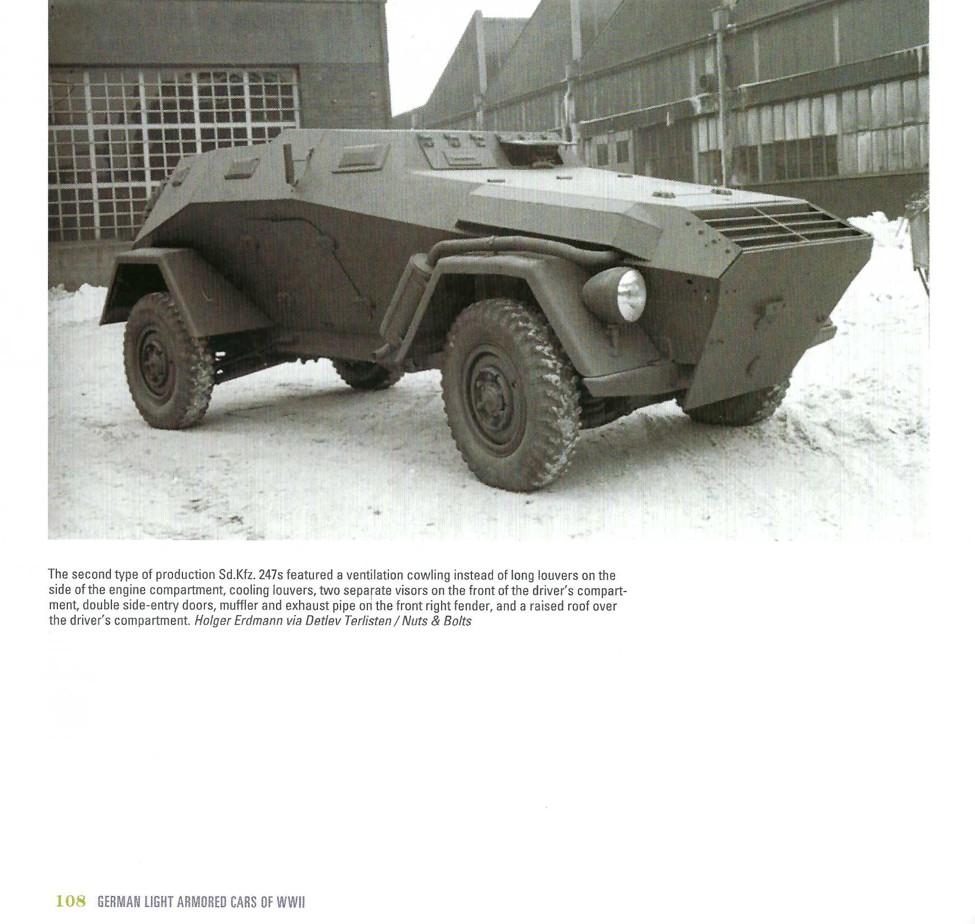
- Field Service and Modifications [Page 108]
- Sd.Kfz. 247 Series Comparison [Table]
Model wise, the Sd.Kfz 221 / 222 / 223 / 247 / 260 / 261 series of armored cars has been well served in 1/72 and 1/35-scale kits. Bronco released a new tool kit in 2008 and has followed with Chinese Army and German releases with new parts. HobbyBoss delivered a new tool kit in 2014, also with subsequent releases with new parts to cover variants. Tamiya’s new tool Sd.Kfz. 222 was released in 1975 but was re-released in 2007 with aluminum gun barrels and photo-etched parts [Anti-Grenade Screens]. First to Fight released a new tool kit in 1/72 in 2017. ICM released a 1/48 Sd.Kfz. 222 in 2007 that was re-released by Tamiya in 2008. ICM released a 1/48 Sd.Kfz. 223, Sd.Kfz. 260, and Sd.Kfz. 261 in 2017 with new parts in 2017. All are well served with after-market parts and decals.
This is a great hardbound book and is well worth the money at the MSRP of $19.99. I had no problem plowing through it in one evening. Primarily a photo essay, David Doyle provides plenty of detailed photographs with detailed captions. This is an excellent reference book for historians and modelers, especially with the 19-page color walk-around. I will be looking for more monographs in this affordable Legend of Warfare series of books from Schiffer.
My thanks to David Doyle Books, Schiffer Publishing, and IPMS/USA for the chance to review this great book.
Highly recommended!
Reviewer Bio
Frank Landrus

Frank retired from the Ophthalmic industry with over thirty-six years of Research and Development experience. Frank's first model kit was a 1959 Hawk 1/72 US Marines Vought AU-1 Corsair and has been building models for over sixty years. Frank's first encounter with IPMS was attending a North Central Texas ScaleFest show in 1984. Frank soon became more involved in Make-N-Take activities and became the IPMS Western Coordinator for Make-N-Takes [West of the Mississippi River]. Make-N-Takes quickly became a local model contest and airshow staple reaching a high of reaching over 1,300 children before the COVID shutdown. Frank has volunteered to assist in contest judging since 1985 and is currently the Nationals Head Figure Judge until he is dead or they find someone better.
Comments
Add new comment
This site is protected by reCAPTCHA and the Google Privacy Policy and Terms of Service apply.
Similar Reviews