
Brewster Body Shield - US Infantry
Modern soldiers today most likely wear body armor in combat to protect against bullets. That was not always the case as body armor designed to stop rounds really came about in the early 2000s. Prior to that flak jackets, designed to protect US airmen against shrapnel and explosives from German “flak” rounds, and evolved to protect US ground troops in Korea through the 1990s. Body armor hails back to antiquity and knights were the penultimate examples.
In 1917, Dr. Guy Otis Brewster from Dover, New Jersey developed the Brewster Body Shield (or Brewster Body Armor) developed for the United States Army to survive on the meatgrinder of WWI trench warfare. Looking more like the Australian bushranger Ned Kelly and his gang in their bullet-proof suits of armor, the Brewster Body Shield was a huge step forward in protecting soft parts being penetrated by metal traveling at high velocities. From ICM’s webpage which also has online instructions.
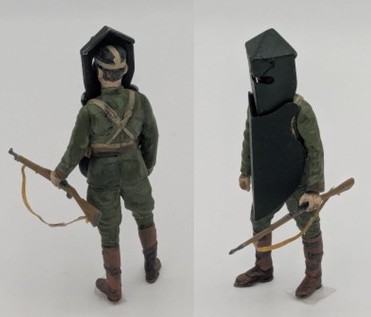
In 1917, Guy Otis Brewster, an American gunsmith from New Jersey, created a set of wearable armor to protect soldiers from small arms fire, which went down in history under the name “Brewster Armor”. This kit included a large shield-shaped body plate and a heavy helmet. The armor plate for the body was fastened with shoulder buckles, and it also had some kind of damper cushioning. The helmet was equipped with adjustable eye shields. The thickness of the armor was 5.5 mm (0.21 inches), and, according to Brewster’s idea, it was supposed to reliably protect the soldier from the effects of small arms.
In April 1917, this unusual protection was tested, and the inventor himself tested it on himself. Initially, the armor was struck with a sledgehammer, and then Brewster stood in front of the machine gun, and several bullets were fired at him. The tests were successful, and Brewster himself stated that the impact of machine gun fire is only a tenth of the shock that he experienced when hit with a sledgehammer.
Despite this, Brewster’s Armor had a significant drawback – it was heavy and severely fettered the soldiers in their movements. Perhaps that is why history has not recorded cases of the massive use of this armor protection on the battlefields.
The Brewster Body Shield was also clumsy and weighed in at 40lb. Anything more than being stationary (guard or sentry duty) would require great strength and flexibility, especially when maneuvering. The design was such that accessing gear under the armor would require incredible strength and dexterity. Regardless, it looks impressive and will make people stop when observing something this unusual.
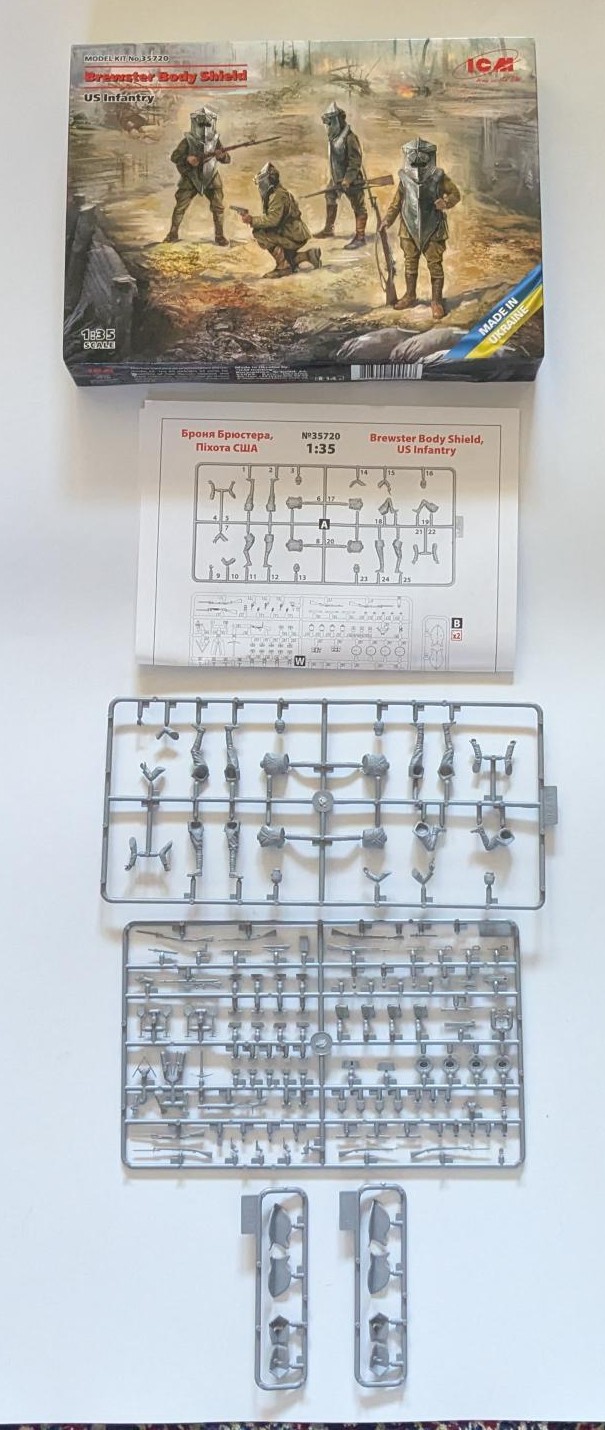
This fantastic ICM kit begs to be opened upon arrival. Upon opening the colorful lid and cover of the typical sturdy ICM box, there is a reinforced white inner box that does a good job of protecting the four sprues, instructions, and an advertisement folder for ICM acrylic paints.
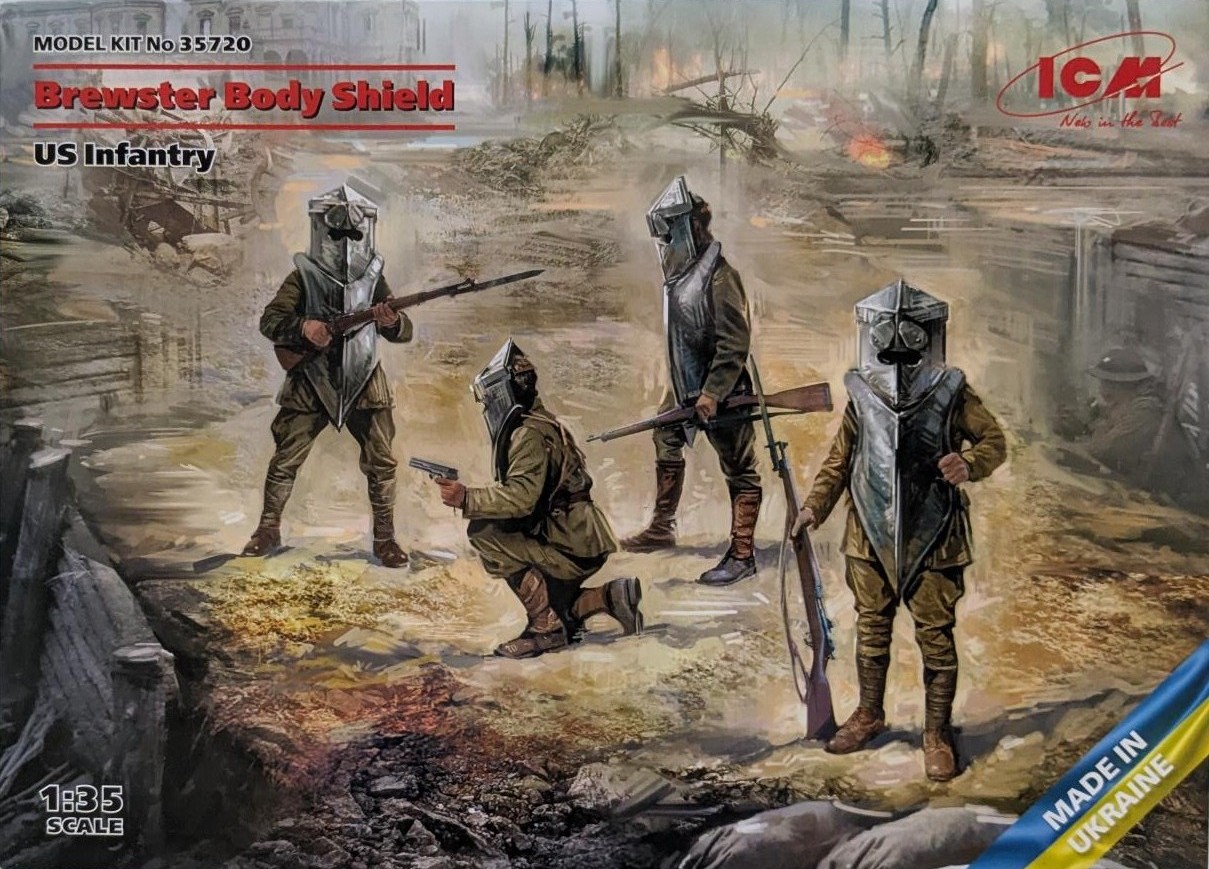
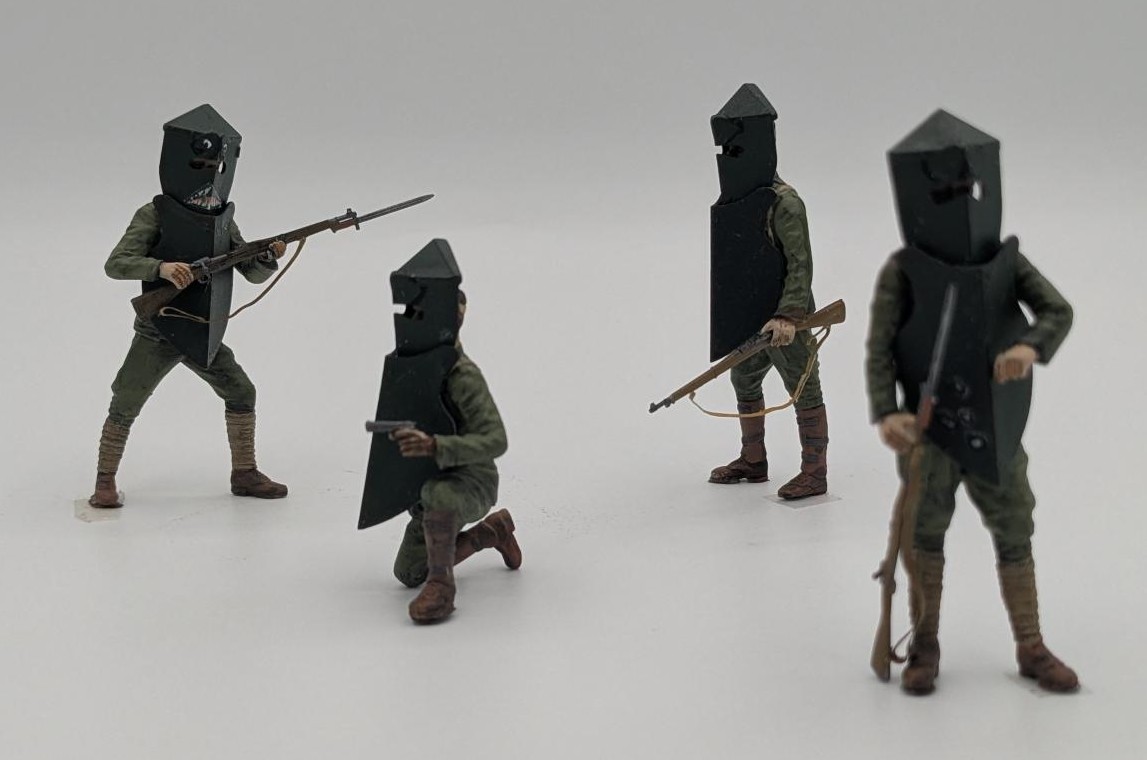
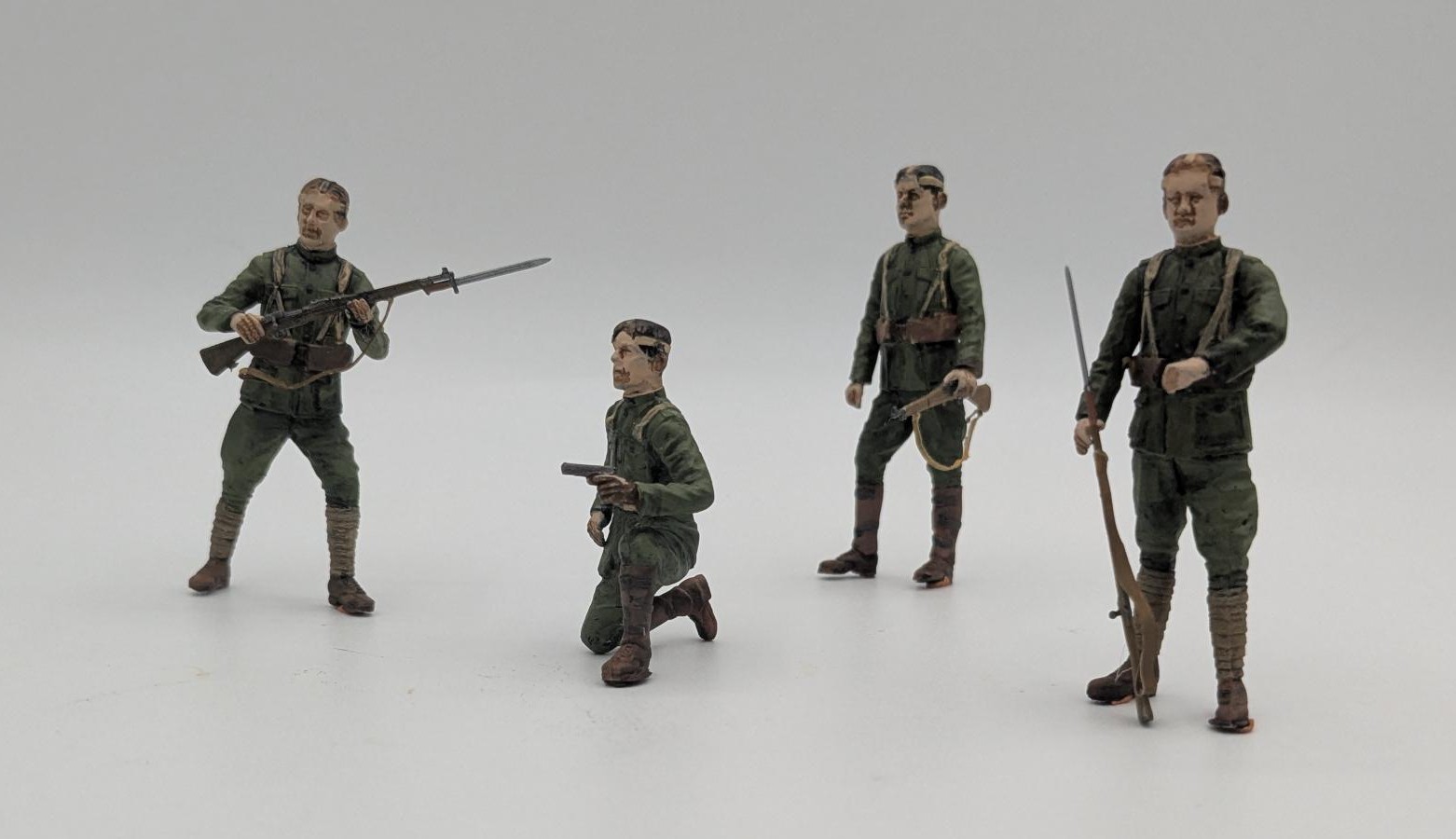
There are four US Army WWI figures in Brewster Body Shields:
- Soldier standing guard with a M1903 Springfield rifle at modified at ease
- Soldier kneeling with a drawn M1911 pistol
- Soldier standing/walking with right leg forward with M1903 Springfield rifle
- Soldier with M1903 Springfield rifle at port arms
All the Soldiers are wearing Brewster Body Shields composing of face shield and chest plate. ICM was considerate to include the four figures on one sprue, and two smaller sprues containing the Brewster Body Shields as Sprue 35720. Another sprue marked 35688 is from their WWI US Infantry Weapon and Equipment set and consists of the following (worth the price alone for unique WWI figures and the weapons sprue):
- ammo pouches
- revolver ammo pouch
- three section 30-06 ammo pouches
- two section 30-06 ammo pouches
- Babbit rifle grenade
- Bausch & Lomb binoculars and carry case
- M1917 Brodie helmets
- canteens
- Chauchat Modele 1915 CSRG 30-06 version light machine gun
- Colt M1917 revolver
- gas masks and respirators in carry case
- Lewis Mk.I light machine gun
- M1903 Springfield
- M1903 Springfield with M1905 bayonet
- M1903 Springfield with rifle grenade projector
- M1905 Bayonet
- M1905 bayonet and scabbard
- M1911 Colt pistol
- M1911 Colt in holster
- M1911 Colt pouch
- M1918 Browning Automatic Rifle
- Browning M1918 MG Pouch (L and R)
- Mk.1 grenade
- trench periscope (steel)
- trench periscope (wood)
- trench periscope (wood) in carry case
- Smith & Wesson M1917 revolver
- Smith & Wesson M1917 in scabbard (L and R)
- M1917 knuckle duster trench knife in scabbard
- trenching tools
- axe
- axe in case
- pick axe
- pick axe (with dismounted head in carry case)
- shovel
- shovel in case
- Winchester M1897 TG (Trench Gun – shotgun)
- Winchester M1897 TG with M1917 bayonet
The figures build up quickly and easily with only a little filler. Be sure to dry fit the arms with the chest armor in place before committing to glue, otherwise the arms may not fit afterward. There is only item not mentioned in the instruction, and that is the M1903 Springfields (Parts No. W1 (with bayonet) and W9 (without bayonet)) need to have the separate bolt (Part No. W12) attached. This is mentioned in the separate instructions for the aforementioned WWI US Infantry Weapon and Equipment Kit No, 35688. The best part about the inclusion of this set is that your doughboys can be outfitted in a plethora weaponry, but again, remember to test fit as very little will fit under the armor, including helmets, and anything strapped to their backs would be impossible to access by that soldier.
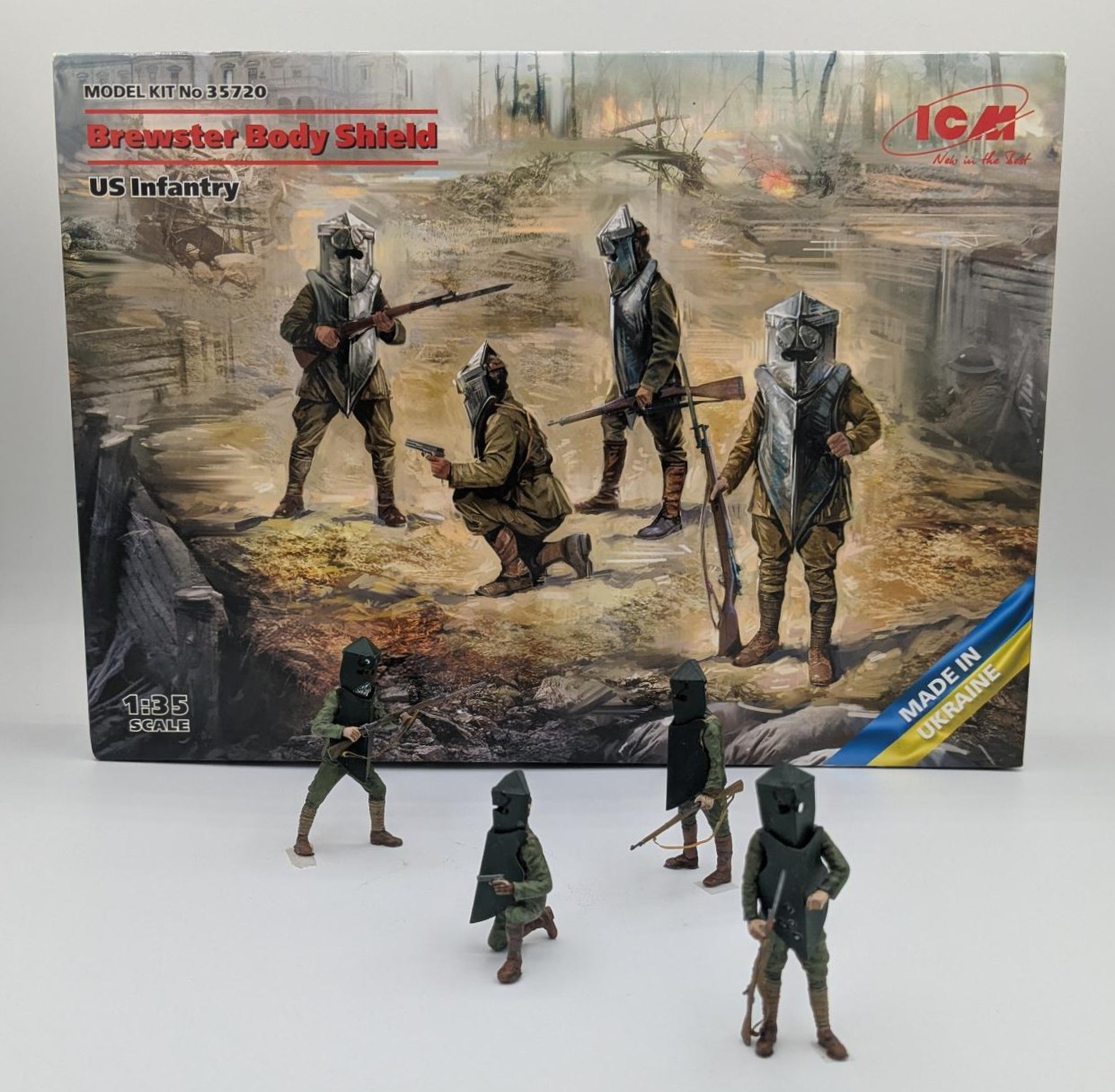
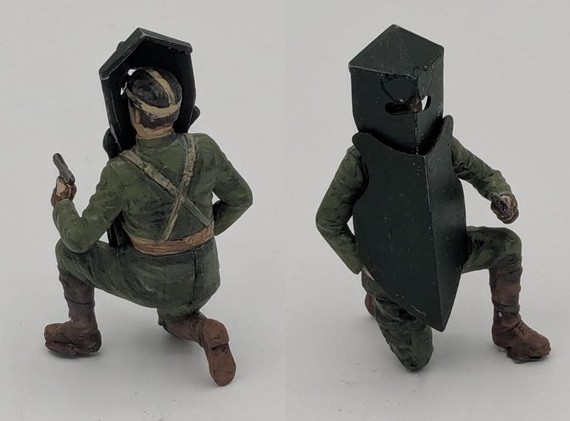
the figures straight out of the box and painted them as displayed on the box art. Three things of mention. First, the box art shows that the Brewster Body Shield chrome nickel steel to be painted in natural steel. While this sounds logical, a quick search revealed the armor was painted olive drab. Second, I painted one of the Brewster Body Shield’s face mask with a shark mouth as found in an old photograph. Finally, one historical photograph showed the armor with at least five bullet impact points, which I attempted to replicate for visual impact.
These figures look the part and can easily be put together with a vehicle, vignette, or diorama for a what-if of the Great War. Regardless, finding WWI figures, particularly American is hard, this fills a somewhat niche role. Also, with a little plastic surgery (cutting the top of the head, scraping off some of the armor attachment points, etc), you have very easily added four more figures to the WWI collection available to modelers, particularly with the generously apportioned included weapons set.
I had a lot of fun building this gem from ICM and they really stand out once completed.
Slava Ukraini!
Profuse thanks to ICM and IPMS/USA for providing the review sample.
Comments
Add new comment
This site is protected by reCAPTCHA and the Google Privacy Policy and Terms of Service apply.
Similar Reviews