
The Battle of Cuito Cuanavale: Cold War Angolan Finale, 1987-1988
The late Dr Leopold Scholtz was a senior journalist, political commentator and a highly regarded military expert. He was deputy editor of Die Burger until 2007 and was the European correspondent for Media24's Afrikaans dailies. Scholtz obtained his doctor's degree from the University of Leiden and was a research fellow at the University of Stellenbosch. He wrote several books and over 40 academic articles, most of which are about military history. He was a captain in the Reserve Force of the South African Army. His books include "The SADF in the Border War 1966-1989" [2013], "General Christiaan de Wet as Veldheer" [1978] and "Terror and liberation: The ANC/SACP, Communism and Violence (1961–1990)" [2022]. Scholtz died of leukemia in 2022 in Delft, the Netherlands, and is survived by his wife Ingrid, also a historian.
Helion’s latest volume in the Africa @ War series is a square back soft cover that includes 72 glossy paper pages [excluding covers] in their standard portrait A4 [8.25” x 11.75”] format. This release revises the original release of 64 pages from October 2, 2016, where it was 10th in the Africa @ War series. This revised edition is the 48th in this series and was released in Britain on February 15, 2020, and in the United States on February 10, 2020. I counted 11 black and white photographs and 85 color pictures. There are ten black and white maps and one color map. David Bocquelet provides fourteen color armor side profiles and Tom Cooper chimes in with seven color aircraft side profiles.
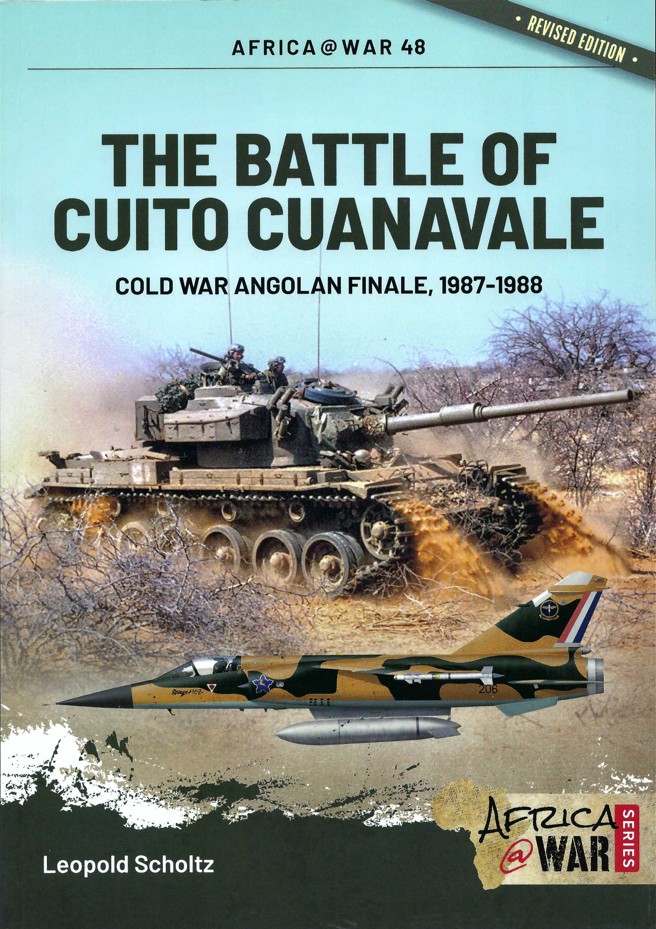
The front cover’s color photo is of a South African Defense Force [SADF] Olifant Mk. I tank moving towards the enemy. Due to the UN arms embargo, these were South African overhauled and heavily modified British Centurian Mk. V main battle tanks with some Israeli guidance. A Rolls Royce Meteor 4B petrol V12 engine was installed along with a Ordnance AF 20 pounder 84 mm gun. SADF Olifant Mk Is were upgraded starting in 1983 to the Olifant Mk IA standard with American Teledyne Continental turbo-charged V12 diesel engines and transmissions adopted from the M60 Patton. They were fitted with a 105mm L7 rifled gun. Combat experience in the dense bush of Angola led to the side skirts being removed. The Tom Cooper color profile depicts a Dassault Mirage F.1CZ, at the time, the primary interceptor for the SADF. This aircraft was operated by No. 3 Squadron and piloted by Captain Andrew Piercy. An engagement on September 27, 1987, six Mirages were attacked head on by Cuban MiG-23s. One of the radar guided missiles exploded near Captain Piercy’s F.1CZ, rupturing his hydraulic lines. He was able to land his damaged Mirage, but on overshooting the runway [no brakes], his ejection seat activated with the result that Captain Piercy broke his back [C6. C7 facture] on landing. His Mirage would be repaired and returned to service, but he would live on as a paraplegic.
This Revised volume of The Battle of Cuito Cuanavale from Leopold Scholz begins with the start of the Border War in August 1966 that culminates with the final battles of March 1988. This war was basically between Castro’s Cuba and their proxies, the People’s Armed Forces for the Liberation of Angola [FAPLA] and South Africa and their proxy, the National Union for the Total Independence of Angola [UNITA]. The Soviet Union was also a player providing support to FAPLA in the form of new military hardware and advisers attached to each FAPLA unit. Both sides claimed victory which is still debated today. The end result was negotiations mediated by the United States with the result of withdrawing Cuban and South African forces from Angola and Namibia by 1991.
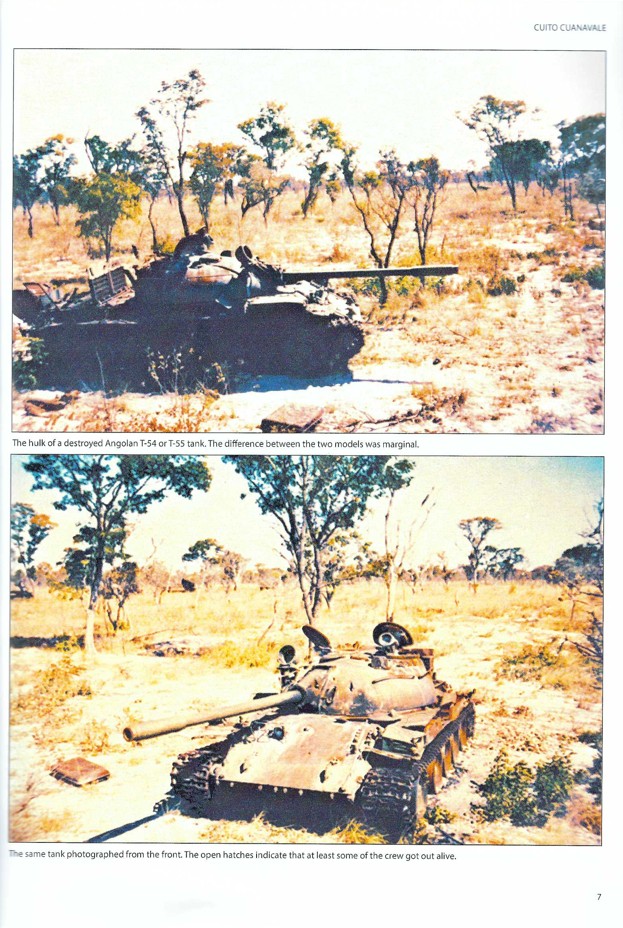
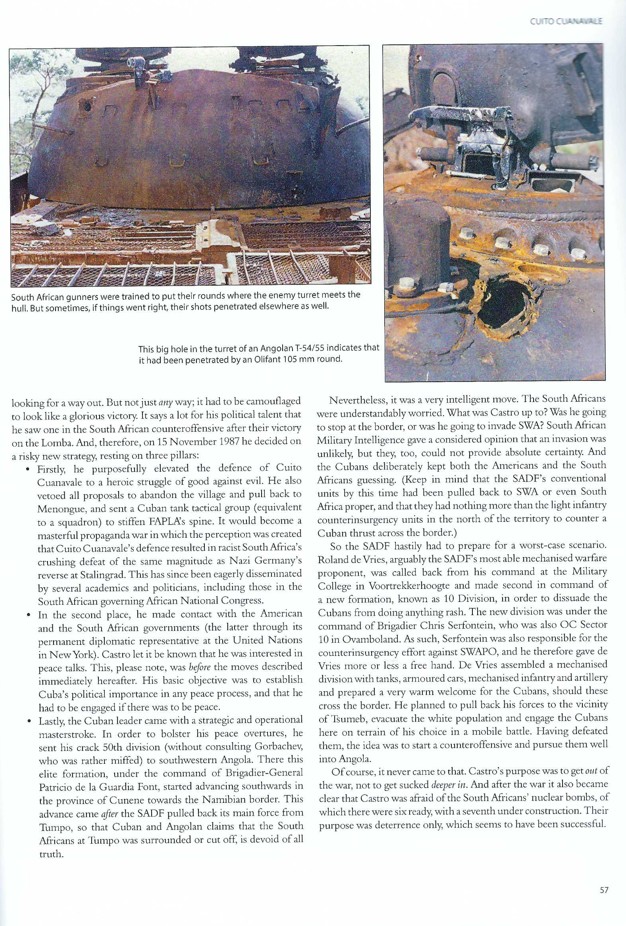
A Soviet T-54 hulk is shown in the two-color photographs on Page 07. The T-54/-55 series of medium tanks are the most-produced tank in history with a production run exceeding 100,000 units. The T-54 and T-55 are difficult to distinguish externally as both were continually updated, generally every 7,000 km. One visual difference is that the T-55 did not have the small mushroom shaped air vent between the two hatches on the turret. Some countries even added fake equipment to lead an opponent into thinking it was the latest variant. Another burnt T54/55 is shown on Page 57, the victim of an Olifant 105mm round.
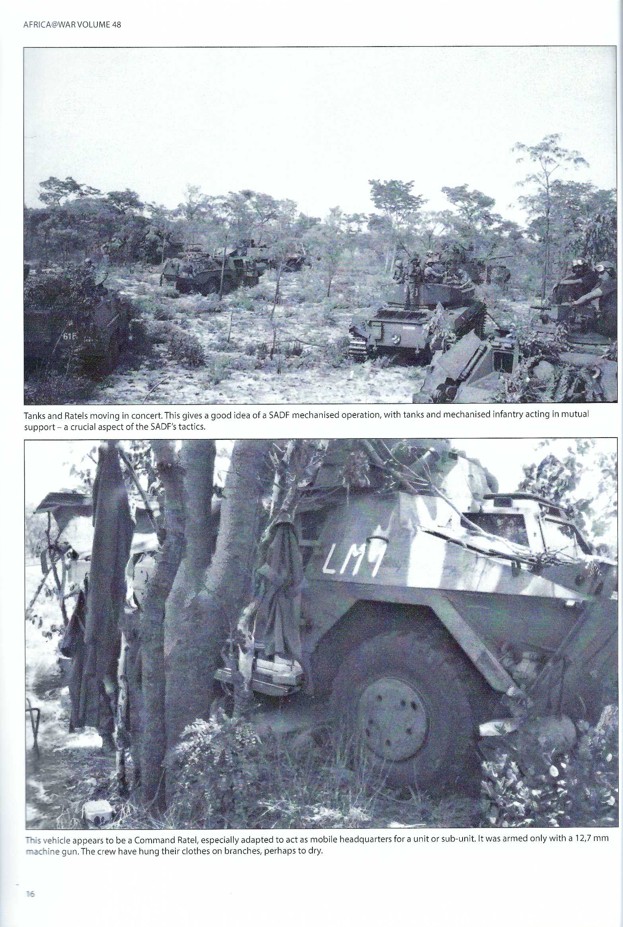
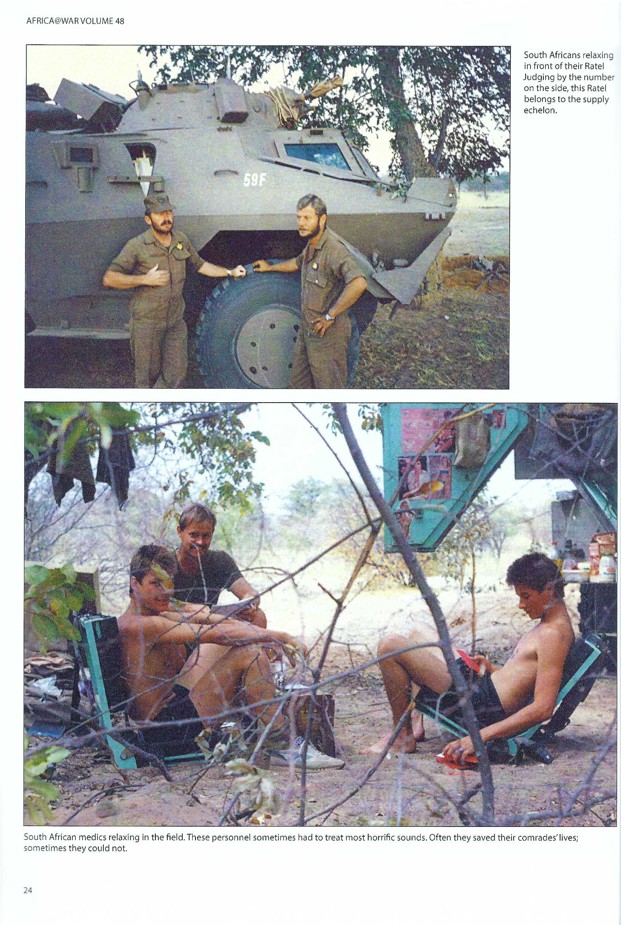
The two black and white photographs gives the reader an idea of the environment both sides were operating in. The top photograph shows off the Olifant tanks and the Ratel Infantry Fighting Vehicles [IFV] that were utilized by the SADF. The lower picture shows a parked Command Ratel where the crew had hung their clothes on the tree branches. The Ratel saw its beginnings in the UK’s refusal to supply South Africa any longer, forcing South Africa to turn to France and West Germany. Sandock-Austral would build a new factory in Boksburg specifically for armored vehicle production in a newfound cooperation between West Germany and South Africa. Additional production was delivered by the South African company, Land Systems OMC, a division of Denel SOC Ltd. There were at least eleven major variants of the Ratel and it would serve in 13 countries, primarily in Africa and the Middle East. The Ratel Command IFV featured a two-man 0.50 BMG turret. The Ratel Command crew would normally consist of nine men: a commander, driver turret gunner, and an infantry section. More Ratels are displayed on Page 24 with two color photographs. The top picture depicts a Ratel serving with the supply echelon while the lower picture shows three SADF medics relaxing. Note the pictures adorning the interior of a Ratel door.
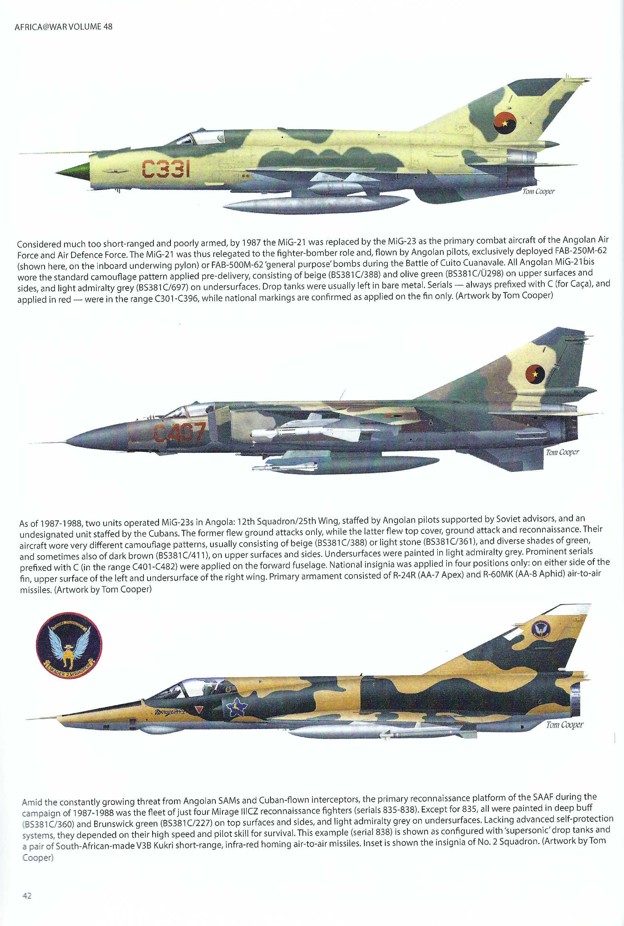
Three color side profiles by Tom Cooper can be found on Page 42. The top side profile is the Mikoyan-Gurevich MiG-21bis, in standard Angolan Air Force camouflage. Primarily flown as a fighter bomber by Angola, they would typically carry FAB-250M-62 or FAB-500M-62 general purpose bombs. National marking roundels were only applied to the vertical tailfin. Angola still operates the MiG-21bis, along with MiG-21M, MiG-21F-13, and MiG-21U fighters as part of the 25th Fighter Aviation Regiment, 11th Fighter Squadron, based at Joaquim Kapango Airport [formerly Kuito Airport].
The side profile in the middle is a third-generation supersonic Mikoyan-Gurevich MiG-23ML [Flogger-G]. During the battle of Cuito Cuanavale, Angola normally armed this swing-wing fighter with air-to-air missiles, R-60MK (AA-8 Aphid) and the R-24R (AA-7 Apex). The R-60MK was a highly maneuverable short range, infrared homing missile while the R-24R was a Semi-Active Radar Homing (SARH) missile. The Angolan pilots were limited to ground attack missions while top-cover in the MiG-23ML was provided by Cuban pilots in an undesignated unit. Russian advisors wee key in supporting the Angola MiG-23ML operations. Angola still operates the MiG-23ML fighter as part of the 25th Fighter Aviation Regiment, 12th Fighter Squadron, based at Joaquim Kapango Airport [formerly Kuito Airport].
The bottom side profile is one of four SAAF Dassault Mirage F.1CZ reconnaissance fighters, here s/n 838. Here she is carrying South African Amscor and Kentron manufactured V3B Kukri short range infra-red homing air-to-air missiles and supersonic drop tanks. It was a bit ahead of its contemporaries with its helmet mounted sighting system. Based on the AIM-9B Sidewinder IA, it achieved no kills in its limited use. South Africa operated both the Mirage F.1AZ ground attack variant and the Mirage F.1CZ fighter variant with both being developed in coordination with Dassault. Both were retired by South Africa by 1997. There were studies to upgrade the Mirage F.1 with the MiG-29 Klimov RD-33 engine, but in the end, the SAAF decided to buy the Saab JAS 39C/D Gripen. The sections include:
- Preface
- Introduction
- Background
- The Early War
- Turn-Around
- South Africa Is Sucked In
- The Main Adversaries
- Into the Fray [Page 07]
- The SADF Reaction
- Thunderclap on the Lomba
- The Final Battle
- Counteroffensive
- SADF Replanning
- The SADF’s Operational Objective
- The ‘Chambinga Gallop’ [Page 16]
- Stormclouds Arise
- Reorganization
- The SADF Forges Ahead [Page 24]
- Into the Caudron
- Preparations
- Tumpo 1
- Tumpo 2
- Tumpo 3
- Color Illustrations [Page 42]
- End-Game
- Fidel Castro’s Strategy [Page 57]
- Clashes
- War in the Air
- Peace Talks
- So Who Won?
- The Adversaries Weighed
- The Role of the Objective
- Acknowledgements
- About the Author
It was a pleasure to read this book as I finished it over three evenings. I found several fascinating topics, several of which are summarized above. This book by Leopold Scholz, who was South African reservist, is presented from the South African perspective and includes several first-person accounts. The different strategies utilized by the SADF and Cuba’s Fidel Castro provide an interesting contrast. If you own one of the previous releases in the Africa @ War series, you know what you are getting. If this is your initial entry into this series, you will be quite pleased.
Helion is a UK-based company that produces books on many aspects of Military History from the Late Medieval period through to the present day. Helion was established in 1996 by University of Warwick graduate Duncan Rogers. Since then, they have published over 1,200 books, with 100 or more new titles coming out every year, for readers around the world. Casemate markets Helion books in the United States.
My thanks to Helion & Company, Casemate Publishing, and IPMS/USA for the chance to review this great book.
Highly recommended!
Reviewer Bio
Frank Landrus
Frank retired from the Ophthalmic industry with over thirty-six years of Research and Development experience. Frank's first model kit was a 1959 Hawk 1/72 US Marines Vought AU-1 Corsair and has been building models for over sixty years. Frank's first encounter with IPMS was attending a North Central Texas ScaleFest show in 1984. Frank soon became more involved in Make-N-Take activities and became the IPMS Western Coordinator for Make-N-Takes [West of the Mississippi River]. Make-N-Takes quickly became a local model contest and airshow staple reaching a high of reaching over 1,300 children before the COVID shutdown. Frank has volunteered to assist in contest judging since 1985 and is currently the Nationals Head Figure Judge until he is dead or they find someone better.
Comments
Add new comment
This site is protected by reCAPTCHA and the Google Privacy Policy and Terms of Service apply.
Similar Reviews