Scott retired from the commercial nuclear industry with over thirty years of experience in Maintenance, Engineering, and Training. Prior to that he served on two aircraft carriers during his time in the U.S. Navy. He has been building models for over 50 years with his first kit being purchased with money from his grandparents for his sixth birthday. With a stash that consists of more aircraft than anything else, Scott still enjoys building a little bit of everything (including but not limited to tanks, cars, show cars, military vehicles (aside from tanks), ships, figures, real space, and some science fiction), which keeps his stash growing. Scott and his wife Fern reside in southwest lower Michigan, not far from South Bend, Indiana, and have three adult children and currently three grandchildren as well as a small dog and a large cat.
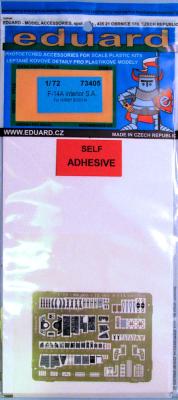
Recently, Eduard released photoetched detail sets for the 1/72 scale Hobby Boss F-14A, and these included both an interior as well as an exterior set. Having been fortunate enough to receive both sets for review, I will begin with my evaluation of the interior detail set. Upon opening this set, you will find two frets of photoetched parts, one being pre-painted and self-adhesive, the other being unpainted metal with no adhesive, along with a single-sheet page of directions. This was my first experience with an Eduard self-adhesive detail set, and I greatly enjoyed the encounter. I will mention here that if you are modeling on a budget and needed to choose between the interior and exterior sets, that I would recommend the interior set.
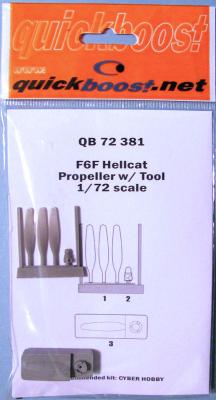
Attached to the front of the powerful Pratt & Whitney 2000 horsepower R-2800 that moved the Grumman F6F-3 Hellcat was a thirteen foot, one inch Hamilton Standard propeller. This new release from Quickboost provides a replacement for the kit-provided propeller, and is a nice upgrade for the Cyber Hobby kit. The detail set comes with a single runner with the four parts attached, as well as the tool used to set the proper pitch on the propeller blades. If you have some experience in working with resin, this will be an easy upgrade to put to use, and if you have little or no experience with resin, this could be a good item to start with.
Packaging for this set is simple with the three propeller blades and hub being attached to a single runner. Also included is the tool that is… more
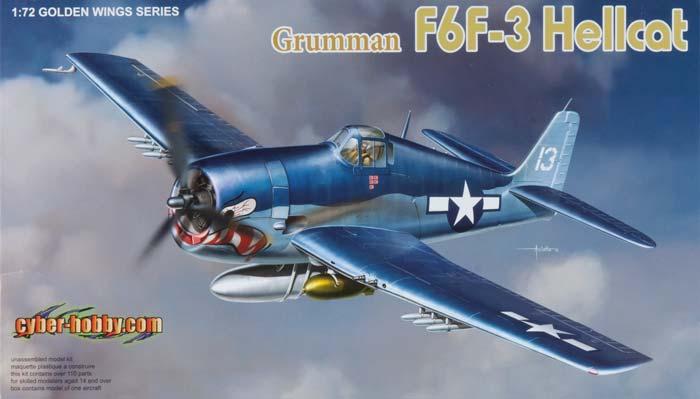
Cyber-Hobby has recently entered the model aircraft community, and their latest offering is that of a 1/72 scale F6F-3 Hellcat. The kit builds up reasonably well, with good fit for most of the parts, and options such as extended or retracted landing gear, open or closed canopy, and extended or retracted wings. Cyber-Hobby also does a nice job of including the markings for six different squadrons, and in the case of VF-27, there are markings for three different planes with the legendary “cat mouth” motif. The kit itself contains 124 light gray parts spread across seven sprues, as well as 5 clear parts on a single sprue and 4 photoetch pieces on a single fret. The directions are on eight pages (a single sheet of paper with three folds), and are printed in black and blue. The kit will… more
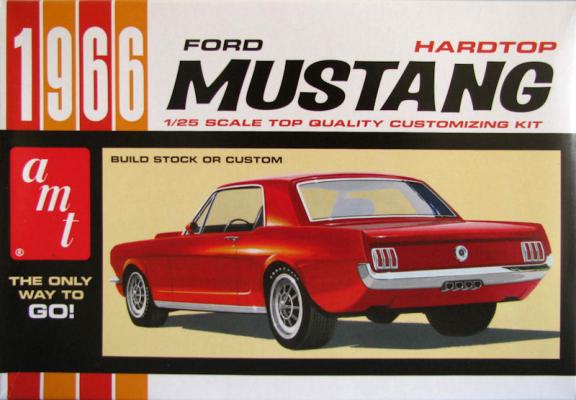
If you are interested in building some of the older kits that you may have missed when they were first introduced, you have a friend in Round 2 Models, who are re-releasing kits from the likes of AMT, MPC, and Polar Lights. One of the latest releases is this 1966 Ford Mustang Hardtop in a “Retro Deluxe Edition” that includes pad-printed tires, vintage kit packaging, and all new decal designs. The kit may be built as a stock, custom, or drag racing variant, with plenty of supplied kit parts to allow for customizing to the tastes of the builder. The built-up kit is a respectable looking 1966 Mustang hardtop with plenty of options; just keep in mind that being an older kit, there will be some fit issues to overcome.
The Ford Motor Company first rolled out the Mustang in April,… more
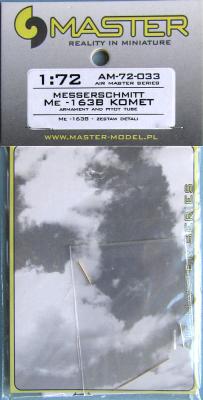
If you have read my review of the 1/48 scale detail set from Master Model for the Messerschmitt 163, this is going to seem eerily familiar, but as Halloween is approaching, eerie is not a bad thing. The topic for this review is a new set designed to upgrade your 1/72 scale Komet, and is the same as the company’s offering in 1/48. As with my review of that set, there is no recommended kit to use these new parts on, so I chose an Academy Me-163B/S release that was sitting in my stash. As with any of the other Master Model releases that I have come in contact with, these parts will greatly improve the look of your small-scale Komet.
I have held a long fascination with some of the late-war production aircraft that Germany put to use. This is mostly due to the engineering effort that… more
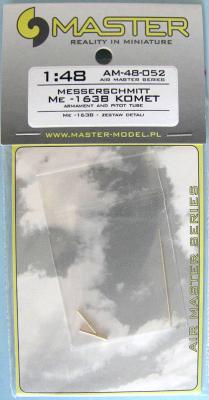
As a member of the IPMS/USA Review Corps, I have had the wonderful opportunity to review a few items now from the Polish company Master Model. The topic for this review is a new set designed to upgrade your 1/48 scale Komet. Unlike most of the sets that I have reviewed, there is no recommended kit to use these new parts on, so I chose a Dragon release that was sitting in my stash. As with any of the other releases that I have come in contact with, these parts will greatly improve the look of your Komet.
I have held a long fascination with some of the late-war production aircraft that Germany put to use. This is mostly due to the engineering effort that went into weapons like the Me-163 Komet, which was designed by Dr. Alexander Lippisch. The Komet, also known as the “floh” (flea… more
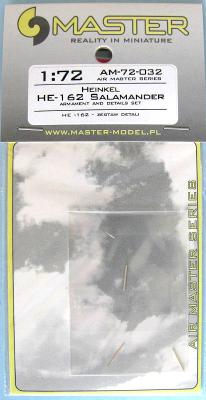
This is the seventh item that I have reviewed from Master Model, a Polish company that specializes in brass detail parts, typically in the form of gun barrels, antennas, and pitot tubes. This new 72nd scale release is designed for the Heinkel He-162 Salamander, and replaces the kit supplied forward pitot tube and gun barrels, and also provides a nose gear position indicator. No kit is mentioned for installing these parts onto, but for comparison purposes, I have put a Dragon release to use. As with the other releases from Master Model, these parts will dramatically improve the appearance of your plane, plus provide the nose gear indicator that I have not seen on kits in this scale.
The Heinkel He-162 Salamander, also known as the Volksjager (or people’s fighter) was a late war “… more
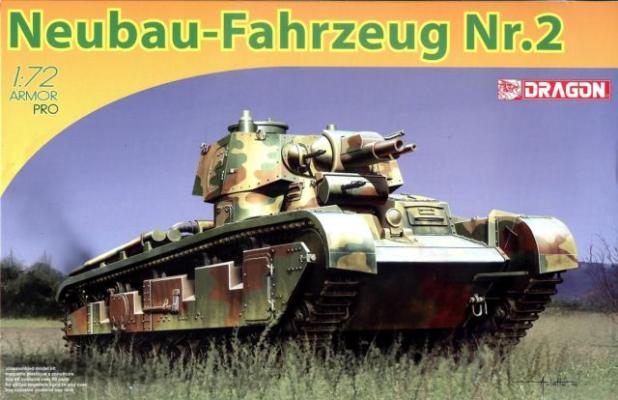
I will start this review by stating that the new Dragon release of the German Neubau-Fahrzeug is a well-engineered, fun to build kit that goes together nicely to produce a very realistic replica of the “new construction vehicle”. My assembly time was short as there were no fit issues, and I probably spent more time researching this vehicle than anything else, but more on that later. The slide mold technology being utilized by Dragon allows for the front idler wheels and road wheels to be single-piece items, but with an impressive amount of detail for this scale.
In researching the Neubau-Fahrzeug, I found a vast amount of information, most of it conflicting, which led to more research, which led to more conflicts…well, you get the idea. From what I can reasonably trust (I think… more
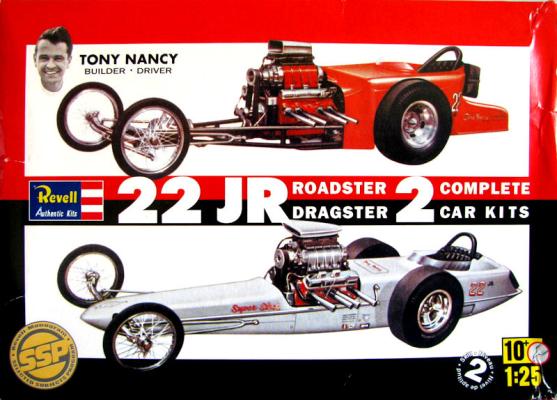
If, as a builder, you are interested in nostalgia, or are fascinated by early organized drag racing, then Revell has come through for you with the re-release of this classic Tony Nancy set of dragsters. First released in 1963, and with the date still showing up in the moldings, this kit represents the dragster and roadster that won the Competition Eliminator (the ’23 “T” Roadster) and Best Engineered Car (the Dragster) awards at the Winternationals in 1963. Tony Nancy, whose nickname was "The Loner" based on his ability to practically field a car by himself, set at least one record or Drag News 1320 mark in every class in which he competed, which encompassed cars such as a V/Fuel Dragster in 1957 through Top Fuel, where he held the national speed record at 236.22 in 1971. He was well… more
Published: Book Author(s): Colin D. Heaton and Anne-Marie Lewis (forewords by Jorg Czypionka and Barrett Tillman) Company: Zenith Press
Although I must admit that my all-time favorite aircraft will always be the Grumman F-14 Tomcat, right next to it in second place is the legendary Messerschmitt 262 Stormbird (also known as the Schwalbe {Swallow}). In my stash of unbuilt kits are several boxes containing various versions of the plane, and yes, there may a double or two present. I have seen and photographed the Me 262 that is kept at the Smithsonian Air and Space museum on more than one occasion, and have several books in my personal library on this legendary fighter. Anyway, I normally start my reviews talking about the history of the item I am assessing, but thought that I would instead talk about my interest in the topic before delving into the contents of this book.