

Pablo Bauleo
Reviews By Author
|
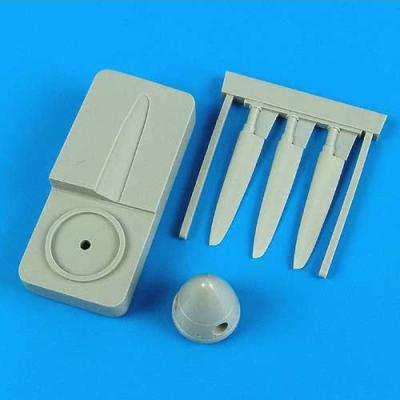
Hurricane Rotol Propeller (with Rotol and Spitfire spinner) and toolPublished:
QB 48446 (Rotol Spinner) and QB 48447 (Spitfire Spinner), each $6.50 The Italeri Hurricane is getting a lot of attention from the aftermarket manufactures. Quickboost has released two resin Rotol propellers for it. One of the sets has the typical Rotol spinner (more pointed); the other set has a Spitfire spinner (more blunt). I’ve read that during the Battle of Britain there were some Hurricanes fitted with Spitfire spinners. A nice feature of these aftermarket sets is the provision of a “tool” to ensure the proper pitch of all the propeller blades. After sanding off the back of the spinners, the tool provides you with a “seat” for the spinner, and then you only need to tack the propeller blade in place with a drop of superglue. A simple way to ensure perfect axial… more |
|
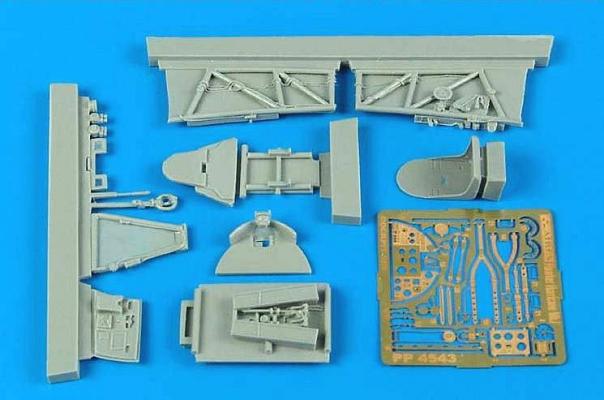
Hurricane Mk.I Cockpit SetPublished:
The Italeri Hurricane has been molded with the option of having both the escape door and canopy open, allowing a great view of the cockpit. The original cockpit is fine but there is always space for enhancement and Aires is offering a nice resin and photoetch cockpit detail set for it. Sadly, the review sample I got only had the Hurricane photoetch fret on it. The resin parts were for a different model, probably a “George,” as the cockpit layout and seat look a lot like a Japanese cockpit to me. As such, I cannot comment on the fit of the parts or any other assembly issue (I just did not have all the right parts!). Based on the parts breakdown, this detail set is intended to be a full replacement “drop-in” cockpit. Based on the picture from the Aires website,… more |
|
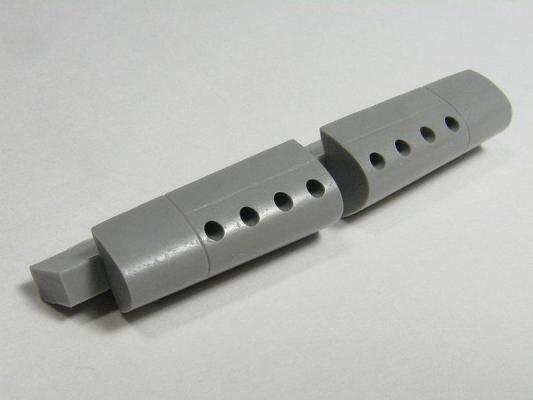
Hurricane Gun BarrelsPublished:
Quickboost has released several items to enhance the Italeri Hurricane. Among them are these “drop-in” replacement parts for the gun barrels. They are very nicely rendered in medium grey resin, with crisp panel lines and good depth for the barrels. During construction, however, I ran into problems. The replacement parts are a bit too wide to fit in their slots in the wings. Maybe the problem is due to my construction of the wings, but neither the starboard nor the port gun barrel would fit. I’ve measured the slots and the resin parts and maybe the problem is that both the replacement parts and the slots have the exact same width (20.0 mm, measured with a caliper). Perhaps the resin parts should have been a tad narrower to be able to fit in the slots? It could be… more |

|
The Falklands 1982, Ground Operations in the South AtlanticPublished:
This year is the 30th anniversary of the Falklands/Malvinas War or the South Atlantic conflict, as it has been known. As such, different plastic model kit sets and publications are been released and The Falklands 1982, Ground Operations in the South Atlantic is among them. The Falkland conflict included combat in the air, sea and ground. This book concentrates on the ground combat. It is impossible not to refer to the other arms in any conflict, but as the author clearly states a few times during the book, the content is devoted to the ground operations. The book covers the operations in a chronological order, starting with the events of South Georgia in March, 1982, before moving into the Falklands itself, with the Argentine landings in April, the British… more |
|
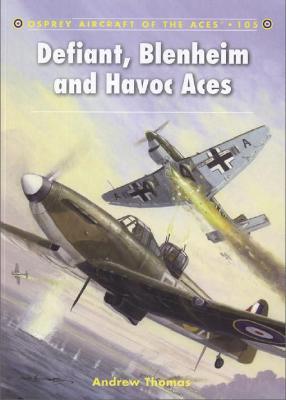
Defiant, Blenheim and Havoc AcesPublished:
This book from the series Aircraft of the Aces covers the exploits of Defiant, Blenheim, and Havocs in the RAF (with only one exception of the USAAF). It follows the chronological order of the type’s services in the RAF. First, the book covers the day fighter role of the Defiant over Dunkirk and the Battle of Britain, when it was quickly realized the airplane needed to be flying only against unescorted bombers and therefore converted to night fighter duties. Interestingly enough Defiants and Blenheims could hold their own their own against Bf-109s, but only if flown by well-trained pilots and if the whole flight would utilize proper tactics to coordinate protection for each other. During the winter of 1940-41, Defiants and Blenheims found their niche as night… more |

|
Wings of the MalvinasPublished:
This year is the 30th anniversary of the Falklands/Malvinas War, or the South Atlantic conflict, as it has been known. As such, different plastic model kit sets and publications are been released and “Wings of the Malvinas” is among them. This book covers the air operations from the Argentinean point of view. You can tell this book is a work of love from the author, Santiago Rivas, as the attention to detail is second to none. The book is divided into 3 parts: The first one covers the path towards the conflict, with a succinct but well detailed description of the long-lasting dispute between the United Kingdom and Argentina over the islands and the events on March, 1982, in South Georgia, which precipitated the war. The main part of the book is devoted to the… more |
|
Soviet Draisine "Krasnaja Zvezda"Published:
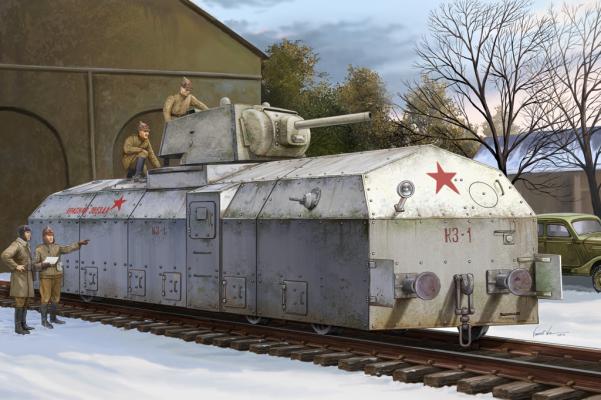
Hobbyboss has produced a model of an unusual subject: a Soviet armored draisine (a draisine is a light self-motorized train vehicle). I must confess that I have never heard of this vehicle before, nor it is easy to find references online. The box comes with 41 parts in a sturdy box. All sprues are molded in light tan and bagged independently, to prevent scuffing and scratches during transportation. There is no flash on the parts and the connector gates are small. Construction of this kit is straightforward, with good engineering and excellent fit. Something to be noted is that the bogies could be easily replaced by HO scale ones, if anyone would like to convert it and add it to their HO layout. While on the same topic, the bogies are wider than the standard gauge. They… more |
|
GAZ-MM Model 1941 1.5 Ton Cargo TruckPublished:
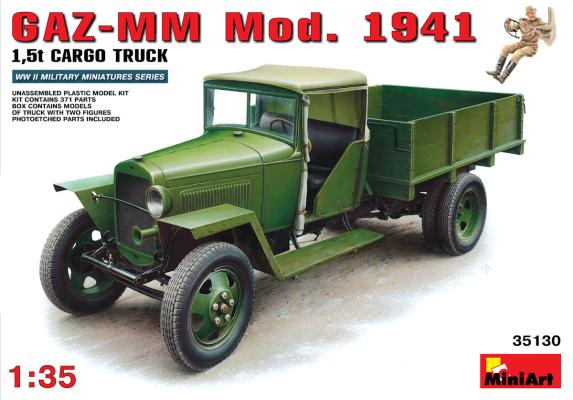
MiniArt has released a model of the 1941 GAZ-MM. These trucks are very similar to the Ford A and they were widely used in World War 2 by the Soviet Army. This model is not a limited run release. There was no flash at all, and the connector gates are small. There are few locating pins and the plastic is a bit soft, so be careful when removing parts from the sprues. I know that by experience, as I managed to damage and/or bend some very small parts when releasing them from the sprues. You get 14 sprues, including a small photo-etch fret for a total of 371 parts. There is a very small decal sheet, which only applies to one of the three finishing options. Instructions covers 35 steps, not counting sub-assemblies required within several steps. The instructions are a bit vague… more |

|
Voices of the BulgePublished:
Authors Michael Collins and Martin King have written a well researched and historical account of the German attack in the Ardennes in December, 1944. What makes this book special is that it covers the human (but not necessarily humane) aspects of the battle. The book is a day-by-day narration of the main military actions that occurred during the Battle of the Bulge. Each chapter begins by describing the front situation and what different units were charged to do. So far, that is a ‘regular’ history book. But then the rest of each chapter has first person narratives from the soldiers (from both sides, but mainly American ones) and even support personnel like nurses, on how they managed to do what they were charged with. Most of the book covers the German thrust up to… more |

|
Into the Vally – The Valentine Tank and Derivatives 1938 - 1960Published:
Mushroom Model Publications keeps expanding its “Green Line” (dedicated to armored fighting vehicles) and its latest installment covers the Valentine family of tanks, from the design in the late 1930s through its operational use during WWII and other uses in post-war years, up to the 1960s. The main sections of the book includes the development of the tank, technical description, description of each mark of the family, operational use, painting and markings, overseas use (Canada, New Zealand, India, USSR, among others), variants, and a walk-around. I found the historical pictures to be very valuable from a modeling point of view, as they provide details on the markings of the tanks plus the environment in which they operated. The picture of the Malta Valentines (with… more |