

Luke R. Bucci, PhD
Reviews By Author
|
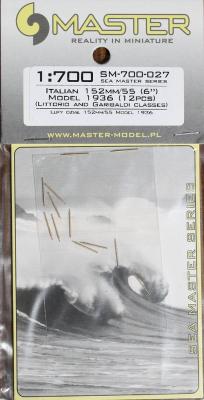
Italian 152mm/55 (6”) Model 1936 Gun BarrelsPublished:
Bottom Line: Perfect to-scale 6” (152mm) barrels for Littorio and Garibaldi WW2 Italian warship classes The latest secondary, or anti-torpedo boat, armament for new construction (Littorio battleship and Garibaldi light cruiser classes) was the 1936 model 152mm/55 caliber gun. This new gun was derived from the earlier 1926 and 1929 versions in use on then-current Regia Marina light cruisers. Two different versions were made – a monobloc construction by the original designer, Ansaldo, and heat-forced tubular element construction from OTO (used only in Vittorio Veneto and Roma battleships). Twin and triple turrets with independent cradles for each gun were made. Rate of fire was one round every 14 seconds. The guns were… more |
|
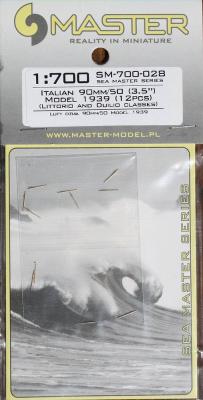
Italian 90mm/50 Model 1 AA Gun BarrelsPublished:
History In the mid-1930s, Italy began design studies for a new naval antiaircraft gun to replace the 100mm/40 mounts, which was too slow to elevate and track modern aircraft. After calibres from 6-127 mm were evaluated, Regia Marina opted for a compromise between firepower, rate of fire, and system weight. Ansaldo did the initial design work and developed the 90mm/50 Ansaldo 1938, OTO 1939 model heavy antiaircraft gun and stabilized mount. Performance was similar to the famed German 88mm, and these guns remained in service for many years after WW2. These guns were installed in the Littori class battleships and the reconstructed battleships Andrea Dorea and Duilio. Plans for fitting out other ships were never carried out. Although the… more |
|
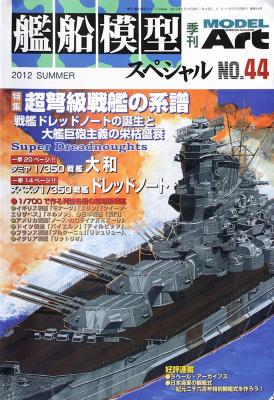
Model Art Modeling Magazine, #44, Summer 2012Published:
Model Art No. 44 is devoted to Super Dreadnoughts – battleships from the beginning (HMS Dreadnought in 1907) to the US Navy’s Iowa class (the last operational dreadnought). As usual, in this issue there is extensive historical information along with kit builds of examples. The magazine itself is A4 size – somewhat longer and less wide than standard US 8.5 x 11 inches. There is a centerfold with the full-sized cover art of the Yamato firing a full broadside and Tamiya’s 1/350 Yamato model. The coverage starts with a 14-page pictorial on Zvezda’s 1/350 HMS Dreadnought, the battleship that lended its name to describe the world’s most powerful weapon at that time. A beautiful kit, with pages of how to build the kit. Next up is the ultimate Super Dreadnought – Tamiya’s 1/350… more |
|
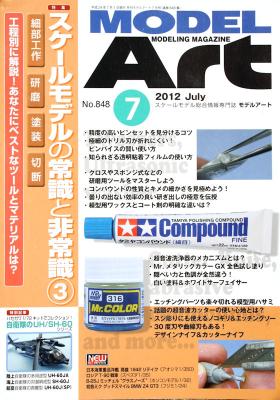
Model Art Modeling Magazine, #848, July 2012Published:
ModelArt No. 848 July 2012 monthly update features modeling tools and supplies. As always, the format is close to 7x10 inches in size, and the printing and reproduction quality are excellent. Model Art’s text is almost entirely in the Japanese language, and most feature photos are in color. The usual sections follow and are listed by their topic:
|
|
IJN Katata and Hozu, Chinese River GunboatsPublished:
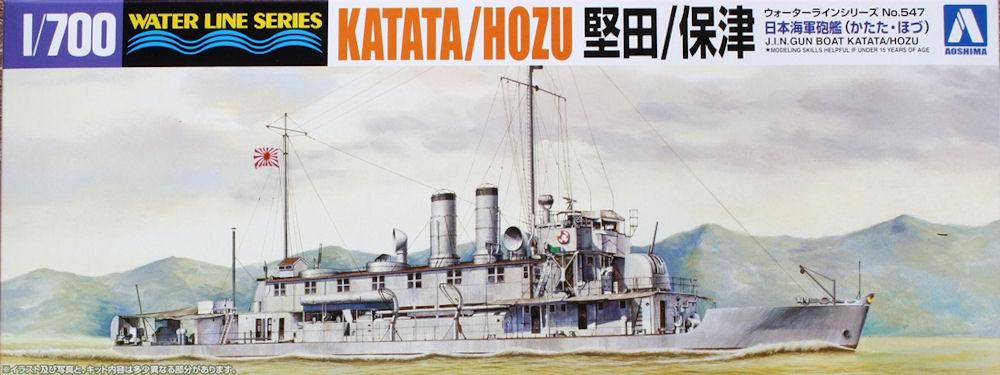
Bottom LineA nicely detailed kit of an obscure topic – WW2 Japanese Navy Chinese river gunboats. HistoryIJN Katata and Hozu were from the four-ship Seta class, assembled in China in 1923. They weighed 400 tons and were capable of 16 knots. During the 1920s and until the Sino-Japanese war, these ships practiced gunboat diplomacy on the major rivers and in ports in China. They participated in the China Incidents of 1937-1938. In 1940, their armament was upgraded to two single 3 inch guns and 13.2mm machine guns, later replaced by 25mm mounts. Main armament was mounted in shields fore and aft, and AA guns were in tubs on the roof and machine guns in windows. When WW2 started, they changed their livery from traditional gunboat white to… more |
|
Model Art Plamo Manual, #8, August 2012Published:
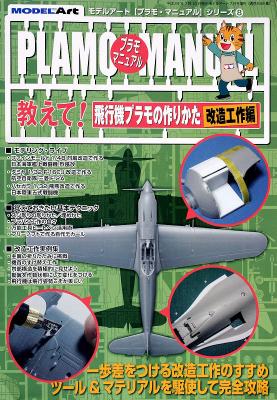
Plamo Manuals are How-To guides for building specific types of models from Model Art in Japan, a prolific publisher of high-quality periodicals on current modeling subjects. This issue (Plamo Manual No. 8) is devoted to converting aircraft models. The theme is to take a currently available aircraft kit and convert it to another version of the real-life aircraft for which no kit is available (or is out of production). For each conversion, pages of small color and B&W photos show how to make the changes needed to change a kit into something else. The text is almost entirely in Japanese, but the photos are self-explanatory. This issue of Plamo Manual also shows how to make certain structures from scratch. Thus, advanced modelers would enjoy this issue, and… more |
|
Model Art Modeling Magazine, #850, August 2012Published:
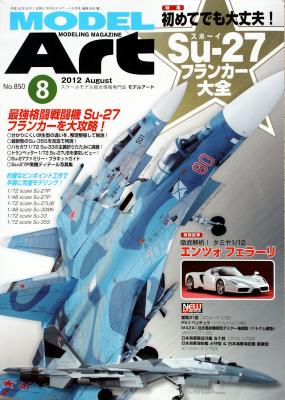
ModelArt No. 850 August 2012 monthly update features Russian Sukhoi jets – Building Model Kits of Sukhoi Su-27, Su-30, Su-35 and Su-37 Flanker. As always, the format is close to 7x10 inches in size, and the printing and reproduction quality are excellent. Model Art text is almost entirely in Japanese language, and most feature photos are in color. The usual sections follow and are listed by their topic:
|
|
WWII German Navy 1/700 Watertight Ship Windows PEPublished:
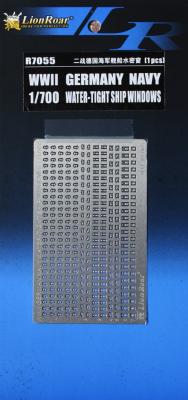
Bottom LineProvides seven types of round and square windows (not portholes) with covers for 1/700 WW2 German Navy warship models. 336 very small pieces. Lion Roar expands its 1/700 warship photoetch set lineup with German Navy (DKM) windows. These are not portholes, but are windows used on above-the-hull superstructures. A small instruction sheet only has pictures of each porthole showing proper orientation. There are no guides as to which windows go where on what ship – you are on your own to determine how to use them. What You GetFor a retail price of $11, you get a medium-sized fret of stainless steel with 336 separate windows. The fret is covered on both sides with a plastic peel-away film. For each window, its cover is attached in the open… more |
|
WWII German Navy Cable ReelsPublished:
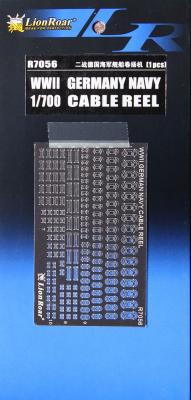
Bottom LineLion Roar expands its WW2 German Navy 1/700 warship photoetch set lineup with German Navy (DKM) cable reels. Caveat: these are the cable reels only – no cables/ropes are supplied – you will have empty reels after assembling that will need to be filled up (or not) with very fine thread or wire. For the advanced modeler only. This set replaces the older Lion Roar 70008 DKM IV Cable Reels set, which had fewer cable reels per fret. What You GetFor a retail price of $11, you get a medium-sized fret of stainless steel with five different sizes of cable reels, a grand total of 84 reels (16, 20, 22, 11, 15 in order of declining size). That is 13 cents per cable reel. You get the matching insides of the reels. The fret is covered on both sides with a plastic… more |
|
Model Art Modeling Magazine, #842, April 2012Published:
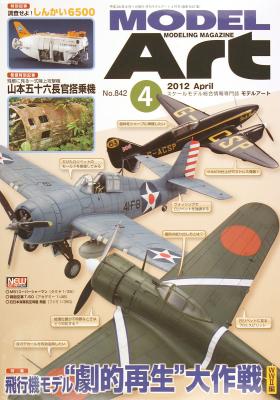
ModelArt No. 842, April, 2012, monthly update features how to update older kits of mostly 1/48 scale WW2 aircraft, as shown by front cover shots of three aircraft. As always, the format is close to 7x10 inches in size, and the printing and reproduction quality are excellent. Model Art text is entirely in Japanese, and most feature photos are in color. The usual sections follow and are listed by their topic:
|