

Chris Vandegrift
Reviews By Author

|
USS Midway Pt 2: Armament and AncillariesPublished:
IntroI was excited to see the upcoming launch of Trumpeter’s USS Midway and jumped at the chance to do this review. The DKM H-Class was a terrific ship to build - if the Midway is as good as that, or better, this will be an enjoyable build for sure. As I got into the build the 3 characteristics of Trumpeter’s ship kits that I think set them apart from others showed up right away: first sprue gate locations are strategically placed so that whenever possible they are on a surface not visible in profile thus requiring no sanding, second the PE is very forgiving with a distinct “snick” when cutting the PE from the fret along with a softness that allows it to be re-bent at least once without breaking, and third a level of detail on even the smallest part that requires a macro-lens… more |

|
DKM H Class BattleshipPublished:
IntroI have to tell you that I bet there will be a couple jealous reviewers out there after they see this ship, wishing they had jumped on the review opportunity! The quality of this kit is really worth it, and it was an exciting ship to build based on the detail level and the overall engineering. Trumpeter has thought through a number of significant elements that make the build feel easier. For instance, thoughtful orientation of sprue gates such that almost no marring occurs on visible surfaces, and error proofing orientation by using 2 different sized alignment pins on parts. You’ll find top-notch photo-etch in the kit, easy to nip off the sprue and not so hardened that it breaks if you bend it the wrong way the first time and have to reverse the bend. Lastly you’ll have… more |
|
RAAF Fighter F/A-18A Hornet NO.77SQ 77th AnniversaryPublished:
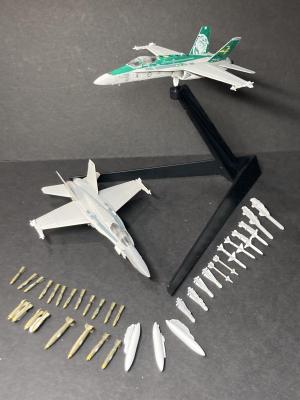
IntroWOW, I’ve always loved the Platz kits and was I surprised to find 2 kits in the box! Initially, I was thinking about what a hard choice it would be to decide on wheels up or down. Not with this kit :D So, I love the box art for the 40th Anniversary livery and decided that had to be the in-flight version and the low-vis aircraft would be parked. The KitTwo things stand out, the way parts are designed to fit together and the detail. Engraved panel lines were clear everywhere except the nose of both aircraft. Some sanding and a fine scriber will clear this up. Parts are practically a snap fit I noted. A unique element in a kit this small is that both retracted and extended gear doors. No cutting and trimming to get a set to fit. And the ordnance! Wait… more |

|
Marmo Method Out-Of-The Box Kenworth AerodynePublished:
Right off the bat, I was drawn into the book through Richard’s writing style. I felt like we were having a conversation over the modeling bench, discussing the history of big rigs on the road and what was available to build. The discussion on available kits is quite extensive, covering the origins as a snap-tite kit through the different re-pops as a glue kit, even covering box tops which are an interest to many in the modeling world. The contents of the book include:
The eBookThe book runs through a classic… more |
|
Texaco Bug US Refueling VehiclePublished:
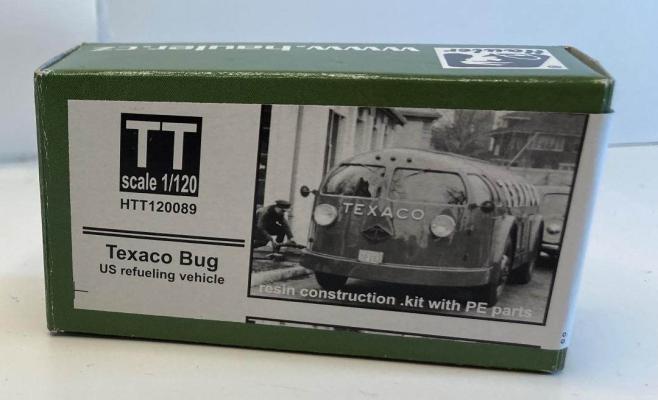
HistoryBack in 1935 Texaco was thinking of the future. Commissioned to help market the company it is believed there were 6 Doodlebugs produced. Coincidentally it was the smooth streamlined look of it that drew me in and motivated me to build this for my 1st IPMS review. It was only 6’ tall, carried 1500 gallons of fuel, and featured a unique compound curved glass windshield. I think you would be hard pressed to find a car in the 30’s with this kind of silhouette, let alone a heavy tanker truck. The KitHauler packages the Texaco Bug in a stiff little box, perfect to protect the delicate parts inside. The resin is crisply detailed, especially for the size of the Texaco Bug in 1/120th scale. There were a few small pinholes that required a very fine… more |