

Charles Landrum
Reviews By Author

|
Mirage 2000B/C/D/N Opened Exhaust NozzlePublished:
There are four manufacturers of 1/48 scale kits of the Mirage 2000 – Airfix/Heller, Italeri, Kinetic, Monogram, and, of course, the re-boxing of the Heller kit by Eduard. All of these kits have poorly detailed exhaust nozzles, except the Eduard re-boxing which provides PE to overhaul the engine to a more convincing replica, the exterior exhaust petals being particularly noteworthy. Enter Aires with its offering of both an open and closed nozzle replacement engine. This is a review of the open nozzle set. I have built a number of Aires engine exhaust assemblies, all US engines, and this set is the best of the bunch. Why? Detail and ease of assembly. Aires continues to astound me with the detail that they can cast in their durable gray resin, and the three resin components of… more |

|
F-101 Voodoo Pitot TubePublished:
Prominent on the nose of the F-101 Voodoo is a large pitot tube, which in 1/48 scale extends 1 1/16 inches (27mm). From a modeling perspective, such a large pitot presents several challenges. First, you hope that the part is not bent, broken, or molded out of round. Surviving that, you then need to remove the mold lines and ensure that the cross-section is round. Lastly, such a large pitot tube becomes a transportation liability during model shows and displays. This Quickboost product provides a safety net to the modeler who has had difficulty with any of these issues with the Monogram/Revell Voodoo kit. Quickboost provides not one but three booms for the price. My sample was molded cleanly with no warping, although any bends could be corrected by immersion in hot water. The… more |
|
Yak-38 Forger Pitot TubePublished:
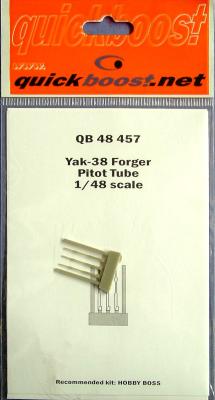
As with most Soviet-designed aircraft, the Yak-38 Forger has a nose pitot tube. While not as prominent as the pitot tubes on the MiG and Sukhoi bureau aircraft, the pitot is still visibly right in front and on top of the nose. As with previous detail sets in this line, Quickboost provides multiples of the same pitot, no doubt because the pitot is one of the most vulnerable parts to damage during transport and handling. This pitot tube is noticeably longer than the one provided by Hobby Boss in their kit. After a comparison with photos of the plane, it appears that, in fact, the Hobby Boss pitot tube is too short. The Quickboost replacements are accurate in length and shape and are drilled at the tip! The part is also keyed to fit right where the kit part mounts. I have found the resin… more |

|
Yak-38 Forger AntennasPublished:
***Note: the packaging of this set indicates that it is antennas. In fact, the details are pitot tubes and angle of attack indicators. As with most Soviet designed aircraft, the Yak-38 Forger had numerous antennas and pitot tubes protruding from the airframe. Hobby Boss has included all them in their nice kit of the Forger. But there are limitations in the injection molding process and you can only get parts so petite. A challenge is trying to get such small parts successfully off the sprue. With this set, Quickboost provides replacement pitots and angle of attack indicators. These are tiny details and I did a close comparison with the kit parts. The QB parts more accurately capture the shape of the pitots, and they are drilled at the end! This second fact alone makes the set… more |
|
KMGU-2 Russian Submunition DispenserPublished:
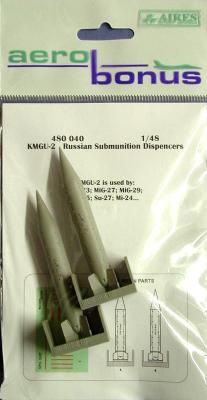
The Soviet intervention in Afghanistan in December, 1979, and the ensuing 10-year conflict tested the ways and means of the Soviet military machine. As the United States military discovered earlier in Vietnam, the tactics and weapons developed for a cold war confrontation in Europe were ill-suited for a counter-insurgency. Afghanistan became the impetus for innovation. As the Soviets shifted tactics, they relied more and more on airpower, and that spawned the need for better and different weapons. One of the most effective and widely used weapons was the KMGU submunition dispenser. The dispenser was used to scatter mines not only to interdict the Mujahedeen lines of operates and supply, but also to protect the flanks of friendly ground forces. The KMGU is a reusable dispenser that can… more |

|
Normandy StreetPublished:
MiniArt has been prodigious in producing accessories for armor dioramas. Though I am primarily a ship and aircraft modeler, I couldn’t help but notice the endless stream of new releases in vehicles, buildings, and figures. So when this kit came up for review, I decided to take the plunge and try a new genre. I used to be a model RR enthusiast, so this was not my first building kit, but it certainly was the biggest in scale and size. What I did not realize until I received the kit is that it is one large vacuum formed model project. The MSRP seems a bit high, but the box is packed with plastic, with enough plastic left over for the spares box. Most of the volume is consumed by the vacuum formed structure of the building. The structures have incredible detail, from the… more |

|
USS Freedom LCS-1Published:
BackgroundThe Littoral Combat Ship is the Navy’s latest controversial shipbuilding program. What was originally designed to be a winner-take-all competition is now a ship construction program with two distinct classes. The LCS-1 USS Freedom Class is a more traditionally designed mono-hull, while the LCS-2 USS Independence Class is the trimaran hull form. Those of us with longer memories remember how controversial the Spruance and Oliver Hazard Perry classes were when they were under construction and during their early service – both were designed to be manned with smaller crews and the ships were delivered before their major weapons systems were ready: Harpoon, Sea Sparrow, SLQ-32, CIWS, and LAMPS Mk III. The LCS program is in a similar position; the hulls are delivered with… more |

|
F-16D Block 40 Cockpit SetPublished:
As a modeler afflicted with AMS, the one aftermarket detail that I have the greatest weakness for is a resin cockpit. This is especially true for jet cockpits, where I find it difficult to duplicate the detail. So when Aires made this cockpit available for review, I was excited, having a Kinetic F-16D on the shelf. In general, I find Aires cockpits to be very detailed, pretty accurate, and durable during fitting. However, the sets have a reputation for being ill-fitting. My experience to date has been positive, with the sets I have reviewed fitting as advertised or requiring just a little work. This set snapped that trend. This Aires release is a replacement cockpit for the Kinetic F-16D Block 40. As with most Aires products, this is a multi-media set with resin and PE details… more |
|
Yak-38 Forger Correct Vertical Engine and CoverPublished:
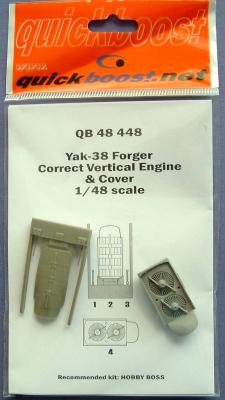
The Yak-38 Forger was the Soviet Union’s equivalent to the Harrier. Built to operate from the Kiev class Aircraft-Carrying Cruiser, the Forger provided limited air defense and anti-surface ship capability. Unlike the Harrier, which relied on a single engine to provide all of the vertical thrust, the Forger had two dedicated lift engines behind the pilot to assist with VTOL. The engines were covered with a large louvered door assembly. Whenever the aircraft was parked, this door was open and the louvers closed, as shown in the accompanying photo from a Soviet State Publication on the Navy. In flight, the door was closed and the louvers open, except during takeoff and landing when the door lifted to provide greater air flow. The Hobby Boss treatment of these details, the engines… more |

|
The Space Shuttle: Celebrating Thirty Years of NASA’s First Space PlanePublished:
With the recent retirement and consignment of the Shuttle fleet to museums around the country, it is nice to see a book that is a retrospective on the program. This book is ambitious in its scope, covering the entire program from the early testing of lifting bodies to the final mission of Atlantis (STS-135) in July, 2011, in just 300 pages. It is more photographic history than narrative and, given the scale of the operation, the pictures are captivating and more than make up for the lack of text. The book is divided into seven chapters (called stages) and an appendix:
|