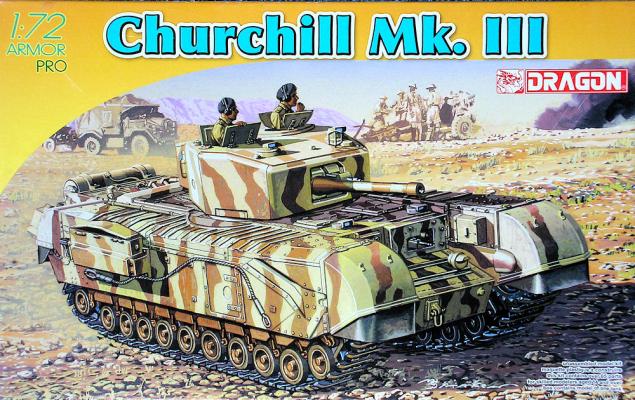
The Churchill tank had one of the largest production runs of any British WWII tank and was built in more variants than any vehicle except perhaps the Sherman. However, until very recently, it has been woefully under-serviced by the modeling manufacturers. The first kit was the old Airfix one from the 50's, which had many limitations. Then came the Aurora 1/48 one in the 60's which was almost toy-like. In the 70's came the 1/72/76 scale kits; the Hasagawa Mk I/II, ESCI Mk. III, Matchbox Mk IV bridge layer, and finally the 1/35 Tamiya Mk VII Crocodile. Since then, nothing has been released. However, Dragon has now released several small-scale models of this historic vehicle. The subject of this review is their kit of the Mk III version with the welded turret and 6 pdr. main gun.
What's New
Items in the Box
The items are made from photo-etched sheets, two in quantity, made from metal. The assembly instructions are a fold out sheet, printed both sides.
Construction
The build is very basic, as I followed the instruction sheet. Many tiny parts are noted on the photos enclosed.
Finish
None. Same as exterior of aircraft.
Conclusion
The items went on the model well. Care must be taken as the parts are tiny. I would like to thank IPMS and Eduard for allowing me to review this product.
History
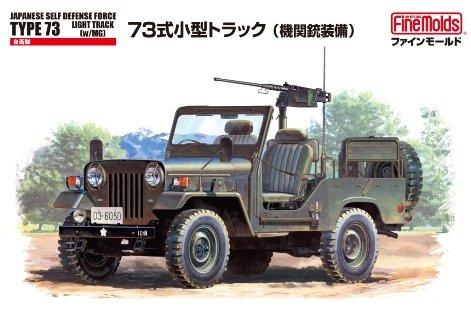
The type 73 light truck is one of a series of light utility vehicles used in the Japanese self-defense forces. JSDF deployed these vehicles from 1973. Almost all of them were phased out by 2010.
Items in the box
The model is made of injection molded plastic, olive drab in color. The instructions were made up of a foldout form, printed on both sides. Clear molded plastic window and headlight lenses were supplied.
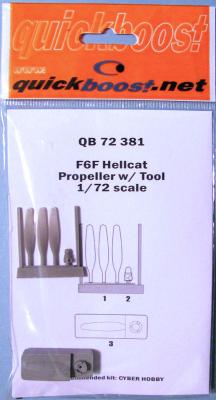
Attached to the front of the powerful Pratt & Whitney 2000 horsepower R-2800 that moved the Grumman F6F-3 Hellcat was a thirteen foot, one inch Hamilton Standard propeller. This new release from Quickboost provides a replacement for the kit-provided propeller, and is a nice upgrade for the Cyber Hobby kit. The detail set comes with a single runner with the four parts attached, as well as the tool used to set the proper pitch on the propeller blades. If you have some experience in working with resin, this will be an easy upgrade to put to use, and if you have little or no experience with resin, this could be a good item to start with.
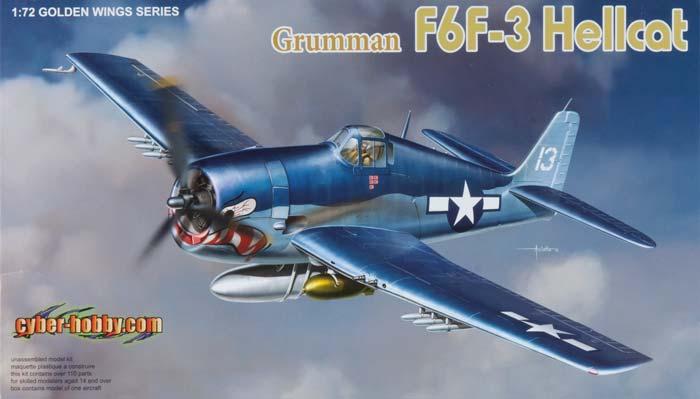
Cyber-Hobby has recently entered the model aircraft community, and their latest offering is that of a 1/72 scale F6F-3 Hellcat. The kit builds up reasonably well, with good fit for most of the parts, and options such as extended or retracted landing gear, open or closed canopy, and extended or retracted wings. Cyber-Hobby also does a nice job of including the markings for six different squadrons, and in the case of VF-27, there are markings for three different planes with the legendary “cat mouth” motif. The kit itself contains 124 light gray parts spread across seven sprues, as well as 5 clear parts on a single sprue and 4 photoetch pieces on a single fret. The directions are on eight pages (a single sheet of paper with three folds), and are printed in black and blue. The kit will make a great addition to the collection of any modeler who is interested in the venerable Hellcat in this scale.
History
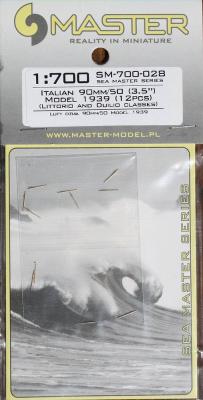
In the mid-1930s, Italy began design studies for a new naval antiaircraft gun to replace the 100mm/40 mounts, which was too slow to elevate and track modern aircraft. After calibres from 6-127 mm were evaluated, Regia Marina opted for a compromise between firepower, rate of fire, and system weight. Ansaldo did the initial design work and developed the 90mm/50 Ansaldo 1938, OTO 1939 model heavy antiaircraft gun and stabilized mount. Performance was similar to the famed German 88mm, and these guns remained in service for many years after WW2. These guns were installed in the Littori class battleships and the reconstructed battleships Andrea Dorea and Duilio. Plans for fitting out other ships were never carried out. Although the guns were satisfactory, the stabilization system was prone to breakdowns and the ammunition had limitations.
The Parts
5, 4, 3, 2, 1...
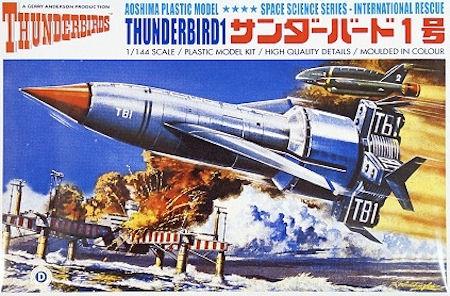
This countdown started each episodes of the British Supermarionation show Thunderbirds. I remember watching this and other Gerry Anderson shows when I was a wee lad. I, of course, watched them for the very cool models.
Thunderbird 1 was always first on the scene to check out what rescue equipment Thunderbird 2 would need to haul in. It was piloted by Scott Tracy. The launch sequence for TB 1 was my favorite, blasting off from its underground hanger through the pool area.
Aoshima has rereleased their 1/144th scale kit and it is probably the best rendition of this machine on the market. It is not one of the many “toy” versions with the pull back wheels but an actual scale model consisting of 50 silver plastic parts and 6 plastic bars which the instructions have you glue 4 of in the bottom of the rocket, probably to help it sit when on its spindly landing gear.
History
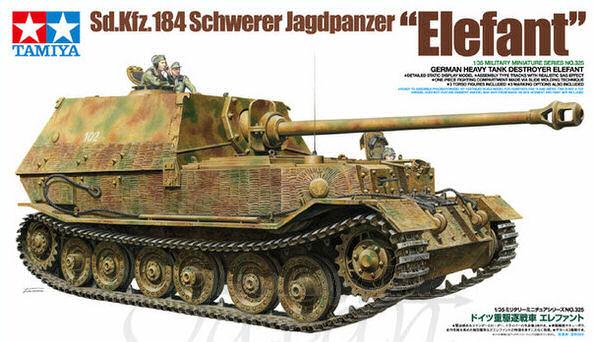
The Elefant came into being from improvements made to the tank destroyer Ferdinand. After the battle of Kursk, surviving Ferdinands from sPz.Jg.Abt.654 were consolidated into sPz.Jg.Abt.653. The unit withdrew to St. Polten in December 1943 for overhauls and modifications, which included the addition of a machine gun at the radio operator's position, a commander's cupola, new tracks, rain gutters on the front of the superstructure, and new armored engine grilles. A Zimmerit coating was also applied. These modifications coincided with Hitler's order to have the vehicles redesignated with the name Elefant. Elefants served on the Russia front, in Italy, and in the defense of Berlin.
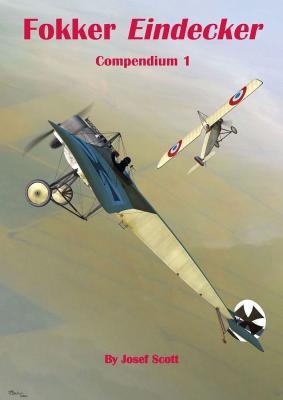
Many decades ago when I became initially fascinated with early aviation and the adventure of WWI fliers in particular, the aircraft that symbolized that era and fascination was, and still is for me, the Fokker Eindecker. Like most modelers interested in WWI aviation, I considered the Eindecker a favorite kit. Unfortunately, until Eduard began producing quality plastic injection kits, a good, accurate, and relatively easy to build Eindecker was hard to find – and one in the larger scales, almost impossible. Accurate information was equally difficult to come by. Most information in depth was to be found on a few enthusiast WWI aviation sites, and even then, contention was rife and misinformation common. This led to the occasional and mainly entertaining flame wars which would flare up, burn brightly for a time, then die down only to lie smoldering until the next ‘expert’ pronouncement was made.
The Kit
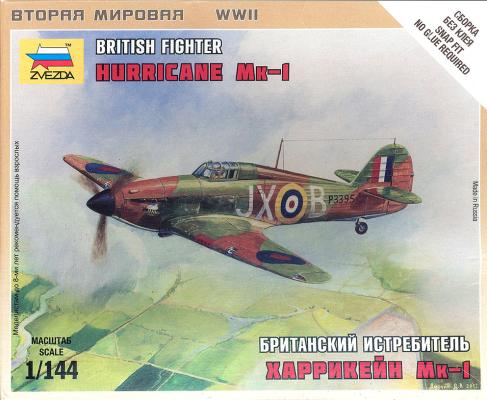
This is another of the 1/144 aircraft for Zvezda’s “Art of Tactic” game system. As such, it’s designed to be robust enough to stand up to handling and repeated abuse. It also means that some of the delightful little details and add-ons you find on other 1/144 fighter kits aren’t there. The kit is only 8 parts plus the stand, and it’s designed to be a snap-together kit. OK, but the horizontal stabs won’t take much handling, and I recommend glue.
Assembly
This was really easy. The single-piece fuselage snaps onto the single-piece wing, the horizontal stabilizers snap into place and immediately fall out, the prop assembly presses onto the pin, the solid canopy presses onto a pin, and the landing gear press into place. I did the painting before putting the prop, gear and canopy on.