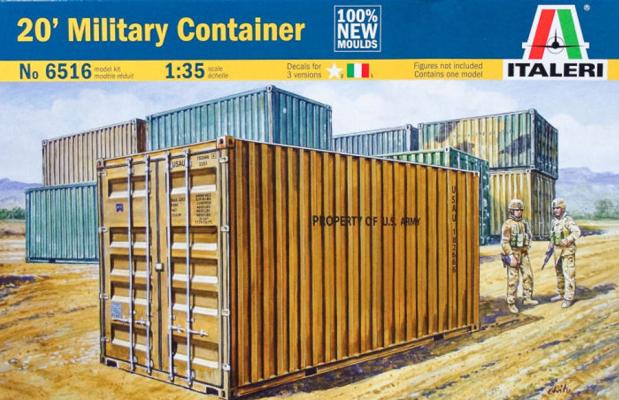
In the current hobby where making obscure one-offs has seemingly become the norm and where every manufacturer feels they have to make a kit with more than 300 pieces and at least one 2x3 sheet of photo-etch, Italeri stands alone! I must applaud them for making that stand! One of their latest releases is a kit that contains only twenty two pieces. There is no PE, no clear or colored styrene, and no metal. OMG!!! This is ridiculous! There must be a mistake! It isn’t even a kit of an armored vehicle of any kind! However, it is more valuable than any M1, M1126, M113 or M117. It is also more easily recognized and used than any of the above mentioned vehicles. Italeri has made a bold move and issued a model kit of a 20-foot container.
What's New
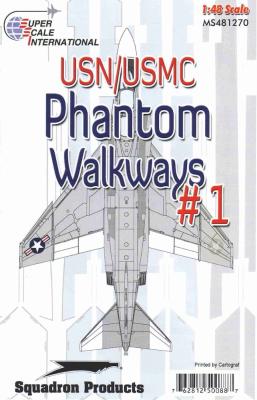
Superscale Decals is now owned by the excellent people at Squadron Products, and their latest release is this sheet containing four different sets of walkways for 1/48th scale Phantoms. Both the wing and top of fuselage walkways are included. The set is printed by Cartograf and is beautifully in register and glossy.
The sets included are:
- Black outlines with the walkway language
- FS36231 Gull Gray with black outline and stenciling
- FS36231 Gull Gray with no outline and with stenciling
- FS36118 Gunship Gray with no outline and with stenciling
The instructions are well done, in color, and show the needed location of the decals.
This set is highly recommended and will go really well with older Phantom kits or the newer Academy kit. My thanks to Gary Newman and Squadron Products for the chance to review these great decals, and to IPMS USA for the opportunity to do so.
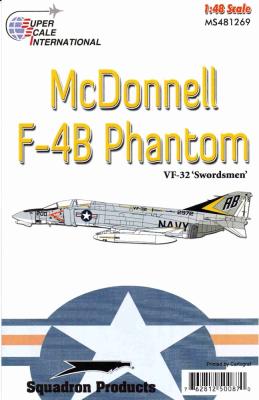
Super Scale (Squadron Products) has released and excellent new set of decals for the Academy F-4B Phantom. This set covers an F-4B from the VF-32 Swordsmen aboard the USS John F. Kennedy (CFA-67) circa 1970.
The decals come with a single sheet of colorful decals and include the markings for BuNo 152972. The national insignia are also included, along with some specific stencils. The decals are printed by Cartograf and are perfectly in register and very colorful. The highlights are the large yellow/black tail flashes and sword on the rudder. The intake warnings are colorful and also included.
These decals are a great addition to the excellent Academy kit. Highly recommended. My thanks to Squadron Products and IPMS/USA for the chance to review these decals.
This is the third book in the new Combat series from Osprey which looks at soldiers who faced each other in battle. The Zulu War of 1879 has long been a subject that captured the imagination of military historians and modelers. Numerous books on the subject have been written, including several by Ian Knight, the author of this book and one of the leading authorities in the world on the Zulu War.
This series follows a similar format in all the books, looking at subjects such as training, morale, weapons, and leadership. The book compares the fighting styles and tactics of the British and Zulus in three very different battles – Nyezane (22 January 1879), iSandlwana (22 January 1879), and Khambula (29 March 1879). Accounts from combatants on both sides are included.
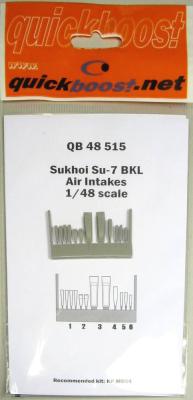
Quickboost is well known for creating nicely detailed drop-in replacement parts to enhance the detail of plastic models. This time around they have released a set of fuselage air intakes for the Su-7 from KP (reboxed by Eduard).
The air intakes are perfectly cast in grey resin, with a smooth, bubble-free finish. The molding includes two side walls to prevent accidental damage of the parts while in transit or storage. Removal of the parts should be easy, with either a hobby saw or even by scoring with a #11 blade if you take your time.
All the air intakes are hollow and have very thin edges, adding to the scale effect of your model. You can compare the resin parts with the plastic ones. The plastic ones have thick edges and in some cases (like part 119) they are not even hollow, being just a bump in the fuselage.
Recommended to modelers of all skill levels.
I would like to thank Aires, Quickboost, and IPMS/USA for the review sample.
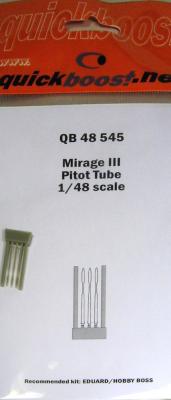
Quickboost is well known for creating nicely detailed drop-in replacement parts to enhance the detail of plastic models. This time they present a trio of pitot tubes for the Mirage III, for either the Eduard or the Hobby Boss kit.
The pitot tubes are perfectly cast in grey resin, with a smooth, bubble-free finish. The molding includes two side walls to prevent accidental damage of the parts while in transit or storage. Removal of the parts should be easy, with either a hobby saw or even by scoring with a #11 blade if you take your time.
This set provides you with spare parts, which is a very thoughtful decision from Quickboost, as pitot tubes are very easily broken off. If you are careful in construction, you have spares for your next Mirage!
Perhaps the single best advantage of this replacement part is the lack of a mold seam (in comparison with the plastic one), and we all know that a nose-mounted pitot tube is one of the focal points of any airplane.
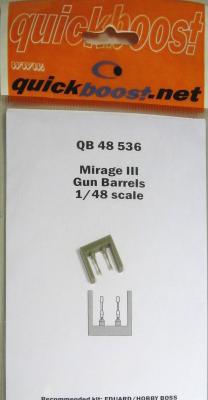
Quickboost is well known for creating nicely detailed drop-in replacement parts to enhance the detail of plastic models. They have released a set of gun barrels for the Mirage III, for either the Eduard or the Hobby Boss kit. It might be possible to use this set with the Italeri Mirage IIIE, but I am not sure.
The cannon barrels are perfectly cast in grey resin, with a smooth, bubble-free finish. The molding includes two side walls to prevent accidental damage of the parts while in transit or storage. Removal of the parts should be easy, with either a hobby saw, or even by scoring with a #11 blade, if you take your time.
You can compare the resin parts with the plastic ones provided in the Hobby Boss kit. The main difference you’ll see is the muzzle brake detail and a much finer cannon barrel.
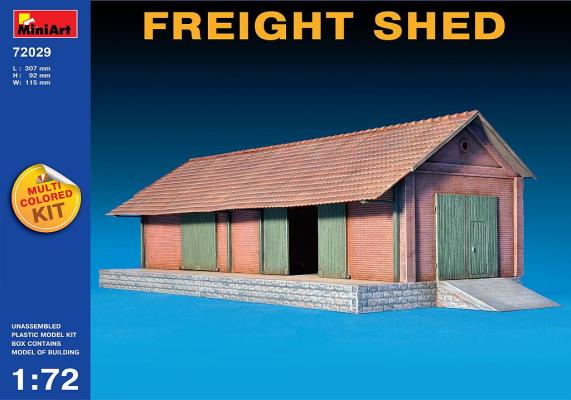
Mini Art has been releasing a series of modular buildings in 72nd scale. By modular I mean you get parts for roofs, windows, doors, walls, etc., and you potentially could mix-and-match and make your own building. The modular design allows a significant level of flexibility, but it comes with the price of multiple pieces (perhaps 83 pieces are a bit too many for a building of this size?) and with too many seams.
The kit is molded in different plastic colors with the intention of being displayed without actually painting it. I decided to build it that way so you will see what you get if you were to build it out-of-the-box.
In this book, the author covers the Civil War’s eastern theater from 1861-65 and leads you through a progressive linage of the fighting infantryman on both sides under the, quoting the book, “appalling realities of warfare in the industrial age.” You’ll follow the infantryman in the key battles such as First Bull Run/Manassas, “The Bloody Angle” Gettysburg, and Chaffin’s Farm/New Market Heights. The later battle sets focus on African American troops fighting for the union. The book further discusses in-depth the tactics and strategies used by both sides. The evolution of uniforms worn by the troops is an interesting story in itself and will surely aid the purist modeler. The diorama modeler will appreciate the interesting period b&w photographs, plus it’s packed with a wide range of colorful paintings and maps.
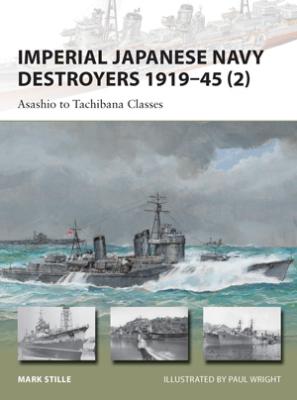
Osprey hits another home run with this 2nd volume on Japanese destroyers. Picking up where the 1st volume left off, this book covers several classes, principally the Asashio, Kagero, and Yugumo. It also details the history, weapons, and tactics of the Japanese destroyers. The author further weighs in on the design and construction, armament, service modifications, and wartime service of each class. The book also covers an interesting experimental destroyer, the Shimakaze, with a top speed of almost 40 knots and 15 torpedo tubes. I found the book’s contents to be well thought out, with a very coherent outline. And it’s written with easy to understand explanations. It has beautiful color paintings and artwork including cutaway illustrations. It offers a wide range of vintage b&w photographs that are pretty decent and would be helpful to the ship modeler. The book has a softcover with a corded gum binding and it’s printed very well.