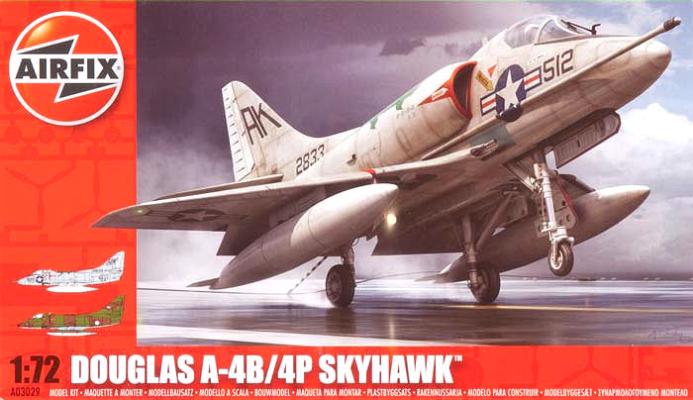
Airfix has been busy lately coming out with newly tooled model kits, and the A-4B/4P Skyhawk continues that trend. The A-4 Skyhawk was a very successful light attack design by Douglas for the US Navy (and foreign buyers) and had a very long and effective career. There are many books that will go into great length on the development and history of this aircraft, so I will only deal with the build of this model kit. 73 parts are molded in a soft gray plastic (two more are clear parts), so be careful and don't sand to aggressively. Some have mentioned that the recessed panel lines are too deep, but what I found on my model was the fuselage lines got less deep towards the top and bottom of the fuselage and I had to rescribe these to match the rest of the fuselage, but it only took about 15 minutes to do so.
December 2012
- Product/Stock # and Price:
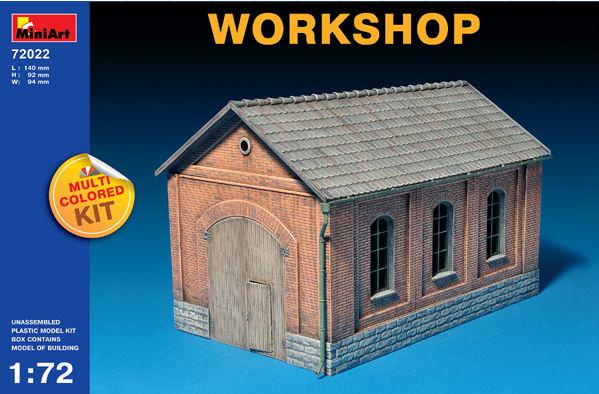
- Workshop – 72022, $43.00
- City Building – 72019, $62.00
MiniArt is a Russian, I think, company that has produced a line of 1/72 scale buildings. These could be of use not only to the small scale modeler, but also to the model railroader as well.
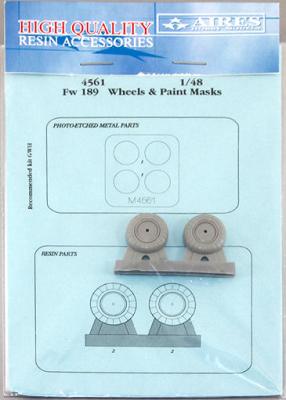
A relatively new company on the modeling scene, Great Wall has released a handful of kits to date and, with reference to this review, they have two variants of the FW-189, an A1 and an A2, along with a third ski-equipped A1 version. Aires has stepped up to the plate and has released a resin wheel set (with paint mask) for the trio of kits. Typically, I buy a resin wheel set for a single reason and that is to obtain a set of weighted wheels for the kit I'm building. Many of you (and you know who you are) prefer the kit’s un-weighted round wheels, and that fine, too. In the case of the Great Wall kits, they ship with weighted wheels. What is a modeler to do? In this case, Aires is your answer. Unlike the kit parts, the resin set they provide is the round, non-weighted wheels. Problem solved.
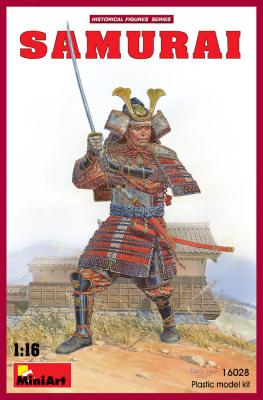
Though well known for their various diorama kits, MiniArt also has a long line of 1/16 scale historical figures. One of the latest, and quite possibly the most complex, is their Japanese Samurai Warrior. Being somewhat of a fan of the Samurai culture, I jumped at the opportunity to review MiniArt’s kit. Little did I know just what I was getting into.
History / Background
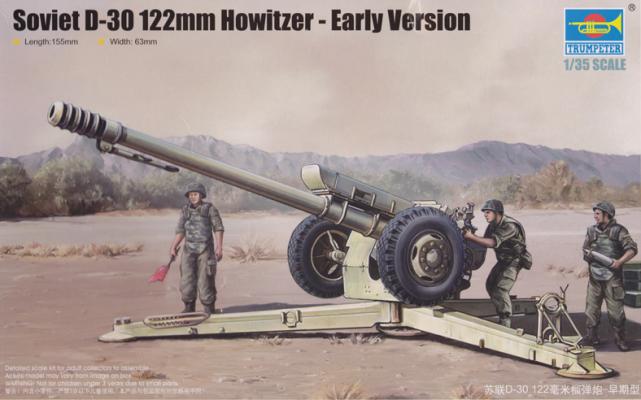
The Soviet D-30 (122mm howitzer) entered service with the Russian Army in 1963 as a replacement for the M-30 and M-1942 artillery pieces. Nearly fifty years on, the D-30 is still in active service in over fifty armies today, including the Afghans under supervision of US forces. Unlike a conventional artillery piece that utilizes two trail legs the D-30 uses three, and when deployed, the trails are placed into a very stable configuration separated by 120 degrees. In travel mode, the D-30's rearmost legs fold forward alongside the forward leg, and the entire gun is pulled via the tow ring on the muzzle. With this build, I broke one of my cardinal rules for modeling: avoid equipment made after 1946. Why did I break this rule? For one, the gun has been in service as long as I have been around, and for some strange reason I am attracted to the unconventional three leg configuration.
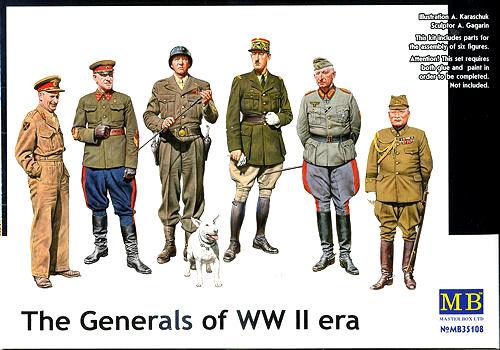
I have been painting miniatures for over 40 years and have seen some bad and some great. This set of figures depicting important Generals of WW II is one of the best I have ever seen.
It is a set consisting of six Generals, including General George S. Patton, Marshal Georgy Zhukov, General Sugijama Hadjime, General Erich von Manstein, Marshal Bernard Law Montgomery, and General Charles deGaulle.
I was totally impressed with the fine casting and how accurate each face was for the particular general. This is something I have rarely seen in my many years of figure painting.
There is a color guide on the back of the box to help the modeler paint each figure accurately. As far as assembly goes, I couldn’t have asked for more. The fit was perfect on each figure without any seam lines to show. It took me about five minutes to assemble each one.
Model features (taken directly from Wingnut Wings’ website):
Released in October 2012
- High quality decals for 5 aircraft
- 166 high quality injection moulded plastic parts
- 6 photo-etched metal detail parts
- Highly detailed 17 part 100hp Gnome Monosoupape engine
- Optional 2 & 4 blade propellers, instrument boards, undercarriage, aileron controls and ammunition stowage
- Fine in scale rib tape detail
- full rigging diagrams.
You know what? – it’s all true and you get a lot more.
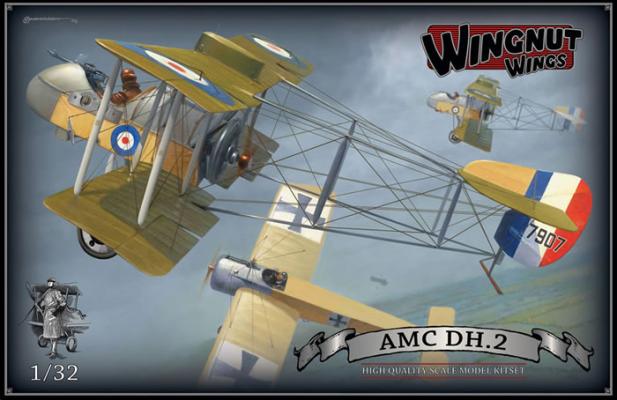
The Aircraft Manufacturing Company de Havilland 2 (AMC DH.2) first flew in June, 1915, was sent to the front in July for evaluation, and was promptly captured in August. This didn't deter the development, and by February, 1916, they were there to stay. By July, 1917, they were slowly replaced by more modern aircraft but continued to serve well into 1918.
There’s Merkavas and Pumas and Magachs, oh my.
I have been a fan of the Israeli military for many years but have concentrated my interest on the 1967 and 1973 wars. Their ingenuity regarding their armor and aircraft make them more interesting than German Panzers, in my opinion.
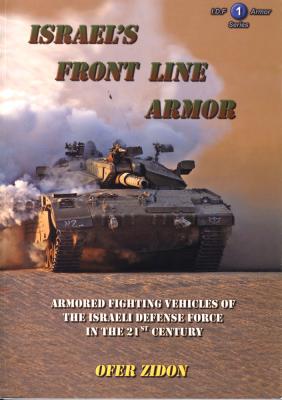
This is the first book in a new series by Wizard Publications (Israel) on IDF Armor. Wizard has done many books on the Israel Air Force and it is nice to see them take up the armor side.
This softcover book is full of full color pictures of the modern Israeli armored fighting vehicles starting in the late 80’s on up through 2011. This time frame covers a change in tactics from the wide open killing grounds of the Sinai to the towns of Lebanon and the Gaza Strip. To meet these challenges, the IDF converted its tanks and APCs to more heavily armored vehicles designed for close-in fighting.
I am reviewing these as one set, because if you want to use one, you will certainly want the other.
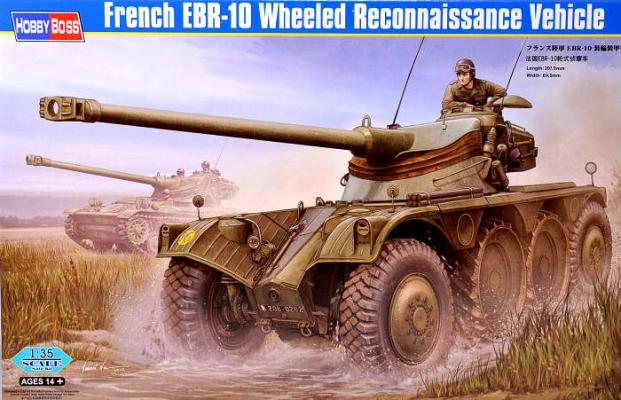
If ever there was proof that we are currently in a “gold age of modeling,” it is the release of models such as the one under review today. While produced in fairly large numbers (1200+), this French post-WW2 wheeled armored reconnaissance vehicle didn’t see widespread use outside the French Army. As far as I can determine, the only other military units to employ this vehicle were the Armed Forces of Portugal. Yet, despite this, here we have a state-of-the-art injection molded plastic kit of the subject!
Hobby Boss’ (Panhard) EBR-10 kit consists of over 330 well-detailed injection-molded plastic parts, contained on 10 tan colored sprues of various sizes. Along with the plastic parts come 8 “rubber” tires, a fret of photo etched brass parts, a small sheet of decals, and a 12-page instruction booklet. The modeler is forced to utilize the PE parts, since there are no plastic alternative parts contained within the kit as there are in some other manufacturers’ products.